Representing a collective $42 billion in 2019, these 14 charitable foundations are among the largest in the country, founded by some of the biggest names in Canadian business. From 2018 to 2019 alone, their collective investable assets grew a whopping 43 per cent, from $29.3 billion to $41.2 billion. But in 2019, none of them met the Canada Revenue Agency’s minimum threshold for running charitable programs and making gifts to other charities.
Skip to content
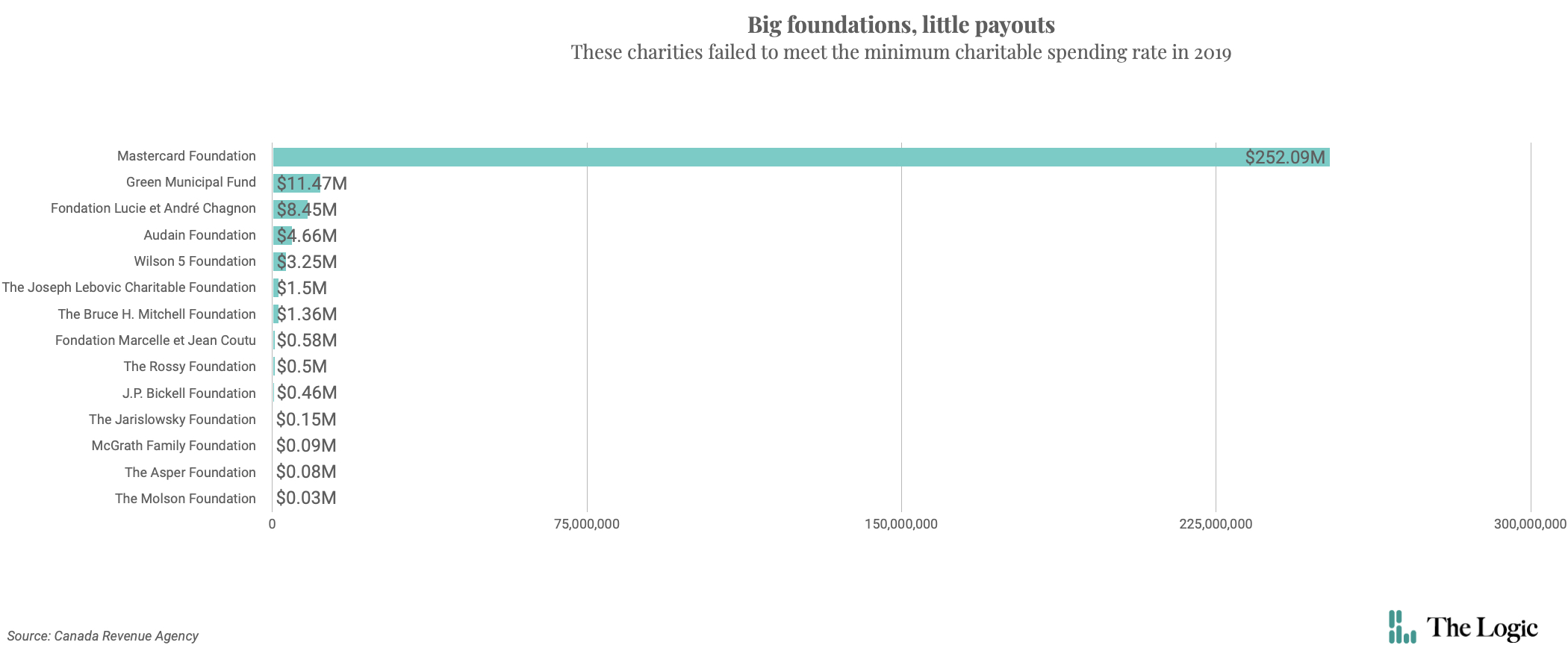

Representing a collective $42 billion in 2019, these 14 charitable foundations are among the largest in the country, founded by some of the biggest names in Canadian business. From 2018 to 2019 alone, their collective investable assets grew a whopping 43 per cent, from $29.3 billion to $41.2 billion. But in 2019, none of them met the Canada Revenue Agency’s minimum threshold for running charitable programs and making gifts to other charities.
Some of them came close, like the Molson Foundation, which was just under $28,285 short of the 3.5 per cent minimum. Others missed it by a mile, like Lululemon founder Chip Wilson’s Wilson 5 Foundation, which spent just over $142,000 on charitable activities in 2019 while reporting the previous two years’ average value of its investable assets—the denominator the Canada Revenue Agency uses to calculate the disbursement quota—as $96.8 million.
The Logic reached out to all 14 foundations for comment. Of those that got back to us, none denied they gave away less than 3.5 per cent in 2019. But five of them—the Asper Foundation, the Bruce H. Mitchell Foundation, the Fondation Lucie et André Chagnon, the Molson Foundation and the Audain Foundation—told The Logic they believed they were in compliance with the law because they had spent more than the minimum in some of the previous five years. If a foundation falls short of meeting the disbursement quota in any given year, the CRA lets them carry forward any spending above the minimum from the preceding five years, or back in the following year, and count it against the shortfall.
It’s a loophole. The trouble, however, is there’s no standard way it’s applied. “There is total confusion about how private foundations use carry-forwards,” said Kate Bahen, managing director of the charity-research organization Charity Intelligence, in an email to The Logic. Her organization is among those calling for “basic transparency” about how foundations use the exemption.
Read the rest of the series
Uncharitable is a series based on a data investigation by The Logic’s Claire Brownell. Don’t miss these other stories:
Methodology: How The Logic crunched the numbers
Canada’s only ‘mega-foundation’ in the spotlight during debate over minimum giving
Questions raised over Sabia sitting out Finance Canada’s discussions on charitable sector
The Logic used two different accounting methods to check whether these 14 large foundations, which in 2019 failed to meet the minimum charitable payout rate of 3.5 per cent, met their legal obligations thanks to the carry-forward loophole. In one method, we added up the shortfalls and excesses in the five previous years to see if they cancelled out the current year’s; in the other, we drew from excesses as if they were savings accounts, adjusting the balance as we went so shortfall years couldn’t draw on the same money twice.
Three of them—the Audain Foundation, the Bruce H. Mitchell Foundation and the Molson Foundation—had enough excess spending in the five previous years to meet the disbursement quota under both accounting methods. Seven of the 14 met the disbursement quota using one method but not the other, while four failed to meet it using either method.
The Asper Foundation and the Fondation Lucie et André Chagnon, which told The Logic they believe they were in compliance with the disbursement quota in 2019 thanks to excess spending in previous years, were among the seven foundations that met the disbursement quota using one accounting method, but not the other.
Moses Levy, executive director of the Asper Foundation, told The Logic that an external accounting firm had calculated its carry-forwards. Claire Neveux, a spokesperson for the Fondation Lucie et André Chagnon, said the foundation uses the CRA’s official method, but did not outline what the foundation believes that is.
The Green Municipal Fund, a federally funded foundation held in trust by the Federation of Canadian Municipalities to fund cities’ sustainable projects, had almost $452 million in investable assets in 2019, giving away just $2.3 million. FCM spokesperson Véronique Breton said the organization believes it is in compliance with its disbursement-quota requirements because all of its assets are used for its charitable purpose of funding municipal projects.
Bruce H. Mitchell, chair and chief executive of the investment and holding management company Permian Industries, was the only representative of the 14 foundations to agree to an interview. The Bruce H. Mitchell Foundation was one of the four foundations that met its disbursement-quota obligations in 2019 according to both accounting methods, thanks in part to a large gift it made to Queen’s University announced in 2017 that allowed the school to expand its research into artificial intelligence.
Mitchell said the carry-forward loophole is essential to foundations like his that want to plan large gifts in advance.
“The purpose of the foundation is to do something of significance,” he said. “You do something of significance when you target a big dollar amount at one thing.”



Loading...
Thanks for sharing!
You have shared 5 articles this month and reached the maximum amount of shares available.
CloseThis account has reached its share limit.
If you would like to purchase a sharing license please contact The Logic support at [email protected].
CloseGift the full article!
You have gifted 0 article(s) this month and have 5 remaining.
Recipients will be able to read the full text of the article after submitting their email address. They will not have access to other articles or subscriber benefits.
Most Popular This Week




In-depth, agenda-setting reporting
Great journalism delivered straight to your inbox.
Commentary
Carmichael: Being boxed in will help Canada focus on what matters
Briefing
Rio Tinto gets nearly $165M in additional federal funds for Quebec aluminum
U.S. to lift tariffs on some Canadian products crucial to Maine: Collins
Carney warns of tech dependence after Starlink disruptions in Ukraine
Best business newsletter in Canada
Get up to speed in minutes with insights and analysis on the most important stories of the day, every weekday.
Exclusive events
See the bigger picture with reporters and industry experts in subscriber-exclusive events.
Membership in The Logic Council
Membership provides access to our popular Slack channel, participation in subscriber surveys and invitations to exclusive events with our journalists and special guests.






