OTTAWA — Space gear should be its own category of critical infrastructure, MDA has tried to convince the federal government, because the current list of 10 key sectors leaves out vital and delicate systems.
Skip to content

News
Feds urged to designate space gear as critical infrastructure, docs show
Some space equipment is captured in other categories, but satellites and downlinks have unique qualities, Canadarm maker MDA argues
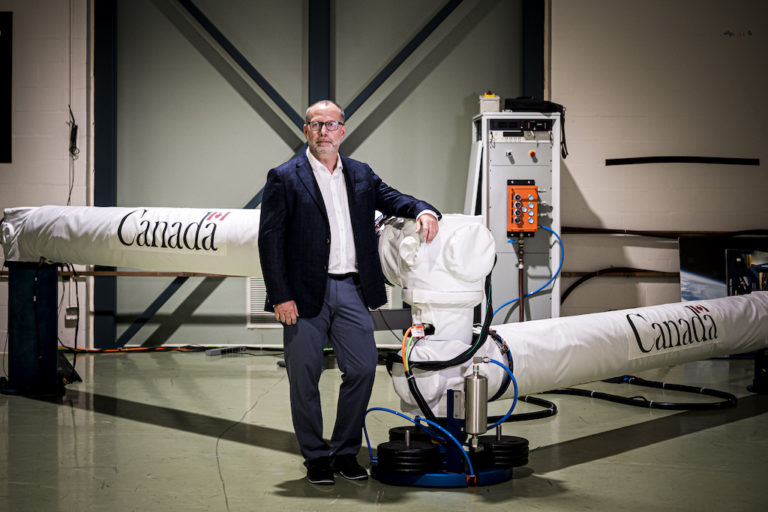
Images of the Canadarm adorn the lobby of MDA’s facility in Brampton, Ont., in October 2021. Photo: Christopher Katsarov Luna for The Logic
OTTAWA — Space gear should be its own category of critical infrastructure, MDA has tried to convince the federal government, because the current list of 10 key sectors leaves out vital and delicate systems.
The equipment maker and satellite operator that has supplied generations of Canadarms to the country’s space program sent Leslie Swartman and retired brigadier general Kevin Whale, respectively its senior directors of government affairs and defence strategy, to make the case in January to the top official at Public Safety Canada, according to a government briefing document.
Talking Points
- Canada has a list of 10 infrastructure fields it considers “critical” and in need of defending, from food to telecom
- The list doesn’t include space equipment, despite its unique vulnerabilities and importance to many vital services and functions
The Logic obtained a copy of the note for deputy minister Shawn Tupper through an access-to-information request.
Public Safety has a program to help protect privately owned infrastructure that’s key to health, safety, security or the economy from threats such as natural disasters and cyber-attacks. Broadly, the idea is to limit vulnerabilities and make sure critical systems are resilient so a failure in one spot doesn’t turn into catastrophe across the board.
Designation doesn’t carry legal weight but it does mean private-sector leaders in those sectors are included in discussions the federal government convenes to share information, talk about emerging threats and set priorities.
“The risks and vulnerabilities are heightened by the complex system of interdependencies among critical infrastructure, which can lead to cascading effects expanding across borders and sectors,” the federal critical-infrastructure strategy says. “The implications of these interdependencies are compounded by society’s increasing reliance on information technologies.”
Related Articles
Think of how the buggy upgrade to Rogers’s network took out the entire Interac system last year as one of those cascades.
“Global positioning, timing and navigation, nationwide connectivity and communication, northern surveillance, and crop and environmental monitoring are all great examples of services that Canadians rely on every day,” Swartman wrote in an email to The Logic, in response to questions about the January meeting. “Canada and many other spacefaring nations are rightly reflecting on their national approach to space sustainability and resilience measures.”
Space isn’t one of the 10 categories of critical infrastructure (“CI”) identified by the federal government, a list that includes broad sectors such as communication and information technology, food, manufacturing and government services.
Critical Infrastructure
Canada’s current list of 10 critical infrastructure categories:
- Energy and utilities
- Finance
- Food
- Transportation
- Government
- Information and communication technology
- Health
- Water
- Safety
- Manufacturing
Nevertheless, the January briefing note for Tupper, deputy to Public Safety Minister Marco Mendicino, agreed with Swartman on several points.
“Canada’s CI relies heavily on the data and services provided by space-based assets and their supporting ground-segment infrastructure,” it says. “This includes position, navigation and timing services provided by global navigation satellite systems; earth observation and remote sensing data, which are critical to delivering government services such as environmental monitoring and disaster response; and communications services that underpin the functioning of Canada’s CI more broadly.”
Public Safety is updating its approach to critical infrastructure, a project formally begun in fall 2021, and has held consultations and discussions. “Based on the input received, space received the most support for recognition as a distinct sector due to the essential role that space infrastructure plays in underpinning all other forms of CI and environmental monitoring,” the briefing note says.
Because of how broad many of the federal categories of critical infrastructure are, they encompass a lot of space-related equipment. A communication satellite, for instance, is up in space but it’s still communication infrastructure.
That still leaves gaps. Swartman pointed to a recent U.S. report laying out the case in detail. “The majority of today’s space systems were developed under the premise that space was a sanctuary from conflict, but this is no longer the case,” says the document, prepared by a group called CSC 2.0.
(CSC 2.0 is an unusual entity, co-chaired by a senator and a congressman even though it’s not a government body. It was born when congressional funding for a commission on cyber defence expired but the participants decided to keep working under the aegis of a charitable foundation.)
Equipment in space is different from equipment on the ground, the report says.
Satellites might use old software—maybe written for them alone—that can’t be updated, the report says. They’re often stripped down to the essentials, because of the cost of launching them to orbit, and lack redundancy. The more sophisticated they get, the more fragile they become. They’re vulnerable to space debris, which is proliferating, and typically lack any kind of defences. Their communications can be intercepted. Many are launched from abroad and interact with ground systems on foreign soil.
Russia and China have demonstrated they can shoot down satellites. Even discounting deliberate threats, Earth orbit is getting increasingly crowded and clogged with debris.
It’s true that a lot of space gear is covered by other categories of critical infrastructure, the CSC 2.0 report says, but a lot isn’t. The U.S. list of critical-infrastructure sectors is slightly different from Canada’s, but weather-monitoring satellites, for instance, don’t fit clearly into either of them.
Public Safety Canada did not answer questions from The Logic about whether it will act on the pressure to designate space systems as critical infrastructure, or when it will decide whether it will. Spokesperson Max Watson acknowledged the questions but did not respond by deadline.



Loading...
Thanks for sharing!
You have shared 5 articles this month and reached the maximum amount of shares available.
CloseThis account has reached its share limit.
If you would like to purchase a sharing license please contact The Logic support at [email protected].
CloseGift the full article!
You have gifted 0 article(s) this month and have 5 remaining.
Recipients will be able to read the full text of the article after submitting their email address. They will not have access to other articles or subscriber benefits.
Photo: Christopher Katsarov Luna for The Logic
Most Popular This Week




In-depth, agenda-setting reporting
Great journalism delivered straight to your inbox.
News
Adam Waterous proposes massive crude exports to Asia by rail through northern B.C.
Briefing
Rivals may be ‘horrified’ to realize how exposed their investments are to AI, Aviva CIO warns
Shopify, Sequoia co-lead US$200M investment in online-selling platform Whop
Amid revenue gains, 1Password bets on tools to protect data from AI agents
Best business newsletter in Canada
Get up to speed in minutes with insights and analysis on the most important stories of the day, every weekday.
Exclusive events
See the bigger picture with reporters and industry experts in subscriber-exclusive events.
Membership in The Logic Council
Membership provides access to our popular Slack channel, participation in subscriber surveys and invitations to exclusive events with our journalists and special guests.







