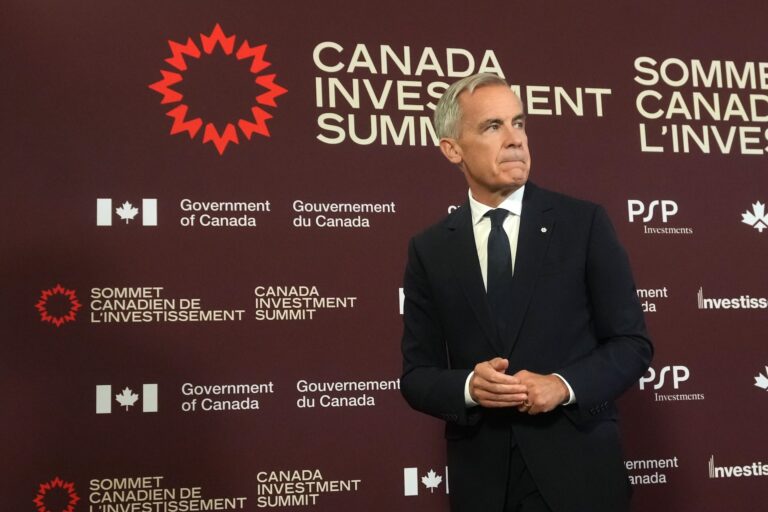
OTTAWA — Justin Trudeau’s last days as prime minister and the brief, pre-election tenure of Mark Carney included a flurry of announcements to support Canadian workers and businesses at risk from U.S. tariffs.
Skip to content


News
What the federal government is doing to help those hit by the trade war
Some programs for workers and businesses are already in effect, but others won’t come before the end of the election
The federal government has already taken some steps to insulate workers and businesses from the trade war, but other measures will need the support of Parliament after the election. Photo: The Canadian Press/Sean Kilpatrick
OTTAWA — Justin Trudeau’s last days as prime minister and the brief, pre-election tenure of Mark Carney included a flurry of announcements to support Canadian workers and businesses at risk from U.S. tariffs.
With an election campaign now underway and the federal government in caretaker mode, here’s a guide to which supports are actually in place, and which are now just more campaign promises.
Employment Insurance
Related Articles

The government launched a pilot project on Friday to make it easier for people to qualify for employment insurance benefits. The usual one-week waiting period before claimants can start receiving income support is waived for the next six months. Over the same time period, the government is also suspending rules that make people use up vacation and severance pay before they can start getting EI benefits.
For the next three months, the government is artificially increasing the regional unemployment rates by one percentage point so that it is at least 7.1 per cent across Canada. Employment and Social Development Canada uses this rate to calculate the number of insurable hours someone needs to have worked in the previous 52 weeks to qualify for benefits, as well as for how long. The result is that no one applying for regular benefits will need to have worked more than 630 hours, compared to the 700 hours normally required in some areas of the country.
Both those measures are already in place. So are temporary changes to the EI work-sharing program announced March 7, two days before Carney won the Liberal leadership race.
Business tax deferrals
On Friday, Carney announced that businesses needing help with cash flow can defer payment of corporate income tax, as well as GST/HST remittances, from April 2 to June 30. The Canada Revenue Agency says businesses generally pay this tax in instalments throughout the year, with any balances due two or three months following the end of the tax year. The federal government estimates this short deferral could free up a total of $40 billion in liquidity for businesses.
Access to credit
Canada’s largest businesses suffering losses in the trade war will be able to access credit through a new Large Enterprise Economic and National Security Facility that Carney announced Friday. (He blamed the mouthful of a name on François-Philippe Champagne, the finance minister seeking re-election in the Quebec riding of Saint-Maurice—Champlain.) Details are scant, as are the costs, but the Finance Department said Tuesday it is already in motion. “The federal government has the necessary authorities to launch this new program during the election. More information on the program will be announced in due course,” department spokesperson Marie-France Faucher said in an email.
The federal government announced other ways businesses can access credit on March 7, including Business Development Bank of Canada loans for small and medium-sized businesses whose U.S. sales or supply chains are at risk from the trade war.
Just promises
Carney announced a host of other moves on Friday that need to go through Parliament. That means they won’t be enacted unless the Liberals win the April 28 election. Those pledges are not aimed directly at supporting workers and businesses during the trade war, but Carney framed them as ways to boost the economy. Among other things, Carney promised to introduce a bill by July 1 (Canada Day) to bust down any remaining federal barriers to internal trade, including obstacles to labour mobility for those working in federally regulated sectors such as banking, telecommunications and aviation.
The Conservative vision
Conservative Leader Pierre Poilievre has promised to use nearly all the money collected from Canada’s retaliatory tariffs on U.S. goods to offer tax breaks to businesses and individuals to lessen the economic strain. He said a “small sum” should be used as targeted relief for workers hardest hit by the trade war. The Conservatives have not yet released any details of who would qualify for those funds. He has also billed his other tax proposals, including cuts to personal income taxes and eliminating the GST on new homes worth up to $1.3 million, as other ways to provide relief to those affected by tariffs.
With files from Laura Osman



Loading...
Thanks for sharing!
You have shared 5 articles this month and reached the maximum amount of shares available.
CloseThis account has reached its share limit.
If you would like to purchase a sharing license please contact The Logic support at [email protected].
CloseGift the full article!
You have gifted 0 article(s) this month and have 5 remaining.
Recipients will be able to read the full text of the article after submitting their email address. They will not have access to other articles or subscriber benefits.
Photo: The Canadian Press/Sean Kilpatrick
Most Popular This Week




In-depth, agenda-setting reporting
Great journalism delivered straight to your inbox.
News
Panel decries Canada’s chaotic way of funding world-class science
Briefing
Feds pledge $15M for U.S. satellite navigation company Xona to expand in Montreal
Inovia raises US$200M for new VC fund as it eyes AI’s impact
43% of eligible Albertans voted ahead of Monday’s referendum
Best business newsletter in Canada
Get up to speed in minutes with insights and analysis on the most important stories of the day, every weekday.
Exclusive events
See the bigger picture with reporters and industry experts in subscriber-exclusive events.
Membership in The Logic Council
Membership provides access to our popular Slack channel, participation in subscriber surveys and invitations to exclusive events with our journalists and special guests.