TORONTO — The federal government will start pushing the use of artificial intelligence in all its new programs and policies in a bid to become more efficient and better serve the public.
Skip to content


News
The federal government is turning to AI to help it work better and smarter
Under Ottawa’s new artificial intelligence strategy for the public service, the technology needs to be considered for every new federal program and policy
Prime Minister Justin Trudeau at the All In conference on artificial intelligence in Montreal in September 2023. Photo: Roger Lemoyne for The Logic
TORONTO — The federal government will start pushing the use of artificial intelligence in all its new programs and policies in a bid to become more efficient and better serve the public.
Under a new AI strategy for the public service published Tuesday, Ottawa will require all federal departments and agencies to consider using AI when they propose new initiatives. It will set up a unit that will help coordinate the work, and track the adoption of the technology and its impact. It’s also promising a public register of government AI systems that details what data they’re using and how they maintain privacy and security.
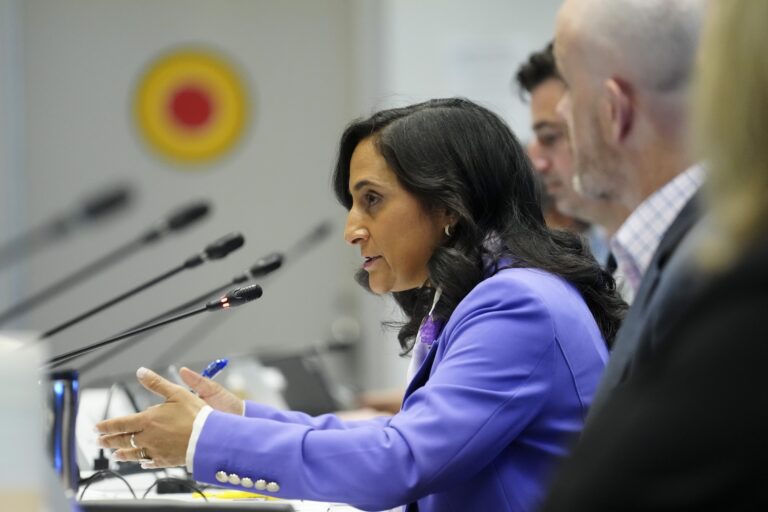
“We want to ensure that our staff have access to the appropriate tools that they need in order to efficiently do their work,” Treasury Board President Ginette Petitpas Taylor said in an interview Thursday.
Talking Points
- The federal government is setting up a new unit that will encourage the public service to adopt AI and track whether the technology is improving efficiency and service quality
- Ottawa will require departments to come up with AI projects and consider the technology as they develop new programs and policies
Ottawa launched work on the AI strategy last May, and delivered it ahead of schedule. It comes at a time when the federal government is trying to claim an international leadership position for Canada in AI, while also cutting spending on government operations.
Canada’s startup founders have called for Ottawa to be aggressive in adopting AI. Federal agencies should constantly evaluate where they could insert the technology, and launch pilot projects using it within six months, wrote Benjamin Alarie, CEO of Toronto-based Blue J, in a memo for the Build Canada group last month.
Technology executives have long criticized Ottawa’s reluctance to try new products from domestic developers. “By prioritizing Canadian AI firms in procurement, we will spark a domestic industry of firms who are specialized in AI in government,”Alarie’s memo reads. “These products will be in demand by governments everywhere, creating jobs, increasing innovation and keeping AI talent and technology in Canada.”
Departments have made limited use of a tool designed to let them buy AI faster. Some 145 firms have gone through the process to join Ottawa’s AI source list, which expedites contracts up to $9 million. But there have been few actual purchases.
Petitpas Taylor would not make any buying commitments, noting that it will be up to officials running programs to make procurement decisions. “My hope is that we would have Canadian vendors that will be able to provide us those tools that are needed,” she said.
Related Articles

Digital rights advocates have argued that Canada lacks robust laws on government AI use, while public service unions have warned the technology may lead to job losses.
Several departments are already using automated tools. The agriculture department has a chatbot that gives farmers information about crop markets and support programs, for example, while the immigration department now uses AI models to triage applications.
The new federal strategy states it’s focused on measures that are “concrete” and “can be achieved or initiated” within a two-year time frame. One major step is setting up an AI centre of expertise, which will share information and code between departments and help expand successful AI projects across the government. It will also track and report on the adoption of the technology across the public service.
The new centre would be the second unit set up to coordinate AI work across the federal government. In July, the Liberals established an AI secretariat within the Privy Council Office, which leads the public service, headed by a long-time top innovation department official.
As part of its new AI strategy, the federal government will also require all departments to identify three programs or services which could be improved with the technology in the short term. Officials will also need to include AI and any necessary data and compute resources into budget and other program proposals.
To showcase what AI can do for the public service, Ottawa is planning to spread across the government a tool developed by the in-house Translation Bureau that interprets “low-risk and low-value documents.” As an officially bilingual operation, the government spends a lot of time and money converting from French to English or the other way.
The bureau has eight billion words logged to train a model that can automate that work, according to the AI strategy, although more important files will still get the human touch. The document says expansion of the tool can be a “lighthouse project” that helps identify barriers and gaps in the government’s internal AI rules and processes.
Ottawa is also promising to develop a plan to train public servants on how to use the technology, including “prompt engineering,” which helps find the best instructions for large language models. And it will try to hire more workers who already have the necessary skills.
“We don’t always have to do things the way that we’ve always worked,” Petitpas Taylor said. AI is “a tool to provide to the public service—it’s not there to replace them,” she added.
Still, the strategy is high-level, and does not include timelines or budgets for the rollout of AI across the government. And while it pledges to “update procurement processes” to reflect the “pace and requirements” of AI, the document does not promise any specific changes to how and where departments buy the technology.
Petitpas Taylor said the publication is a first step, with a more thorough plan to come at some point in the future.
Editor’s Note: This story has been updated with comments from Treasury Board President Ginette Petitpas Taylor.



Loading...
Thanks for sharing!
You have shared 5 articles this month and reached the maximum amount of shares available.
CloseThis account has reached its share limit.
If you would like to purchase a sharing license please contact The Logic support at [email protected].
CloseGift the full article!
You have gifted 0 article(s) this month and have 5 remaining.
Recipients will be able to read the full text of the article after submitting their email address. They will not have access to other articles or subscriber benefits.
Photo: Roger Lemoyne for The Logic
Most Popular This Week




In-depth, agenda-setting reporting
Great journalism delivered straight to your inbox.
The Big Read
Alberta’s referendum is just the start of the turmoil
Briefing
EverWind plans $10B data centre and wind development in Nova Scotia
Canada ready to force Stelco to sell its Canadian operations, Joly says
Feds plan a 60 MW defence-oriented data centre for Ottawa
Best business newsletter in Canada
Get up to speed in minutes with insights and analysis on the most important stories of the day, every weekday.
Exclusive events
See the bigger picture with reporters and industry experts in subscriber-exclusive events.
Membership in The Logic Council
Membership provides access to our popular Slack channel, participation in subscriber surveys and invitations to exclusive events with our journalists and special guests.