OTTAWA — America’s global trade war is breaking up delicate supply chains for essential drugs and Canadians should expect shortages, says Mark Lievonen, a co-chair of Canada’s COVID-19 vaccine task force and veteran pharma executive.
Skip to content
 Mark Lievonen Photo: Handout/Lievonen

Exclusive
Trump’s trade war will lead to drug shortages in Canada, new report warns
Anti-science mentality and U.S. trade barriers pose a pandemic-level risk to global health, says Public Policy Forum report
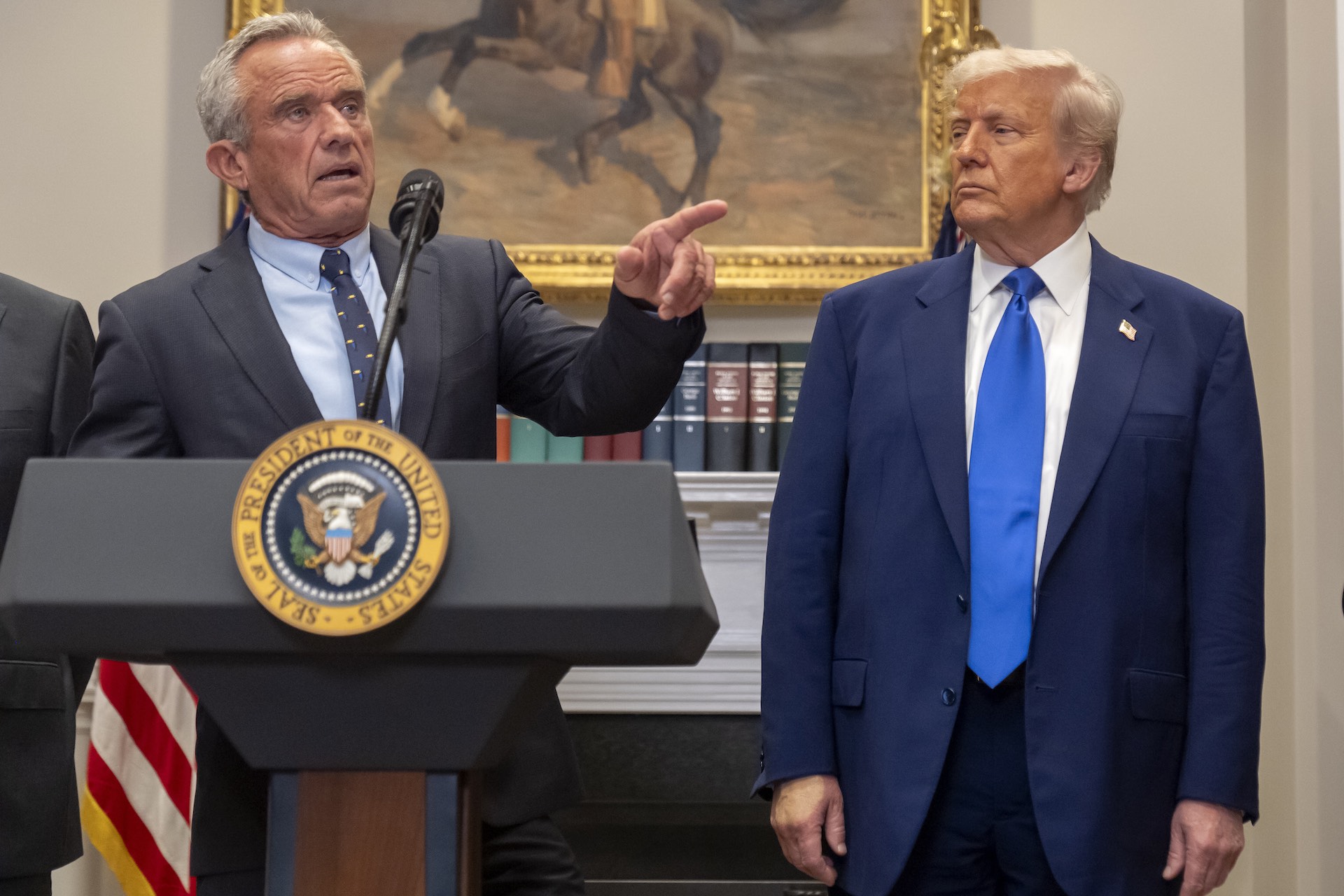
Trump’s health and human services secretary, Robert F. Kennedy Jr., left, purged the U.S. Centers for Disease Control’s advisory committee on immunization. Photo: AP Photo/Mark Schiefelbein
OTTAWA — America’s global trade war is breaking up delicate supply chains for essential drugs and Canadians should expect shortages, says Mark Lievonen, a co-chair of Canada’s COVID-19 vaccine task force and veteran pharma executive.
All the instability has created pandemic-level risks to health security already, Lievonen, a former president of the Canadian arm of French pharma giant Sanofi, told The Logic.
“It’s not disease, but it’s underlying infrastructure,” he said.
Lievonen contributed to a new report from the Public Policy Forum warning the federal government that U.S. policies put Canadians at risk of greater illness and shortages of critical medicines.
Talking Points
- The U.S.’s new trade barriers and funding cuts to life sciences are a pandemic-level threat to global health, the Public Policy Forum warns in a new report
- Some critical drugs are in short supply, even without tariffs breaking up supply chains that often originate in China or India
“This new emergency may not feel as immediate as the last, but the impact will be as real and the consequences as hard,” says the report. Sector experts from the think tank’s life sciences leadership table contributed, and the report was written by Christopher Waddell, a former head of Carleton University’s journalism school.
It calls for speeding up parts of the life-sciences strategy the Liberal government kicked off in response to COVID-19, and for the country to protect itself from a new “anti-science and anti-vaccine mentality” in the United States.
Related Articles


Measles and bird flu outbreaks are a leading indicator of trouble, the report says. More will bleed into Canada from the U.S., it warns, straining health systems and increasing the odds of another full-blown pandemic.
Sanofi’s operation in Canada is largely in the business of producing vaccines for Canadians and export markets. Lievonen left the company in 2016; his long resumé includes board memberships at other pharma companies, the National Research Council’s new vaccine factory in Montreal and the University of Saskatchewan’s elite research institute for infectious diseases.
Predicting what might run out first is hard, but Lievonen believes treatments that are part of the bedrock of the health system, like common chemotherapy drugs, are vulnerable to U.S. trade blockages and other countries’ retaliations.
“They’re so inexpensive now, they’re so specialized—they’re so fragile. Now, why on earth would we even consider tariffs on those? We have supply shortages without tariffs,” he said.
Many active pharmaceutical ingredients in traditional drugs come from India and China, where production has been cheapest, Lievonen said. These ingredients—“APIs,” for short—often go to the United States to be combined with delivery mechanisms, buffers and fillers to make final products, and some of those get exported to Canada.
“There’s a factory that, if it has a fire and goes under, maybe we don’t get a cancer medicine, right? So that was fragile enough already, and the trade tariffs just exacerbate it tremendously,” Lievonen said. Even routine cold medicines have run out before, thanks to trouble at one Nebraska factory.
“One of our strategies should be to say, ‘Let’s make some APIs in Canada.’ We can do that,” Lievonen said. Those ingredients would be more expensive than the same chemicals produced in China or India, he warned, but the price would be worth it to have all-Canadian supplies of important medicines.
Newer biologics (drugs derived from living organisms) are also vulnerable because of the complexity of making them, he said. Common examples include drugs like Humira and Remicade, which are used to treat autoimmune diseases, as well as Avastin, which is used in cancer treatments.
We saw the way this happened with the COVID-19 vaccines from Moderna and Pfizer when they were first rolling out in late 2020 and early 2021. Producing those shots took something like 200 separate steps carried out in different places around the world, Lievonen said. A slowdown at one stage of production held up deliveries of thousands of doses.
In the longer run, Lievonen worries about the U.S.’s destruction of its scientific research capabilities and its ability to regulate wisely.
Having spent much of his career focused on vaccines, he’s especially appalled by Health and Human Services Secretary Robert F. Kennedy Jr.’s decision to purge the Centers for Disease Control’s advisory committee on immunization practices.
“The brightest people in the world making recommendations,” Lievonen said. “It’s like the Supreme Court of vaccine uptake … I can’t fathom it.”
The whole world has used American-funded scientific research, even as U.S. industry has accumulated patents and wealth, he said. The Donald Trump administration’s cuts to research grants are being litigated, but clearly the current American government doesn’t want to pay for basic science as previous administrations have.
Canada might be able to snatch some of the researchers and the benefits—the Public Policy Forum report recommends an aggressive recruitment effort. But “there’s going to be less good science globally, which is going to affect everything around the world,” Lievonen said.
To strengthen Canada’s industry, the Public Policy Forum proposes refocusing Canadian regulators. They can make reciprocal deals with other countries’ pharma regulators—ones they trust—freeing up domestic capacity to examine Canadian-made pharmaceuticals.
Health Canada already does some of this, with reciprocal deals for factory inspections, for instance, but it still sends its own experts to manufacturing facilities abroad sometimes. It also does its own reviews of pharmaceuticals, regardless of where else they might have been approved.
“The ultimate goal is a more streamlined and predictable regulatory approval timeline,” the think tank says. “This would both bolster development in Canada and significantly enhance Canada’s attractiveness to foreign investors committed to developing their discoveries in Canada, or bringing them to market here initially.”
The mutual-recognition idea parallels provinces’ moves to recognize each other’s approvals of various kinds of products (which the government in Ottawa is also preparing to do federally, through the Liberals’ internal-trade bill).
“It’s like interprovincial trade barriers,” Lievonen said, “to me, seems to be a no-brainer.”



Loading...
Thanks for sharing!
You have shared 5 articles this month and reached the maximum amount of shares available.
CloseThis account has reached its share limit.
If you would like to purchase a sharing license please contact The Logic support at [email protected].
CloseGift the full article!
You have gifted 0 article(s) this month and have 5 remaining.
Recipients will be able to read the full text of the article after submitting their email address. They will not have access to other articles or subscriber benefits.
Photo: AP Photo/Mark Schiefelbein
Mark Lievonen
Most Popular This Week




In-depth, agenda-setting reporting
Great journalism delivered straight to your inbox.
The Big Read
Beacon is building an AI empire by fixing Main Street’s software
Briefing
EverWind plans $10B data centre and wind development in Nova Scotia
Canada ready to force Stelco to sell its Canadian operations, Joly says
Feds plan a 60 MW defence-oriented data centre for Ottawa
Best business newsletter in Canada
Get up to speed in minutes with insights and analysis on the most important stories of the day, every weekday.
Exclusive events
See the bigger picture with reporters and industry experts in subscriber-exclusive events.
Membership in The Logic Council
Membership provides access to our popular Slack channel, participation in subscriber surveys and invitations to exclusive events with our journalists and special guests.