Skip to content

Exclusive
A telehealth service for chronically ill patients was days from collapse
A dispute over unpaid bills and data ownership nearly cut off lifesaving care to hundreds of patients in Ontario. One paramedic service only found out about the ordeal when contacted by The Logic.
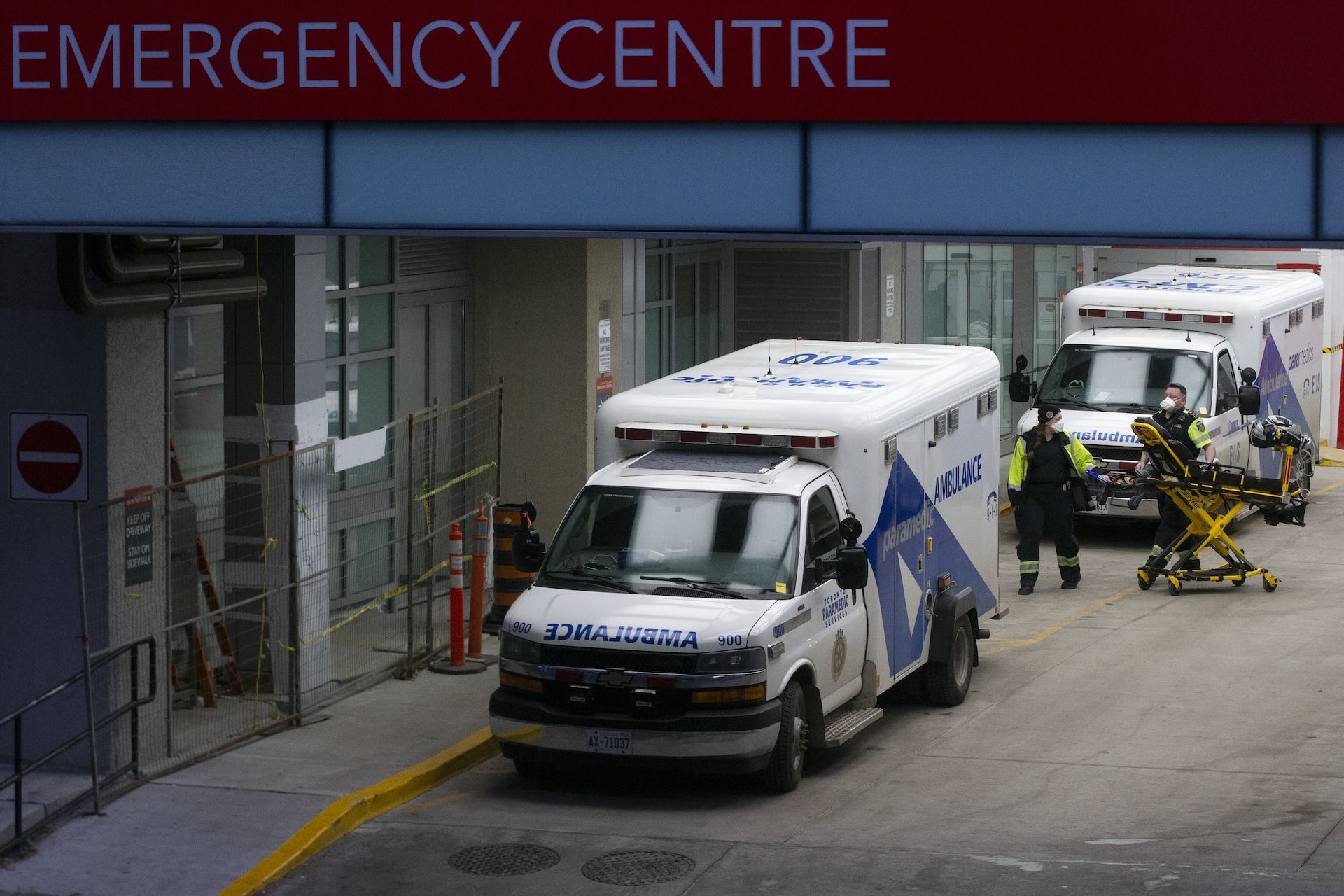
Despite Future Health’s near shutdown, at least one paramedic unit that works with the service was unaware for months that its patients nearly lost access to the monitoring system. Photo: The Canadian Press/Chris Young
An Ontario telehealth company that treats chronically ill patients was pushed to the brink of collapse this summer when a contractor warned it would shut down a crucial backend system. The dispute, which is now before the courts, put more than 1,500 patients in rural communities across southern Ontario at imminent risk of losing access to life-saving health-care services, according to legal filings reviewed by The Logic.
Future Health Technologies, the company responsible for delivering the health-monitoring system through municipal paramedic services, was forced into receivership in September after its lenders said the company was days away from a system-wide shutdown. The creditors said the move was necessary after Future Health’s technology provider—a numbered company known in court records only as 280 Ontario—said it would stop operating the backend system, citing unpaid bills and a broader fight over who controls the intellectual property for the technology.
Talking Points
- Remote-patient-monitoring company Future Health Technologies was forced into receivership after its backend tech provider nearly cut off services for chronically ill patients in dozens of rural Ontario municipalities
- The ongoing conflict exposes the risks to the public health system of relying on a single vendor to provide critical infrastructure and services
Future Health is the backbone of the Community Paramedicine Remote Patient Monitoring Program. Paramedics use the company’s service to track patients with chronic illnesses using bluetooth medical devices that monitor blood pressure, oxygen levels and other vital signs. The technology sends health data to paramedics remotely, letting them intervene only when they need to, and purportedly reducing emergency calls and letting patients live at home longer. Court records show the system has become a key part of local care for high-risk patients in Ontario, with 40 municipalities using it.
Future Health is a subsidiary of Future Health Services, a non-profit organization founded in 2011 by seven Community Futures Program groups—non-profits that exist across Canada and are funded by the federal government. The company sells its service to municipal paramedic units, paid for indirectly by the Ontario Ministry of Health. The receivership application was filed by five of the Community Futures, which claim Future Health owed them nearly $1.3 million as of March 31.
Related Articles


On its website, under a banner that reads “the future of your health is at home,” testimonials praise Future Health for “how simple it is to use” and for reducing emergency room visits in one county by 58 per cent. Another page titled “Mission Statement” is blank. Barb Fisher, a director of Future Health and one of the officials who oversaw the program, detailed the escalating financial strain and vendor dispute in affidavits filed with the court.
Despite Future Health’s near shutdown, at least one paramedic unit that works with the service was unaware that its patients nearly lost access to the monitoring system. A senior paramedic official in southern Ontario said they only learned of Future Health’s financial and legal troubles when The Logic asked them about it last month. The paramedic, who is not being named because they weren’t authorized to speak on the matter which is before the courts, was frustrated they weren’t informed sooner. “If there was a possibility of losing functionality of the system, we should have been privy to that information, just in case you did have a patient that needed assistance and it wasn’t working.”
The paramedic said they received an email from Future Health the day after The Logic contacted them, saying the monitoring program is operating as normal. While their unit hasn’t experienced any service disruptions, the paramedic said they are reconsidering the unit’s contract with Future Health in light of the ordeal.
Rick Whittaker, manager of Future Health Technologies, told The Logic the receiver is expected to make a recommendation to the court about the IP ownership “in the near future.” He said the remote patient monitoring program is “continuing to operate as normal and patients and community paramedics alike will receive the same level of service they have received prior to this dispute.” A lawyer for 280 Ontario declined to comment.
FedDev Ontario, the federal agency that funds the province’s Community Futures, did not provide a statement from a named spokesperson.
Rubab Sarwar, a spokesperson for Ontario’s Ministry of Long-Term Care—which sets delivery and oversight requirements for the community paramedicine program that uses Future Health—told The Logic that third-party vendors are responsible for meeting the obligations outlined in their contracts, including managing funds effectively and identifying risks.
Future Health and its lenders have been aware of the system’s vulnerability since at least this spring. On April 18, a lawyer for 280 Ontario notified Future Health and its lenders that it would shut down services on April 29, claiming Future Health had failed to pay outstanding invoices of more than $1.3 million. Future Health disputed the debts and accused the contractor of billing it for work it didn’t do.
In the April termination letter, the tech provider’s lawyer instructed Future Health to notify clients and patients so they had “sufficient time to prepare for the termination of the services.”
Future Health continued operating through the spring under a temporary arrangement with 280 Ontario, while the two sides attempted to negotiate. But the dispute deepened.
On June 25, 280 Ontario issued a second shutdown notice, warning it would stop operating the system by the end of the month. The lenders filed an application on June 27 asking the court to place Future Health in receivership, arguing the company had no way to run the platform on its own if the vendor withdrew support. An immediate shutdown, they claimed, would stop services and harm patients and ultimately lead Future Health to file for bankruptcy.
On June 30, Justice Kimmel ordered the parties to maintain “status quo” service so the platform did not go dark. Kimmel issued a receivership order on Sept. 11, appointing the insolvency firm MNP Ltd. to take control of all Future Health assets and operations.
On top of disputes over payment, Future Health and the tech provider disagree over who owns the intellectual property behind the remote monitoring platform. They’ve launched competing legal applications in Kitchener, Ont. to resolve the matter. 280 Ontario had opposed the receivership request, arguing it could interfere with the separate intellectual property cases.
The turmoil has exposed how dependent a crucial health-care service used by thousands of chronically ill patients had become on a single private vendor, leaving public providers with no immediate backup plan when the system came under threat.
Samir Sinha, director of geriatrics at Mount Sinai Health and the University Health Network in Toronto, said hospitals, clinics and paramedic services routinely rely on third-party vendors—for everything from software to bed linens. He said the Future Health dispute is a “cautionary tale” of what can go wrong. “If organizations are going to rely on an external vendor to provide a critical service like this, or critical infrastructure, you’re hoping that people are doing their due diligence,” Sinha said, adding that small, fragmented paramedic units “may not have had the capacity to do these risk assessments or consider that this could possibly happen to them.”
What happens next for Future Health and the patients that rely on it will depend on the receiver’s assessment of its finances and its dispute with 280 Ontario. MNP Ltd. is now reviewing the non-profit’s business and will report back to the court with recommendations on the organization’s options going forward, which could include restructuring or selling it. For now, the monitoring platform remains online under the receiver’s supervision.



Loading...
Thanks for sharing!
You have shared 5 articles this month and reached the maximum amount of shares available.
CloseThis account has reached its share limit.
If you would like to purchase a sharing license please contact The Logic support at [email protected].
CloseGift the full article!
You have gifted 0 article(s) this month and have 5 remaining.
Recipients will be able to read the full text of the article after submitting their email address. They will not have access to other articles or subscriber benefits.
Photo: The Canadian Press/Chris Young
Most Popular This Week




In-depth, agenda-setting reporting
Great journalism delivered straight to your inbox.
News
Ottawa is softening its ban on stablecoin yield
Briefing
Rio Tinto gets nearly $165M in additional federal funds for Quebec aluminum
U.S. to lift tariffs on some Canadian products crucial to Maine: Collins
Carney warns of tech dependence after Starlink disruptions in Ukraine
Best business newsletter in Canada
Get up to speed in minutes with insights and analysis on the most important stories of the day, every weekday.
Exclusive events
See the bigger picture with reporters and industry experts in subscriber-exclusive events.
Membership in The Logic Council
Membership provides access to our popular Slack channel, participation in subscriber surveys and invitations to exclusive events with our journalists and special guests.






