MISSISSAUGA, Ont. — Prime Minister Mark Carney promised $5 billion in financing for companies hit by U.S. tariffs, and that Ottawa would buy from Canadian firms first, as the Liberal government faces mounting pressure to address a sluggish economy and trade troubles.
Skip to content


News
Carney puts EV mandate on ice, announces $5B for industries hit by tariffs
The moves aim to spur investment and help companies built on free trade adapt to the new economic order, PM says
Prime Minister Mark Carney and Industry Minister Mélanie Joly announced the new measures at an aircraft plant in Mississauga, Ont. Photo: The Canadian Press/Sammy Kogan
MISSISSAUGA, Ont. — Prime Minister Mark Carney promised $5 billion in financing for companies hit by U.S. tariffs, and that Ottawa would buy from Canadian firms first, as the Liberal government faces mounting pressure to address a sluggish economy and trade troubles.
At an aircraft plant near Pearson airport, where a subsidiary of Mitsubishi Heavy Industries assembles large plane components for customers like Bombardier, Carney also backed off a federal mandate for electric vehicle sales and pledged help for farmers—especially canola growers—in a multi-part announcement of government interventions to help struggling industries.
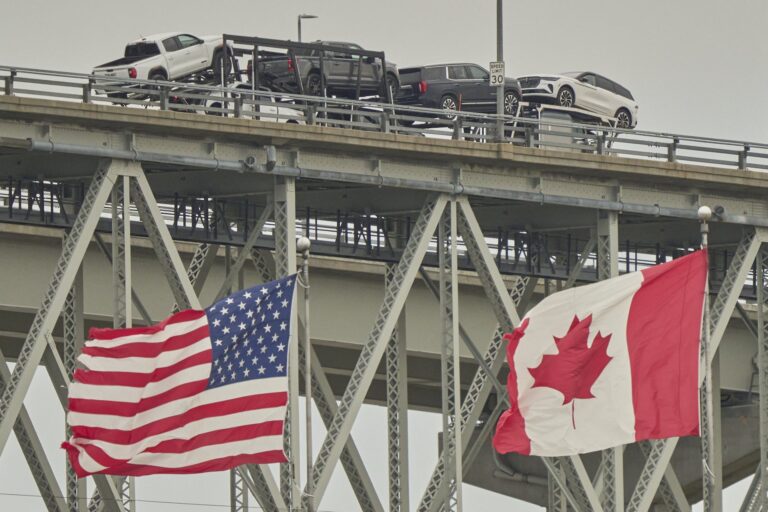
Carney said a global era of free trade is over and mercantilism is ascendant, with changes that go beyond tariff disputes with the United States.
“What’s going on is not a transition, it’s a rupture,” Carney said.
Related Articles

The new order
Mercantilist economic thinking aims to keep imports low and exports high, often using strong government intervention. It underpinned European colonialism, Adam Smith excoriated it in The Wealth of Nations and most adherents discarded it in the 19th century. But we’re back in it, Carney said.
The Liberal government’s new promises are meant to help companies built on free trade adapt to the new order, he said: “With economic uncertainty making it challenging for the private sector to invest, government must act.”
The cash
A new Strategic Response Fund will support firms facing revenue drops or considering layoffs because of trade issues. It will also help companies pay for the development or capital costs of retooling and pivoting to find new customers.
The program will replace Ottawa’s flagship Strategic Innovation Fund, which the government used to attract large projects from multinationals, support plant expansions for big Canadian businesses and finance R&D at homegrown scale-ups.
Sales strategy
Ottawa is promising to ramp up its Buy Canadian policy, purchasing first from domestic suppliers and, if they can’t, requiring foreign firms to use local content. It’s also imposing that approach on its funding programs. “The public sector can serve as an anchor customer for Canadian businesses,” Carney said.
Canadian firms, particularly in the technology sector, have long complained that selling to the federal government and other public-sector organizations is difficult. Carney said government departments and agencies have typically turned to foreign suppliers “for short-term gain.” They will now have an obligation to buy homegrown.
If no domestic suppliers are available, foreign vendors will have to source as many of their inputs as they can in Canada, he said. The policy will only apply to purchases of steel and softwood lumber to start (steel producers swiftly said they’re ready to go), but the Liberals will consider “additional domestic materials” in the future. Carney also promised to simplify the process of selling to the government.
Companies, infrastructure projects and other organizations receiving federal funding will also have to follow the Buy-Canadian rules when using the government’s money to make purchases.
“What’s going on is not a transition, it’s a rupture.”
Climate struggle
Carney is scrapping a federal target to have 20 per cent of new light vehicles sold in Canada in 2026 be zero-emissions and will take 60 days to review a policy requiring that it be 100 per cent by 2035.
“The EV mandate this year adds to the financial challenges these producers have. They’ve got enough on their plate right now,” Carney said.
Global Automakers of Canada welcomed the move, saying it acknowledges that neither consumer demand nor charging infrastructure is where it needs to be to meet the current targets.
Carney said he’s not abandoning his long-held belief that climate change is a big problem, though. He promised a climate-competitiveness plan will be part of a broader industrial strategy that’s still to come; he said he intends to “strengthen” tax credits for investments in clean energy and keep the government’s industrial carbon levy—but “improve the way the carbon market works.”
In an interview the evening before Carney spoke, Industry Minister Mélanie Joly told The Logic the government will stand by its investments in EV battery plants and remains committed to boosting EV sales through consumer purchase incentives.
And also
Carney announced numerous smaller moves as well. Among them:
- Increasing the cap on Business Development Bank of Canada loans to small- and medium-sized businesses, from $2 million to $5 million.
- Aid for farmers, especially canola farmers hit by Chinese tariffs, by increasing the limits on government loans and more aggressively marketing their products abroad. The government will also spend over $370 million over two years to help biofuel producers.
- Spending $450 million over three years to boost re-skilling programs for up to 50,000 workers and $1.6 billion over five years to extend employment insurance coverage for “long-tenured” workers who lose their jobs; and working up an AI-assisted system to match EI claimants to job postings and training programs.
The backdrop
The new measures came at the end of a two-day cabinet retreat in Toronto, where ministers worked on the Liberal government’s first budget under Carney and on Canada’s response to the Trump administration. He said the fiscal plan will mix “austerity and investment.” Several ministers touted Ottawa’s plan to significantly increase defence spending as an opportunity for firms in other sectors to sell to the government, as well as NATO allies souping up their own militaries.
The Mississauga factory is an example of that adaptation, as it helps make Bombardier’s Global jets, which the aerospace firm has adapted to sell as military intelligence planes. That made the plant an apt backdrop to an announcement on retooling industries for the government’s new priorities. However, in 2023, Ottawa decided to buy Boeing aircraft instead, as it courted the Biden administration.



Loading...
Thanks for sharing!
You have shared 5 articles this month and reached the maximum amount of shares available.
CloseThis account has reached its share limit.
If you would like to purchase a sharing license please contact The Logic support at [email protected].
CloseGift the full article!
You have gifted 0 article(s) this month and have 5 remaining.
Recipients will be able to read the full text of the article after submitting their email address. They will not have access to other articles or subscriber benefits.
Photo: The Canadian Press/Sammy Kogan
Most Popular This Week



In-depth, agenda-setting reporting
Great journalism delivered straight to your inbox.
The Big Read
Beacon is building an AI empire by fixing Main Street’s software
Briefing
Inovia raises US$200M for new VC fund as it eyes AI’s impact
43% of eligible Albertans voted ahead of Monday’s referendum
AI chip company Tenstorrent raises US$1.5B, valuing it at US$6.2B
Best business newsletter in Canada
Get up to speed in minutes with insights and analysis on the most important stories of the day, every weekday.
Exclusive events
See the bigger picture with reporters and industry experts in subscriber-exclusive events.
Membership in The Logic Council
Membership provides access to our popular Slack channel, participation in subscriber surveys and invitations to exclusive events with our journalists and special guests.







