Innovation Minister Navdeep Bains has spent much of the past two years touting the $2.41-billion Strategic Innovation Fund (SIF) as a way to help cutting-edge Canadian companies compete globally.
However, The Logic’s exclusive analysis shows that so far, the program has favoured foreign-owned firms, directed nearly all its funds to two provinces—Ontario and Quebec—and allocated more money to companies in traditional sectors than scale-up tech firms.
The SIF took four industry-specific innovation support programs—for the automotive, aerospace and defence sectors—worth a combined $1.06 billion, rolled them into a single fund with additional capital and expanded it to all industries.
“This fund will help Canadian innovators build in areas of economic strength, expand the role of Canadian firms and regional and global supply chains, attract investments, and create new, good-quality middle-class jobs,” Bains told a parliamentary committee in May 2018.
The Logic analyzed the $951 million awarded to 35 projects by Innovation, Science and Economic Development Canada (ISED) since the fund launched in July 2017, and found that 50.2 per cent, including seven of the 10 largest awards, went to foreign companies’ Canadian subsidiaries.
Talking Point
The Logic’s analysis shows 50.2 per cent of the $951 million awarded by the Strategic Innovation Fund so far has gone to foreign subsidiaries. Almost all the projects were based in Ontario or Quebec, and more money is going to firms in traditional industries like aerospace and auto than high-growth sectors like biotech and cleantech. This comes despite two years of the federal government talking up the Strategic Innovation Fund as a way for Canadian innovators to scale and expand globally.
The government has frequently invoked domestic scale-ups when talking about the fund. In a December 2018 interview with The Logic, Bains cited SIF funding for Kitchener, Ont.-based North, the wearable technology firm, and NorthStar, the low-earth orbit satellite developer, as examples of the government’s “commitment to help Canadian companies scale and grow.” The two Canadian companies have been awarded $24 million and $9.5 million from the program, respectively.
According to The Logic’s analysis, 22 SIF awards totalling $442 million have gone to Canadian companies; 13 awards totalling $477 million have gone to companies with foreign owners.
When asked why ISED is allocating the majority of funds to foreign firms and almost half to the aerospace and automotive sectors, Danielle Keenan, press secretary to Bains, said the SIF has supported the creation of over 50,000 jobs and attracted $10 billion in investment.
“Two thirds of SIF recipients are potential high growth firms from Canada,” said Keenan, adding that investments in the expansion of Canadian subsidiaries of multinationals “[bring] added benefits by pulling Canadian innovators into global research and development projects.”
All SIF recipients must be incorporated domestically and use the money for projects on Canadian soil, even if they’re foreign-owned. They’re required to report annually to keep the funding flowing and must hit milestones on job creation, retention, intellectual property, R&D and gender diversity.
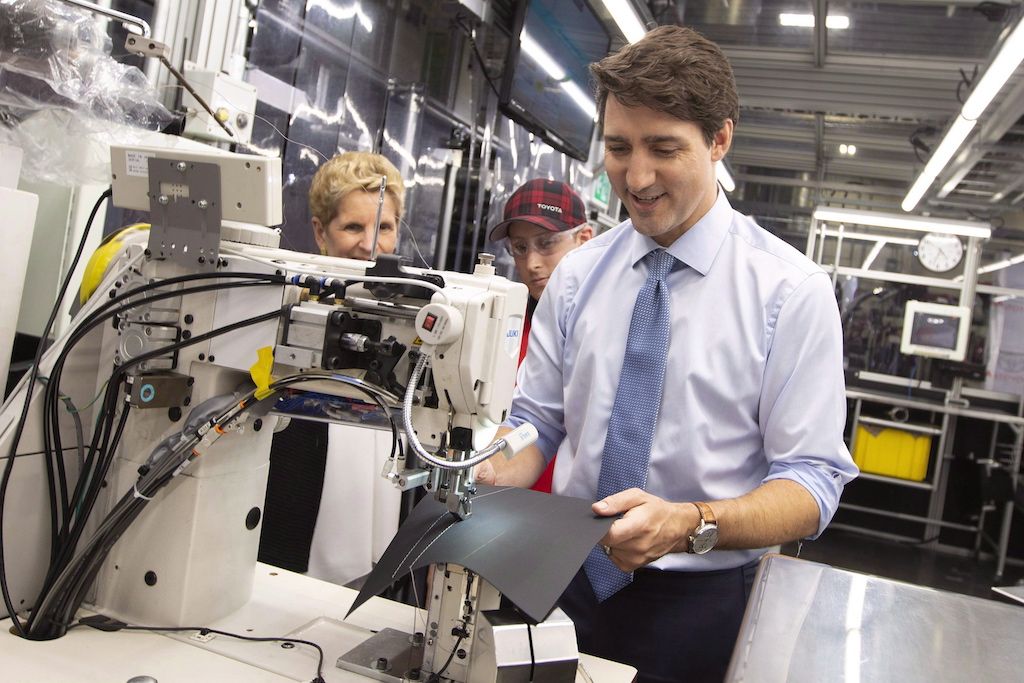
Foreign firms generally received larger awards from the fund. In May 2018, it was announced that Japanese carmaker Toyota would receive $110 million—the second-largest award since the fund began. The funding will help pay for a $1.44-billion overhaul of two Ontario plants building a hybrid model of its RAV4 SUV. The announcement, attended by Prime Minister Justin Trudeau, included a promise from the company to spend $200 million on Canadian research and development (R&D) over the following decade.
The program has heavily favoured Ontario and Quebec: $824 million, or 86.7 per cent of the money, has gone to projects in those two provinces. That’s where Canada’s automotive, aerospace and steel and aluminium industries are based. All but three of the 23 SIF projects from those sectors are in Ontario and Quebec.
The two provinces have partially matched the federal spend, putting up $517 million across eight projects. That includes $66.7 million each for Innovation ENCQOR, a private-public partnership to develop 5G technology led by the domestic subsidiaries of Ericsson, Ciena, Thales and IBM, as well as Canadian tech firm CGI.
No funding has been allocated to projects primarily located in the Prairies, Prince Edward Island or the three territories.
Derek Mellon, media relations manager for ISED, pointed out that many of the companies funded by the SIF will spend money in multiple provinces. Mellon cited Calgary-based, Nova Chemicals, as an example of a firm that will create jobs in Alberta, even though ISED classified its funding allocation in Ontario because that’s where most of the money will be spent.
The Calgary-headquartered firm—owned by the United Arab Emirates’ sovereign wealth fund—is upgrading its facilities in the province as part of a $2.2-billion project that includes $35 million from the SIF.
The western provinces are also likely to receive some of the money when the program’s forestry and oil and gas allocations—$100 million each—start being spent.
The automotive and aerospace sectors have received the most from the fund: $438 million, or 46.2 per cent, so far. Bains has faced criticism from the Quebec government for cutting the aerospace-specific funds and from the federal Conservatives for failing to support the automotive industry. He responded by making clear that the two sectors were still welcome under the new program, writing in a December 2018 op-ed in The Globe and Mail that the SIF’s investments in aerospace “[fall] in line with previous federal government support,” and telling the House of Commons that the program “helped bring forward many investments” in the automotive industry.
Montreal-based aerospace firm CAE had the largest individual award. It’s getting $150 million toward a billion-dollar R&D project to develop training technology for aerospace and healthcare workers. The company was also a big beneficiary of one of the SIF’s predecessor funds, the Strategic Aerospace and Defence Initiative. It received $500 million in two loans in 2009 and 2014—over a third of the program’s $1.32-billion total.
Some of the SIF’s cash has also been reserved for companies in resource industries challenged by economic conditions or trade disputes.
Steel and aluminium was allocated $250 million after the U.S. imposed tariffs on imports of the metals. That money is coming from the revenue from Canada’s retaliatory duties.
Behind the numbers
The Logic analyzed Government of Canada media releases of the 35 funding announcements under the Strategic Innovation Fund.
Foreign versus domestic firms: Corporate records and company websites were used to determine which projects receiving funding involved Canadian subsidiaries of foreign companies. Thirteen were found to do so. In cases where a project involved both Canadian companies and foreign subsidiaries, the number of firms of each type was used to calculate the ratio of funding. For example, the media release for the ENCQOR project says it “will be led by” Ericsson, Ciena Canada, Thales Canada, IBM Canada and CGI. The first four of those firms are foreign subsidiaries, so the $66.7 million in SIF funding was counted as 80 per cent foreign and 20 per cent domestic.
Sectors: The government media releases identify the sectors of the companies receiving funding. The Logic included sectors in the “high-growth” category if they had an Economic Strategy Table (EST).
Aerospace and automotive: Some companies in these sectors who had applied to the SIF’s predecessor programs were carried over into the new fund, upping the total allocation to those industries. Documents obtained by The Logic via access-to-information requests show two projects awarded a combined $12.4 million were holdovers from the Strategic Aerospace and Defence Initiative, as were 11 that got a combined $41.2 million after applying to the Automotive Supplier Innovation Program.
A fifth of the metals allocation has gone to a single project: Luxembourg-based ArcelorMittal’s Canadian operation got $49.9 million to “modernize its facilities” and support a combined 6,400 jobs.
Firms in agri-food, biotech, cleantech, advanced manufacturing and information technology—identified as high-growth sectors by the government—have been awarded $337 million, or 35.5 per cent of SIF funding.
One of those recipients is Stemcell Technologies, a Vancouver-based biotech company. It was awarded $22.5 million—and a matching sum from the B.C. government—in April 2018 to help it build a $138-million facility, where it will manufacture its research tools for clinical trials.
According to Andrew Booth, Stemcell’s chief commercial officer, the funding wouldn’t have been possible before SIF.
“Pre-SIF expanding outside of automotive and aerospace, there wasn’t a government program—at least that I’m aware of—that would have helped with this,” said Booth.
Mellon said “it is misleading to suggest that projects benefit only the identified primary industry sector. That conclusion doesn’t reflect the reality of firms operating in today’s economy where technology has blurred the lines between traditional industrial sectors.”
There have been more than 800 applications to the SIF so far, according to ISED, and more announcements are likely coming soon. “A large number of projects are in development across economic sectors and across Canada,” Mellon said.