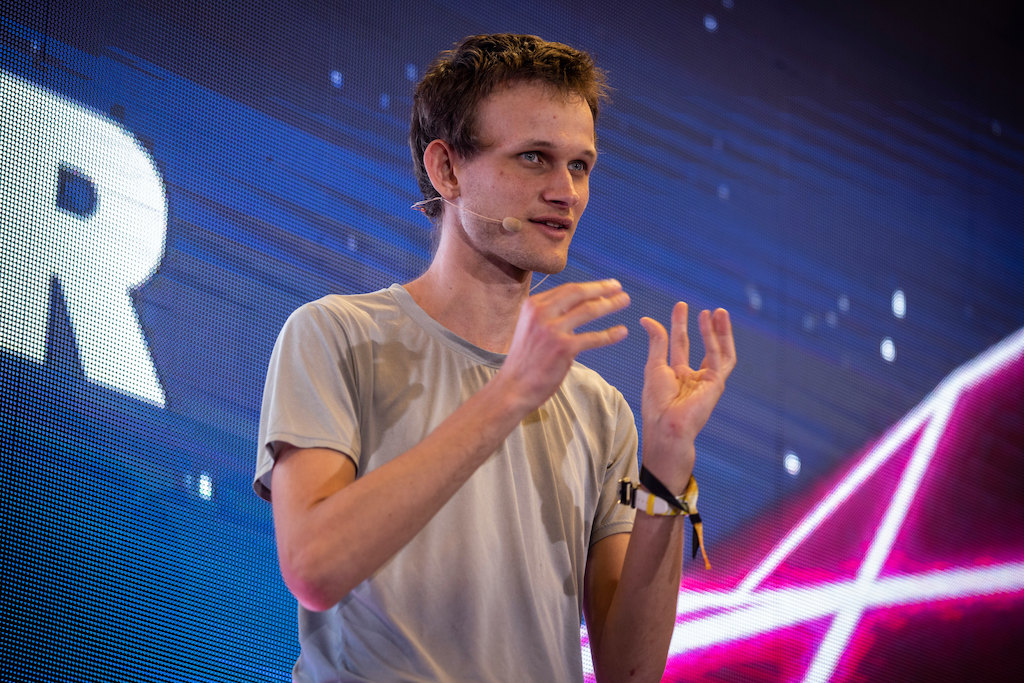
Ethereum co-founder Vitalik Buterin took the stage at the Blockchain Futurist Conference in Toronto Wednesday to talk about the blockchain’s widely anticipated transformation. Under the purple glow of the Rebel Entertainment Complex, Buterin, who is Russian-Canadian, assured attendees that the years-long work to carry out what’s known as the merge—a prerequisite for Ethereum 2.0—is nearly complete.
Skip to content
News
Ether surges as co-founder Vitalik Buterin teases major upgrade
Ethereum co-founder Vitalik Buterin in Denver for the ETHDenver conference in February 2022. Photo: Chet Strange for Bloomberg via Getty Images
Ethereum co-founder Vitalik Buterin took the stage at the Blockchain Futurist Conference in Toronto Wednesday to talk about the blockchain’s widely anticipated transformation. Under the purple glow of the Rebel Entertainment Complex, Buterin, who is Russian-Canadian, assured attendees that the years-long work to carry out what’s known as the merge—a prerequisite for Ethereum 2.0—is nearly complete.
Later that day, Ethereum said it successfully ran its final test for the upgrade, sending the price of the world’s second biggest cryptocurrency to a two-month high on Thursday.
The shift promises sweeping reforms to how the blockchain functions, as crypto skepticism feeds off and fuels a broad sector downturn. Here’s what you need to know:
What is Ethereum 2.0? The next iteration of the blockchain will be triggered by the merge. It promises to slash transaction fees, free up data space, improve security and cut energy use on the Ethereum blockchain by more than 99.9 per cent.
It will do this by moving from a proof-of-work system—a labour- and energy-intensive process for verifying transactions—to a proof-of-stake system, which uses just one validator at a time and no special hardware, helping to make it far more efficient.
“The merge isn’t just about the merge”: Ultimately, the upgrade is meant to make Ethereum scalable and accessible. A major barrier, said Buterin, is the cost of transactions on the chain. The average Ethereum transaction fee over the past two years ranged from US$1 to US$20, he added in his presentation. That’s more than the median daily income in many countries in which Ethereum is trying to take hold. “If we’re talking about blockchains being this global thing that’s supposed to empower people that are not empowered today in underprivileged countries, then you can see how it starts looking less viable,” he said. “We’re talking about single transactions potentially taking up people’s entire daily income.”
Buterin said changes to how transactions are bundled and stored following the merge could bring the cost of a transaction down as low as 0.2 US cents.
Bringing crypto back to the future: Buterin reflected on the ideals of the 1990s, when Bitcoin promised a world in which all daily transactions could be done with cryptocurrency. “Fast forward to today, we have millions of people with crypto wallets and we have millions of people that have private keys inside their own browsers,” said Buterin. “Why? Because they want to trade monkey pictures.” Addressing the cost, scalability and energy issues associated with crypto could bring it closer to a version of the original conceit.
What’s next: Buterin has been teasing the upgrade for years. Hype has been building this year, with its launch expected in the latter half of 2022. After the successful merge test on Wednesday, Ethereum is on track for a Sept. 19 launch date. Crypto skeptic Molly White has criticized the years-long promise of an imminent upgrade as a “useful way for Ethereum fans to dismiss the valid concerns about the enormous energy expenditure of their preferred blockchain.”
Beyond its energy consumption, crypto faces increasing criticism over its utility as more than a speculative asset. Buterin acknowledged there are questions about Ethereum’s applications. “This is basically what I hope we can start thinking about more,” he said. “The technical improvements are happening, and they’re going to happen, but what kinds of improvements in terms of what we use Ethereum for are going to make [these things] possible?”



Loading...
Thanks for sharing!
You have shared 5 articles this month and reached the maximum amount of shares available.
CloseThis account has reached its share limit.
If you would like to purchase a sharing license please contact The Logic support at [email protected].
CloseGift the full article!
You have gifted 0 article(s) this month and have 5 remaining.
Recipients will be able to read the full text of the article after submitting their email address. They will not have access to other articles or subscriber benefits.
Photo: Chet Strange for Bloomberg via Getty Images
Most Popular This Week




In-depth, agenda-setting reporting
Great journalism delivered straight to your inbox.
News
Canada faces a satellite-launch crunch as SpaceX retires its workhorse rocket
Briefing
Cohere says it caught an Alibaba model trying to send data to a server in China
Feds and First Nations to work on sharing resource revenue, with a sovereign wealth fund one option
Zafin buys U.S. fintech Naehas in nine-figure deal
Best business newsletter in Canada
Get up to speed in minutes with insights and analysis on the most important stories of the day, every weekday.
Exclusive events
See the bigger picture with reporters and industry experts in subscriber-exclusive events.
Membership in The Logic Council
Membership provides access to our popular Slack channel, participation in subscriber surveys and invitations to exclusive events with our journalists and special guests.