HAMILTON, ONT. — As the Liberal cabinet met to plan a year’s worth of policy priorities for the country and signalled plans to spend on health care and the green transition, economists inside and outside the building warned there are still serious short-term risks ahead for the Canadian economy.
Skip to content
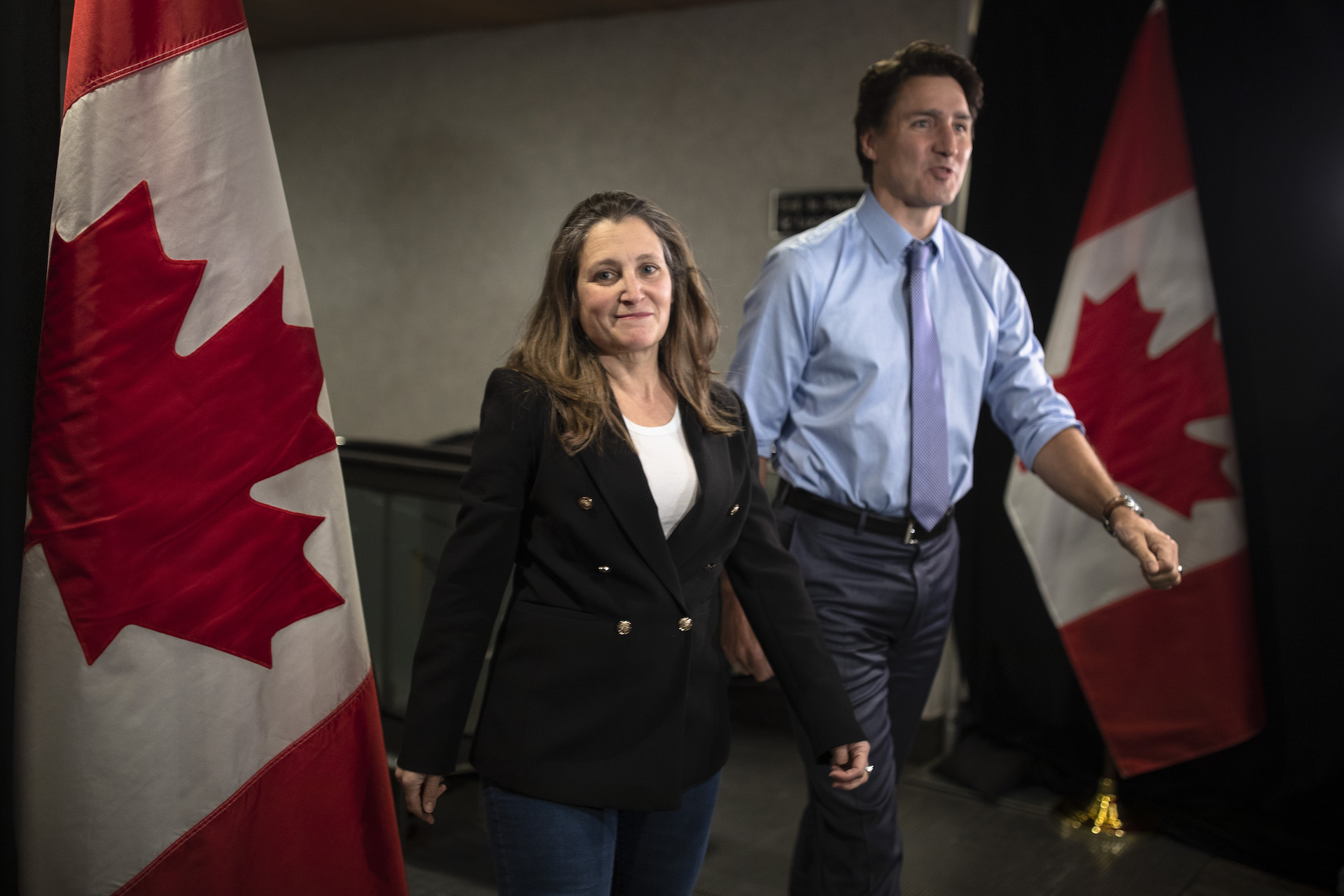 Finance Minister Chrystia Freeland and Prime Minister Justin Trudeau arrive at the Liberal cabinet retreat in Hamilton, Ont. on Jan. 23, 2023. Photo: Nick Iwanyshyn/The Canadian Press

News
Economic hazards remain as Liberal cabinet prepare green transition, policy agenda
Past rate hikes could nudge up unemployment and inflation remains a threat, economists warn
Finance Minister Chrystia Freeland and Prime Minister Justin Trudeau arrive at the Liberal cabinet retreat in Hamilton, Ont. on Jan. 23, 2023. Photo: Nick Iwanyshyn/The Canadian Press
HAMILTON, ONT. — As the Liberal cabinet met to plan a year’s worth of policy priorities for the country and signalled plans to spend on health care and the green transition, economists inside and outside the building warned there are still serious short-term risks ahead for the Canadian economy.
Here’s the outlook from the ministerial retreat in Steeltown.
The view from inside cabinet: In last April’s budget, Finance Minister Chrystia Freeland said the government was keeping its “powder dry.” As she prepares for the next edition, she signalled she’s preparing to start using it. “Health and the need to invest in the green transition … are significant fiscal pressures,” she acknowledged, but issues that need addressing.
Talking Points
- Unemployment rates could still rise as workers and businesses digest recent interest rate hikes, economists warned after a meeting with Liberal cabinet ministers.
- Liberals promised careful spending on ‘big-ticket’ programs like health care and a response to the U.S. Inflation Reduction Act’s clean-energy and -economy subsidies
Industry groups have called for the Liberal government to respond to the US$369-billion U.S. Inflation Reduction Act’s (IRA) clean-energy and -economy subsidies with swift and proportionate measures. The green transition “is a once-in-a-generation moment,” Freeland said. “Either Canada seizes that opportunity and seizes our share of the new industrial global economy which is being built or we get left behind.”
“We still have fiscal room to be able to do the things we need to do,” insisted Associate Finance Minister Randy Boissonnault, although he acknowledged the impact of Canada’s financial commitments to Ukraine. The government will roll out “big-ticket items” like health-care spending and the IRA response “in a responsible way,” he said.
The view from outside cabinet: Fallout from interest-rate hikes could continue for the first three quarters of the year, which points to more unemployment, said Carolyn Wilkins, former Bank of Canada senior deputy governor, speaking to reporters after delivering an economic briefing to cabinet.
Related Articles


“We need to ease off the pressures in the labour market,” said Wilkins, now a Princeton University senior research scholar and external member of the Bank of England’s financial policy committee.
“Typically what that means is a little bit more unemployment. So far what I see in the forecast isn’t a massive increase in unemployment in Canada—it’s a lot worse in countries like the U.K.”
She said the economy is expected to slow significantly, but “the good news here, if there is any” is that companies could help ease labour-market pressure by closing open job vacancies.
The backdrop: On Monday, the Business Council of Canada (BCC) published a report co-authored by former Bank of Canada governor David Dodge warning that the Liberal government may be underestimating what it will have to spend to meet policy goals like greening the economy and increasing health-care payouts to the provinces.
Factor in stubborn inflation, a possible recession and continued supply-chain challenges, and Canada’s debt-to-GDP ratio and prevailing interest rates could “exceed comfortable levels over the remainder of this decade,” wrote Dodge and Richard Dion, senior advisors at law firm Bennett Jones, and Robert Asselin, the BCC’s senior vice-president of policy. Asselin, who served as a policy and budget advisor to former finance minister Bill Morneau, has called for the government to present a more coherent industrial strategy.
Alongside Wilkins was federal chief statistician Anil Arora, and University of British Columbia economist Kevin Milligan, who previously advised Ottawa on its COVID-19 recovery plan. When picking and choosing industries to back, Milligan told The Logic afterward, “the focus of the government ought to be on things that grow our productive capacity.”
The Liberal spin in one line: “We’re the government, and we’ll keep doing good things,” Agriculture Minister Marie-Claude Bibeau told reporters Monday.



Loading...
Thanks for sharing!
You have shared 5 articles this month and reached the maximum amount of shares available.
CloseThis account has reached its share limit.
If you would like to purchase a sharing license please contact The Logic support at [email protected].
CloseGift the full article!
You have gifted 0 article(s) this month and have 5 remaining.
Recipients will be able to read the full text of the article after submitting their email address. They will not have access to other articles or subscriber benefits.
Photo: Nick Iwanyshyn/The Canadian Press
Most Popular This Week




In-depth, agenda-setting reporting
Great journalism delivered straight to your inbox.
The Big Read
Alberta’s referendum is just the start of the turmoil
Briefing
EverWind plans $10B data centre and wind development in Nova Scotia
Canada ready to force Stelco to sell its Canadian operations, Joly says
Feds plan a 60 MW defence-oriented data centre for Ottawa
Best business newsletter in Canada
Get up to speed in minutes with insights and analysis on the most important stories of the day, every weekday.
Exclusive events
See the bigger picture with reporters and industry experts in subscriber-exclusive events.
Membership in The Logic Council
Membership provides access to our popular Slack channel, participation in subscriber surveys and invitations to exclusive events with our journalists and special guests.






