OTTAWA — The second full day of the Canada Strong and Free conservative conference struggled with a question that will likely dog the Conservative Party if Pierre Poilievre leads it to power in the next federal election: how can Canada own a green economic transition that—according to some among them—isn’t happening, or if it is, shouldn’t be?
Skip to content


News
Conservative conference attendees wrestle with how to own a green transition some oppose
Remarks by Alberta Premier Smith, ex-U.K. PM Johnson highlight tension over setting Canada’s industrial course
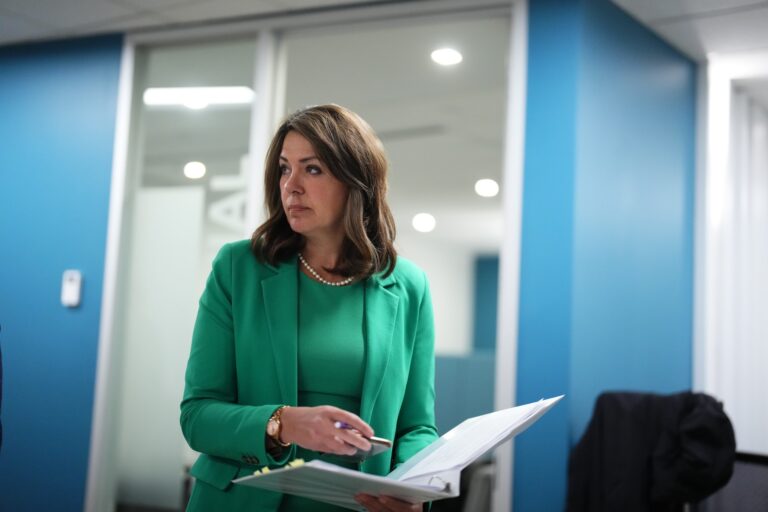
Alberta Premier Danielle Smith at the Canada Strong and Free Network event in Ottawa on April 12, 2024. Photo: The Canadian Press/Spencer Colby
OTTAWA — The second full day of the Canada Strong and Free conservative conference struggled with a question that will likely dog the Conservative Party if Pierre Poilievre leads it to power in the next federal election: how can Canada own a green economic transition that—according to some among them—isn’t happening, or if it is, shouldn’t be?
Different camps: Some attendees at Ottawa’s Westin Hotel sported buttons with red circles and slashes over the words “Net Zero”; a panel on Thursday was built around two members of the American Friends of the GWPF, which criticizes the costs of policies meant to avert climate change.
The conference’s sponsors include groups like the Canadian Association of Petroleum Producers, the Modern Miracle Network (the miracles are from oil and gas) and Canadians for Affordable Energy.
Yet the sponsors also include green energy company Invenergy and Ontario nuclear-plant operator Bruce Power, where the province is planning a massive expansion to meet electrification goals.
Related Articles

Boris vs. Danielle: Former U.K. prime minister Boris Johnson kicked off the conference Wednesday evening with an argument that aggressive policy to fight climate change is, at worst, harmless. Alberta Premier Danielle Smith began Friday by arguing it isn’t.
“I think it was $1.6 trillion that was estimated to implement the Guilbeault vision of, ‘Everything is going to be on the power grid,’” Smith said, before shifting to talk about all the important uses for petrochemicals other than energy, such as lubricants and asphalt. We should aim for no emissions, but not no oil, she said.
All governments, or just this one? Participants in a Friday-morning panel called “Creating Canada’s Next Industrial Revolution” agreed the Liberals are doing a bad job of it.
“In the last decade, the government’s answer to economic opportunity [for] Canada has been government. It’s not opportunity anymore. It’s not negotiating free trade deals. It’s not opening up new markets,” said panellist Andrea van Vugt, a former trade specialist and political aide in the last Conservative government, now a lobbyist.
The government should invest in industry, said Brian Kingston of the Canadian Vehicle Manufacturers’ Association (who also worked in the last Conservative government), especially to answer the gigantic subsidies for green technologies the Biden administration introduced in the U.S. via the Inflation Reduction Act.
“We’re never going to match [that] $370 billion, nor should we, but in specific areas of the supply chain—in particular, EV assembly and battery manufacturing—if we get the critical-mineral connection right, we have the potential for massive economic growth,” he said.
Although, he said, the government is failing to get EV chargers installed to serve the anticipated need.
That, said van Vugt, is “just a perfect demonstration of how government is really, really bad at trying to accomplish these things.”



Loading...
Thanks for sharing!
You have shared 5 articles this month and reached the maximum amount of shares available.
CloseThis account has reached its share limit.
If you would like to purchase a sharing license please contact The Logic support at [email protected].
CloseGift the full article!
You have gifted 0 article(s) this month and have 5 remaining.
Recipients will be able to read the full text of the article after submitting their email address. They will not have access to other articles or subscriber benefits.
Photo: The Canadian Press/Spencer Colby
Most Popular This Week




In-depth, agenda-setting reporting
Great journalism delivered straight to your inbox.
The Big Read
Alberta’s referendum is just the start of the turmoil
Briefing
EverWind plans $10B data centre and wind development in Nova Scotia
Canada ready to force Stelco to sell its Canadian operations, Joly says
Feds plan a 60 MW defence-oriented data centre for Ottawa
Best business newsletter in Canada
Get up to speed in minutes with insights and analysis on the most important stories of the day, every weekday.
Exclusive events
See the bigger picture with reporters and industry experts in subscriber-exclusive events.
Membership in The Logic Council
Membership provides access to our popular Slack channel, participation in subscriber surveys and invitations to exclusive events with our journalists and special guests.






