MONTREAL — The accordionist started playing in the lobby at 7:32 a.m., and the Prosecco popped an hour later, just before dancers took to the stage to stomp to Eye of The Tiger. Treasury Board President Anita Anand’s message to the crowd gathered for the Conférence de Montréal struck a more sombre tone: Canada is drowning in bureaucracy.
Skip to content


News
‘Decades and decades’ of red tape dragging down Canadian business, says Anand
Treasury Board president among Conférence de Montréal speakers decrying onerous bureaucracy
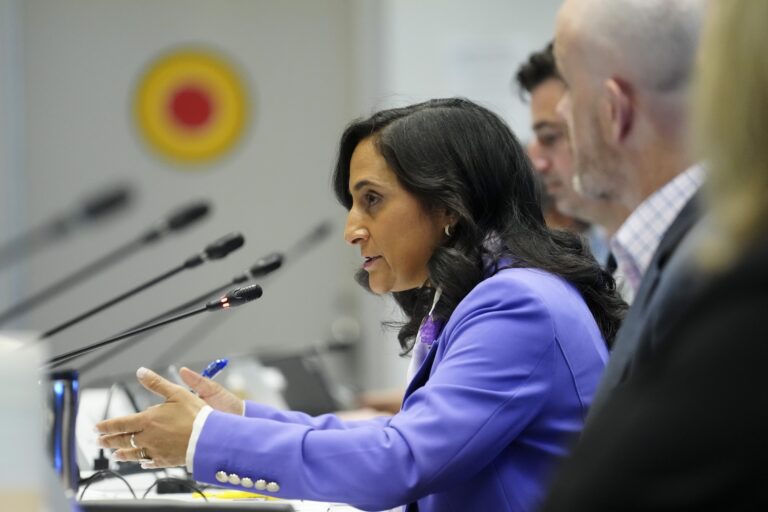
Treasury Board President Anita Anand speaks at the 30th Conférence de Montréal on June 10, 2024. Photo: IEFA/Eric Carriere/Handout
MONTREAL — The accordionist started playing in the lobby at 7:32 a.m., and the Prosecco popped an hour later, just before dancers took to the stage to stomp to Eye of The Tiger. Treasury Board President Anita Anand’s message to the crowd gathered for the Conférence de Montréal struck a more sombre tone: Canada is drowning in bureaucracy.
Talking Points
- Productivity and efficiency were the big topics at the 30th annual Conférence de Montréal, with federal Treasury Board President Anita Anand saying there is too much bureaucracy in the country
- Quebec Finance Minister Eric Girard touted the province’s workforce participation, but tut-tutted its lagging productivity compared to its neighbours
“Decades and decades of legislation and red tape” have encumbered Canadian businesses, Anand said. She pledged to help remove the stuff, both in the country and in dealings with the United States—before “barriers to trade get to the level of trade dispute.” She said the government should serve as an example to businesses big and small, and touted the importance of AI in the drive for efficiency.
In taking a hawkish stance on red tape—“regulatory modernization,” as she called it—Anand was doing more than addressing one of Conservative Leader Pierre Poilievre’s favoured lines of attack on the Liberal government. She was echoing a long-standing complaint of businesses themselves: bureaucracy is a drag on wages and productivity.
Productivity and barriers to it proved dominant themes on the first day of the conference.
Related Articles

Quebec: an example—and a laggard: The province, said Quebec Finance Minister Eric Girard, was just as surprised as everyone else at the rise and extent of inflation. It has protected the purchasing power of its citizens better than any other province, he said, and has the highest worker-participation rates for women in the country, thanks to its long-established public daycare system.
Its biggest problem, Girard said, was productivity. “If we were to summarize Quebec in two numbers, Quebec is 22 per cent of the population of Canada, but only 20 per cent of its economy. As long as we’ve had economic statistics, this gap has existed. So it cannot be attributed to one particular event.” He said the province must increase productivity by 1.5 per cent a year to catch up with the rest of the country. He also singled out public-sector employees across the country. “The public sector also has a responsibility to be more productive,” he said.
Europe, a cautionary tale: Red tape is not, of course, a Canada-only phenomenon. Jean Schmitt of Paris-based Jolt Capital, which invests in mid-cap “deeptech” companies, said overbearing regulation has stifled the sector in Europe, particularly in the field of medical devices.
“Initially you were doing your first approval in Europe because it is easy, and then you would go to the U.S. after making some money. Now, you create a medical device in Europe and you move straight to the U.S. because it’s much easier to get approval,” Schmitt said. “People are starting to figure out that all industries are in trouble.”
Jolt, which has just over US$542 million under management, announced it is opening its first headquarters outside of Europe in Montreal.



Loading...
Thanks for sharing!
You have shared 5 articles this month and reached the maximum amount of shares available.
CloseThis account has reached its share limit.
If you would like to purchase a sharing license please contact The Logic support at [email protected].
CloseGift the full article!
You have gifted 0 article(s) this month and have 5 remaining.
Recipients will be able to read the full text of the article after submitting their email address. They will not have access to other articles or subscriber benefits.
Photo: IEFA/Eric Carriere/Handout
Most Popular This Week




In-depth, agenda-setting reporting
Great journalism delivered straight to your inbox.
News
Tech firms want AI models to create better versions of themselves
Briefing
Lightspeed cuts 250 jobs through layoffs and attrition
Oil tycoon Adam Waterous aims to build new Canadian energy player with US$1B fund
Data centre infrastructure firms 3C and Datalec merge, plan Calgary expansion
Best business newsletter in Canada
Get up to speed in minutes with insights and analysis on the most important stories of the day, every weekday.
Exclusive events
See the bigger picture with reporters and industry experts in subscriber-exclusive events.
Membership in The Logic Council
Membership provides access to our popular Slack channel, participation in subscriber surveys and invitations to exclusive events with our journalists and special guests.