The Canada Pension Plan Investment Board is leading the country’s institutional investors in billions of dollars in losses from U.S.-listed China stocks, as Beijing’s regulatory crackdown prolongs a sweeping selloff.
Skip to content


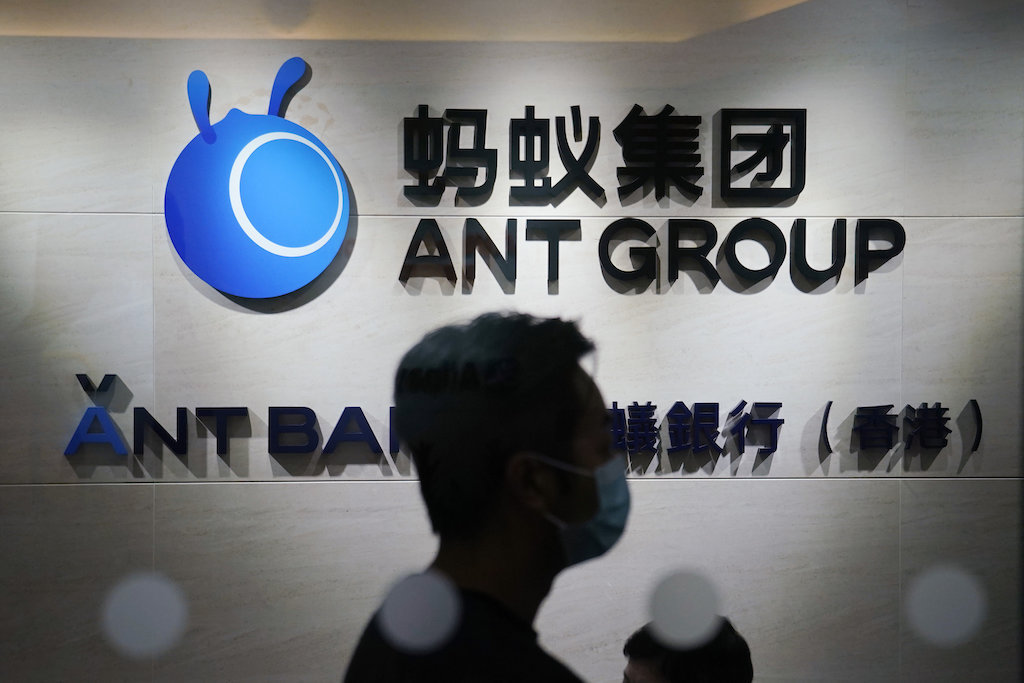 In this Friday, Oct. 23, 2020, photo, an employee walks past a logo of the Ant Group at their office in Hong Kong. Late last year, the government suspended Ant Group’s IPO, one of the first of many Chinese regulatory crackdowns. Photo: (AP Photo/Kin Cheung)

News
Canada’s top institutional investors have lost nearly US$2.7B in China stock selloff
People wearing face masks walk past the offices of Chinese e-commerce firm Alibaba in Beijing, Tuesday, Aug. 10, 2021. Photo: (AP Photo/Mark Schiefelbein)
The Canada Pension Plan Investment Board is leading the country’s institutional investors in billions of dollars in losses from U.S.-listed China stocks, as Beijing’s regulatory crackdown prolongs a sweeping selloff.
Swarms of investors have pulled their money from Chinese assets in recent months, amid a string of new government regulations and fines meant to check the private sector’s unbridled growth. As a result, valuations have plummeted. In one week in July, investors lost nearly US$1 trillion from their Chinese stocks. Since mid-February, the Nasdaq Golden Dragon China Index has lost close to half its value.
Talking Point
Nine of Canada’s top institutional investors may have lost close to US$2.7 billion in combined value from their U.S.-listed Chinese stocks since June 30, an analysis by The Logic shows. Many Canadian money managers have been increasing their exposure to the Chinese market in recent years. Some of those assets are now taking a hit, as Beijing’s sweeping regulatory crackdown against private-sector companies has prolonged a stock selloff and depressed valuations.
A portfolio analysis of nine of Canada’s largest institutional investors shows that their U.S.-listed Chinese stocks collectively lost US$2.65 billion between June 30 and Sept. 24, provided their holdings have stayed the same since they were last disclosed to the Securities and Exchange Commission. None of the investors answered whether they had bought or sold shares of the stocks in question since the quarter ended June 30.
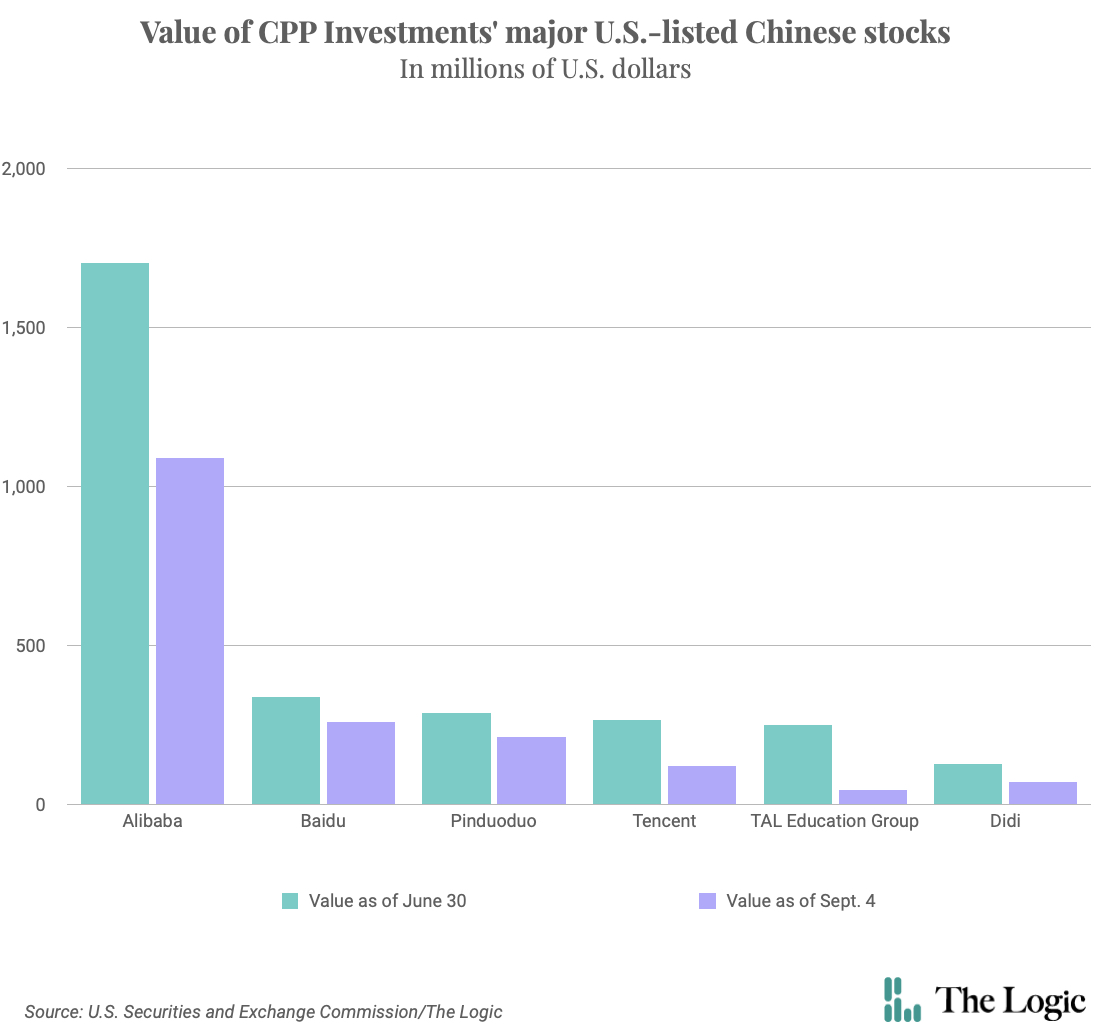
CPP Investments had the largest portfolio of Chinese stocks at the end of June, with its holdings of the top 100 U.S.-listed Chinese companies worth over US$5.2 billion. When markets closed on Sept. 24, those shares had dropped 34.3 per cent to US$3.42 billion.
The Healthcare of Ontario Pension Plan held about US$1.28 billion in the top U.S.-listed Chinese stocks as of June 30. That portfolio dipped to about US$856 million at Friday’s close. The Caisse de dépôt et placement du Québec and the British Columbia Investment Management Corporation reported holding nearly US$480 million and US$263 million million in Chinese stocks, respectively, on June 30; the value of those holdings had fallen to US$316 million and US$176 million by the end of last week.
The crackdown driving the losses has focused largely on data-privacy concerns and monopolistic practices. Late last year, China’s government suspended Ant Group’s IPO and launched an investigation into Alibaba, the fintech giant’s parent company, over alleged antitrust violation. In February, China’s State Administration for Market Regulation unveiled anti-monopoly regulations for internet companies. Two months later, the regulator fined tech conglomerate Tencent, ride-hailing firm Didi and retailer Suning.com, among others, for violating the rules.
The government is showing no sign of easing up on restrictions, with plans to introduce new IPO rules banning companies with large amounts of sensitive consumer data from going public in the U.S., and prohibiting companies from using algorithms that “encourage addiction or high consumption.”
The rules have triggered a broad contraction in publicly traded Chinese companies, as investors consider the regulatory uncertainty now hovering over the market.
Internet companies and those in private education have been hit especially hard. Shares of e-commerce giant Alibaba—which Beijing fined a record US$2.75 billion in April for antitrust violations—dropped from US$226.78 a share to US$145.08 between June 30 and Sept. 24. That translates to a loss of nearly US$614 million for CPP Investments, based on the number of Alibaba shares it held on June 30. The fund also lost more than US$200 million from its TAL Education holdings after the stock shed 82 per cent of its value in the same period.
CPP Investments’ losses reflect the pension fund’s growing exposure to the Asian market. “Since 2008, when we established a local Hong Kong office, Asia has been a key investment market for CPPIB,” said Suyi Kim, its Asia Pacific head, in a 2018 statement. The fund reported that 24 per cent of its total portfolio was invested in Asia in fiscal 2021, up from 20.4 per cent in 2018. That growth is spread across its holdings in both private and public companies. The fund’s private equity portfolio now holds $12.4 billion in assets based in Greater China, up from $8 billion a year earlier, and active equities in Asia, which includes publicly traded firms, grew from $20.3 billion to $25.2 billion between fiscal 2020 and 2021.
Those assets have garnered generous returns in recent years. The fund manager reported that its Fundamental Equities Asia portfolio “delivered another year of outperformance relative to broad equity markets and was the top contributor to [active equities’] result in fiscal 2021 with net income of $1.2 billion.”
HOOPP CEO (then-chief investment officer) Jeff Wendling also noted in 2018 plans to grow the fund’s Asian asset portfolio, and the firm reported a 29.5 per cent growth in returns from its holdings in the MSCI China index in 2020.
BCI is the only investor that addressed The Logic’s questions, though it declined to comment on specific holdings in its public-equities portfolio. “The Chinese market presents unique opportunities given the size, market depth, and growth outlook,” said BCI spokesperson Ben O’Hara-Byrne. “Given the complexity and unique dynamics of the Chinese market, strategic investment partners with strong local knowledge and market expertise will continue to play an important role in BCI’s investment strategy in the country.”
Winston Ma, an investor and adjunct professor of law at New York University who focuses on the global digital economy, said Canada’s investors should reevaluate their strategies in China, particularly regarding firms that operate primarily online. “The Chinese government’s recent internet regulations reflect a major shift in its industry policies,” he told The Logic. “It’s not a question about the exposure, but a question about what’s the right exposure going forward.”
Some investors, meanwhile, are viewing the selloff as a buying opportunity. Mohit Bajaj, director of ETF trading at advisory firm WallachBeth Capital, urged caution with that approach. “We don’t know what’s going to happen next week or a month down the road,” he said. “It really depends on your time horizon. If you’re a long-term investor, then if something’s trading at a discount, it might be beneficial to you. But if you’re not, you can get potentially hurt with the movement in the market.”
Indeed, star investor Cathie Wood of Ark Investment Management has been selling shares in Chinese companies amid plummeting valuations. But the fund hasn’t adjusted its five-year price outlook for the market, noting that the regulatory changes have, “for the most part,” not affected the business fundamentals of the companies whose stocks are currently taking a hit.
The drop in the Canadian funds’ public-equities portfolios don’t reflect additional gains or losses they may have incurred in privately owned Chinese assets. Those investments may be more insulated from the government crackdown, as some of the market reaction has stemmed from new rules for public listings. “Still, anything that is government related, there’s always going to be some kind of scrutiny,” said Bajaj, “so it may not matter whether it’s private or public.”



Loading...
Thanks for sharing!
You have shared 5 articles this month and reached the maximum amount of shares available.
CloseThis account has reached its share limit.
If you would like to purchase a sharing license please contact The Logic support at [email protected].
CloseGift the full article!
You have gifted 0 article(s) this month and have 5 remaining.
Recipients will be able to read the full text of the article after submitting their email address. They will not have access to other articles or subscriber benefits.
Photo: (AP Photo/Mark Schiefelbein)
In this Friday, Oct. 23, 2020, photo, an employee walks past a logo of the Ant Group at their office in Hong Kong. Late last year, the government suspended Ant Group’s IPO, one of the first of many Chinese regulatory crackdowns.
Most Popular This Week




In-depth, agenda-setting reporting
Great journalism delivered straight to your inbox.
Commentary
Carmichael: Being boxed in will help Canada focus on what matters
Briefing
Rio Tinto gets nearly $165M in additional federal funds for Quebec aluminum
U.S. to lift tariffs on some Canadian products crucial to Maine: Collins
Carney warns of tech dependence after Starlink disruptions in Ukraine
Best business newsletter in Canada
Get up to speed in minutes with insights and analysis on the most important stories of the day, every weekday.
Exclusive events
See the bigger picture with reporters and industry experts in subscriber-exclusive events.
Membership in The Logic Council
Membership provides access to our popular Slack channel, participation in subscriber surveys and invitations to exclusive events with our journalists and special guests.






