OTTAWA — Tech companies have begun to tap the brakes on a fast-track program to bring in foreign workers to fill in-demand roles, amid layoffs and hiring pauses across the sector. Startups and multinationals alike slowed their recruitment under the Global Talent Stream (GTS), although visual-effects and IT consulting firms continued to enlist new staff. Here’s what you need to know.
Skip to content


News
Canada’s fast-track program for skilled foreign workers slowed as tech tumbled
Global Talent Stream use drops in first quarter following record year
An Amazon office in Toronto in June 2019. Photo: Dinendra Haria/SOPA Images/LightRocket via Getty Images
OTTAWA — Tech companies have begun to tap the brakes on a fast-track program to bring in foreign workers to fill in-demand roles, amid layoffs and hiring pauses across the sector. Startups and multinationals alike slowed their recruitment under the Global Talent Stream (GTS), although visual-effects and IT consulting firms continued to enlist new staff. Here’s what you need to know.
The program: Employers can use the GTS to fill positions-of-need in fields like digital-media design, engineering and programming, or to bring in experienced specialists. Ottawa promises to process work permits for foreign candidates for those roles in two weeks. Firms using the program must typically commit to hiring or training Canadians and permanent residents.
Talking Points
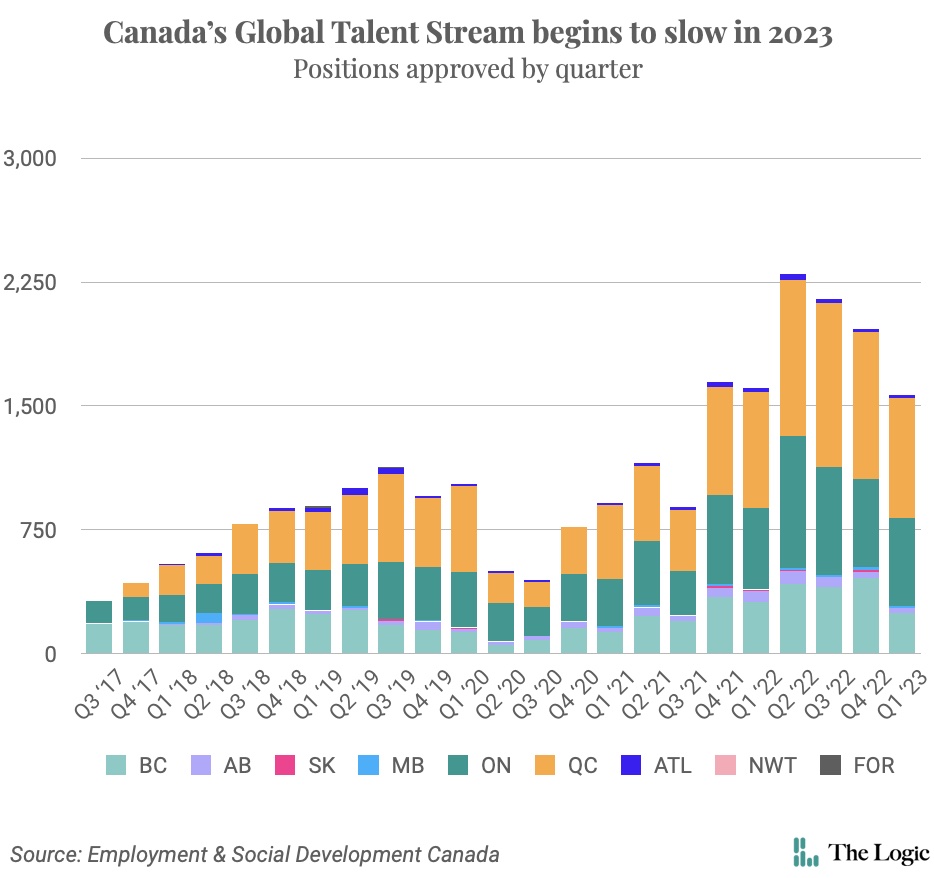
- Employers received approval to fill 1,564 positions with skilled foreign workers via the Global Talent Stream in the first quarter of 2023
- Use of the fast-track program for in-demand roles was down on an annual basis, the first drop in two years amid layoffs and hiring freezes in the tech sector
The federal government launched the GTS in June 2017 under the Temporary Foreign Worker program, after tech firms complained they were losing in-demand talent due to long immigration wait times.
The numbers: Between January and March, employers received approval to fill 1,564 positions via the GTS, according to The Logic’s ongoing analysis of data from Employment and Social Development Canada. That’s down 2.8 per cent from the same quarter in 2022, the first contraction in two years following significant growth during the late-pandemic tech funding and hiring booms.
The slack start to the year follows a record one in 2022, when firms got permission to fill 8,026 roles under the program. Other temporary foreign worker pathways have not seen the same kind of slowdown as the tech-focused GTS: approvals under the trades-heavy high-wage stream increased by a third year over year for the first quarter, while those for the low-wage stream more than doubled. Still, GTS use remains well above pre-pandemic levels.
The talent market: After raising a $225-million Series D round in June 2021, Montreal-headquartered AlayaCare spent the rest of that year and the start of the next in scale-up mode. “We just couldn’t keep up with our growth,” recalled Manuela Paoletta, senior vice-president of people and culture, in an interview with The Logic.
Related Articles


The company brought on some 200 staff during that period, but couldn’t always find developers domestically to work on its software for home-care providers. The GTS “helped us to find that great talent quickly,” said Paoletta. Some new hires also helped bring in others; the firm had particular success recruiting from Cuba.
But AlayaCare made its last hire using the program about a year ago. In August 2022, the firm laid off 14 per cent of its workforce, citing lower-than-expected growth. While its “once-vigorous plans” to staff up are on hold, the company continues to recruit both locally and internationally “at a much slower pace,” said Paoletta. It now has a staff of about 590.
Where prospective workers are located, however, will be one major consideration in the future. AlayaCare hired its share of remote workers during the pandemic, but the firm now wants employees at its hubs—in Montreal, Toronto and Vancouver—at least once a week. “We’re looking at the local talent first now, so they can be in the office,” said Paoletta.
The big names: The GTS is top-heavy, with the 20 most frequent users accounting for more than a third of the 24,513 positions approved between June 2017 and March 2023.
Some of the first-quarter slowdown came from major participants seeking to fill fewer roles via the program. Subsidiaries of second-place Amazon received approval for 62 positions in the year’s first three months of the year, after being greenlit for 653 across 2022. The tech giant announced plans to lay off 27,000 workers between November 2022 and April 2023 after freezing hiring.
Amazon did not directly answer questions about how many Canadian staff were affected by the cuts, but the firm has over 8,000 corporate employees in Toronto and Vancouver, according to spokesperson Kristin Gable. It uses the GTS and other programs for “certain high-skilled corporate and technology roles in Canada, although the majority of local roles have been filled by domestic candidates,” she said.
Other large companies kept up their GTS pace in the first quarter. Consulting firms Alithya, CGI, Cofomo Développement, Groupe Technologies Desjardins and Levio Conseils each received approval to fill dozens of roles via the program. So did game maker Ubisoft and visual-effects studio Double Negative.
The next step: Despite the program’s two-week promise, companies using the GTS reported delays in work-permit processing through last year. In June, the federal government announced it was once again meeting its service standard.
Ottawa is also opening up new pathways. Then-immigration minister Sean Fraser unveiled a Tech Talent Attraction Strategy, including an open work permit for holders of the U.S. H-1B visas favoured by Silicon Valley workers; the program hit its cap of 10,000 applications in two days. Ottawa is also considering a new stream with fewer requirements for high-growth firms or in-demand professionals.



Loading...
Thanks for sharing!
You have shared 5 articles this month and reached the maximum amount of shares available.
CloseThis account has reached its share limit.
If you would like to purchase a sharing license please contact The Logic support at [email protected].
CloseGift the full article!
You have gifted 0 article(s) this month and have 5 remaining.
Recipients will be able to read the full text of the article after submitting their email address. They will not have access to other articles or subscriber benefits.
Photo: Dinendra Haria/SOPA Images/LightRocket via Getty Images
Most Popular This Week




In-depth, agenda-setting reporting
Great journalism delivered straight to your inbox.
Commentary
Carmichael: Being boxed in will help Canada focus on what matters
Briefing
Rio Tinto gets nearly $165M in additional federal funds for Quebec aluminum
U.S. to lift tariffs on some Canadian products crucial to Maine: Collins
Carney warns of tech dependence after Starlink disruptions in Ukraine
Best business newsletter in Canada
Get up to speed in minutes with insights and analysis on the most important stories of the day, every weekday.
Exclusive events
See the bigger picture with reporters and industry experts in subscriber-exclusive events.
Membership in The Logic Council
Membership provides access to our popular Slack channel, participation in subscriber surveys and invitations to exclusive events with our journalists and special guests.






