OTTAWA — More than two years after the federal government published a plan for a comprehensive assessment of the country’s infrastructure—to give the government a better idea where to put the billions of dollars the government spends on it each year—the Liberals are still months away from naming anybody to do it.
Skip to content
News
Canada still flying blind on its infrastructure two years after feds promised full survey
After rush of action in 2021, effort went silent
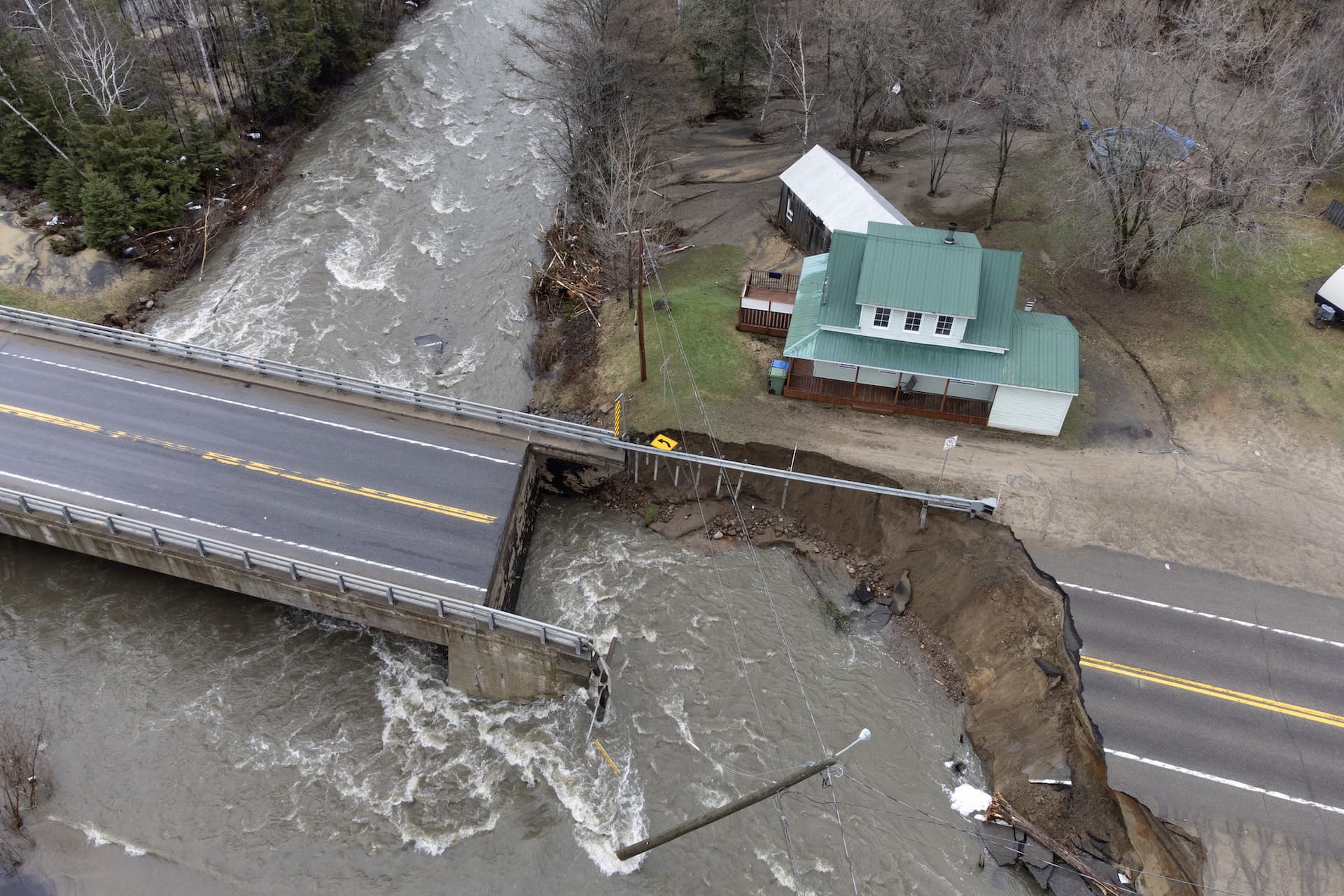
A road washed out by severe spring flooding in Baie Saint-Paul, Que. Photo: The Canadian Press/Jacques Boissinot
OTTAWA — More than two years after the federal government published a plan for a comprehensive assessment of the country’s infrastructure—to give the government a better idea where to put the billions of dollars the government spends on it each year—the Liberals are still months away from naming anybody to do it.
The government funds roads and bridges, transit systems and child-care centres, broadband wires and water-treatment plants, EV chargers and the electricity systems that feed them. Yet it doesn’t have a central list of what Canada has or what needs doing, let alone what’s urgent. Much of what the federal government helps pay for belongs to provincial, territorial or municipal governments; Indigenous authorities; semi-independent institutions like hospitals or universities; or even the private sector.
The national infrastructure assessment is meant to help the government make better decisions on what needs to be maintained, upgraded, replaced or built anew to avert and adapt to climate change, keep the economy rolling and address inequities.
Talking Points
- The federal Liberals began urgent work on a comprehensive assessment of the nation’s roads, pipes, buildings, telecom systems and key natural features in 2021, but have done nothing visible on the file since
- The government spends tens of billions of dollars a year on infrastructure with no master plan or priorities
“We will not achieve our infrastructure ambition by accident,” Catherine McKenna, then the infrastructure minister, wrote in starting a consultation on how to do the assessment, in March 2021. The government was—and is now—in the midst of a 12-year plan to spend over $180 billion on infrastructure, she wrote, and should have a smart scheme for what to use the money on that looks as far ahead as 2050.
Provinces, municipalities and private companies own and operate most of Canada’s infrastructure, so just getting a handle on what the country has is a priority en route to determining what needs doing, who should do it and how it should be funded.
Related Articles

Between March and June 2021, the government organized 12 roundtable discussions with more than 150 organizations and accepted more than 300 written submissions, it said in a report on what it heard.
The report summarized the feedback: The assessment should be done by an independent advisory body or commission. It should produce a roadmap of priority projects, emphasizing investments that reduce greenhouse-gas emissions, harden Canada against the dangers of climate change and redress historical underinvestment. And the government should fund the plans consistently.
“We are planning to establish that advisory body in the coming months, in keeping with recommendations during the public engagement that highlighted the importance of an evidence-based and transparent process,” a spokesperson for Infrastructure Minister Sean Fraser, Micaal Ahmed, told The Logic in an email.
Amid the construction companies, municipal governments, engineering groups and power utilities that participated in the 2021 conversations were blue-chip investors like the Ontario Municipal Employees Retirement System (OMERS), technology providers like BlackBerry and forward-looking activist groups like Quantum-Safe Canada.
Another participant was the Intact Centre on Climate Adaptation at the University of Waterloo, through its managing director for climate-resilient infrastructure, Joanna Eyquem.
Eyquem told The Logic she was happy to see natural infrastructure—like wetlands that absorb stormwater and urban forests that help with extreme heat—included in the consultation report as something for the assessment to consider, and not just “grey” infrastructure built by humans.
“I feel like with infrastructure, we haven’t got a complete understanding of what the risks are.”
But she also said she urged the government to complete the assessment before coming out with its adaptation strategy for climate change. The government released the strategy last June, with a whole infrastructure section.
“We don’t know the baseline case of climate resilience [and] climate vulnerabilities of our infrastructure,” Eyquem said.
This sequence rankles her as a geographer to whom specific places matter. Like the low-lying Chignecto Isthmus that connects New Brunswick and Nova Scotia, which is in the middle of a jurisdictional standoff over who should pay for flood protection.
“You identify your risks, then you analyze them, evaluate them, and then you treat them,” Eyquem said. “Whereas I feel like with infrastructure, we haven’t got a complete understanding of what the risks are.”
A national assessment would also establish national priorities, she said. As it is, the federal government mostly puts up money and invites applications for it.
“Certain small rural municipalities, for example, may have significant risks,” Eyquem said. “But those same municipalities may not have the staff or the time or the resources to actually put the applications together in the first place. “
McKenna left politics with the 2021 election; in the new infrastructure minister’s mandate letter that December, Prime Minister Justin Trudeau told Dominic LeBlanc to launch the assessment.
The department’s official plan for 2022–23 (the federal fiscal year ends in March) put the assessment at the top of its to-do list, saying it would try to launch the assessment that year and aim to have it complete by 2024–25.
Infrastructure Canada’s look back at the same year said nothing about the assessment.
The department’s plan for 2023–24 said it intended to “advance work” on it. Trudeau shuffled LeBlanc out of his post last summer, replacing him with Fraser.
“Since completing public engagement with stakeholders—and launching our engagement paper on the country’s first such assessment in July 2021—we have been doing preparatory work to establish an advisory body to develop the assessment,” Ahmed’s email said. “This has included research on best practices and lessons learned from other jurisdictions that have completed NIAs, such as the United Kingdom, New Zealand and Australia.”
New Zealand’s infrastructure commission was formed in 2019 and began publishing research that year, including a quarterly report on the country’s “pipeline” of infrastructure projects and studies on the rising costs of permits and approvals and how efficiently New Zealand spends infrastructure money.
Not very efficiently at all, that last study found—New Zealand is near the bottom among 50 high-income countries. It performs worse than Canada, though both are below the median.
Regardless, a hefty amount of that research was done a while ago. In August 2021, the government commissioned a think tank at the University of Ottawa to look at other countries’ infrastructure assessments and propose a Canadian approach. Its 409-page report landed in October 2022.
Climate change, inequality, picking up pieces after COVID-19, poor productivity, declining competitiveness and an inability to draw top firms and talent all demand better “decision support,” the Institute for Fiscal Studies and Democracy said, echoing McKenna in saying that building a better country won’t happen by accident.
With infrastructure in particular, politicians tend to think in election cycles of three to four years, and maybe five-year budget forecasts, it said. A building, bridge, dam or communication network can take longer than that to plan and build, and last 30 years or more.
That means “current incentive structures do not naturally support longer-term, outcome-driven decision-making that maximizes public value over multi-decade periods,” the report said.



Loading...
Thanks for sharing!
You have shared 5 articles this month and reached the maximum amount of shares available.
CloseThis account has reached its share limit.
If you would like to purchase a sharing license please contact The Logic support at [email protected].
CloseGift the full article!
You have gifted 0 article(s) this month and have 5 remaining.
Recipients will be able to read the full text of the article after submitting their email address. They will not have access to other articles or subscriber benefits.
Photo: The Canadian Press/Jacques Boissinot
Most Popular This Week




In-depth, agenda-setting reporting
Great journalism delivered straight to your inbox.
Commentary
Carmichael: Being boxed in will help Canada focus on what matters
Briefing
Rio Tinto gets nearly $165M in additional federal funds for Quebec aluminum
U.S. to lift tariffs on some Canadian products crucial to Maine: Collins
Carney warns of tech dependence after Starlink disruptions in Ukraine
Best business newsletter in Canada
Get up to speed in minutes with insights and analysis on the most important stories of the day, every weekday.
Exclusive events
See the bigger picture with reporters and industry experts in subscriber-exclusive events.
Membership in The Logic Council
Membership provides access to our popular Slack channel, participation in subscriber surveys and invitations to exclusive events with our journalists and special guests.






