OTTAWA — As money begins pouring into projects to cut greenhouse-gas emissions, far less is being spent to help us get ready for climate change’s unavoidable effects.
“People find it more sexy to talk about mitigation,” said Peter van Dijk, the North America director of climate risk at the global sustainability consulting firm Anthesis. “The idea is if we invest in that, then we can probably protect ourselves.… We can definitely mitigate the impact, but we have already exceeded some of the tipping points, and they’re kind of irreversible.”
In climate policy, “mitigation” means heading off climate change, mainly by reducing emissions. It means efficiencies, cleaner technologies, electric power. “Adaptation” is getting ready for the consequences of climate change we don’t mitigate.
Talking Point
Cutting greenhouse-gas emissions has become a popular cause in both industry and finance, but preparing for the effects of climate change that we can’t or won’t avert is a tougher task and Canada has a lot more to do.
Adaptation includes preparing for heavier rains, more wildfires and the wearing effects of more extreme temperatures. The Paris Agreement on climate change aims to limit global warming to less than 2 C, so even if humanity makes it, we’ll still have warmer temperatures to adjust to.
The Canada Infrastructure Bank, the government agency meant to mobilize private capital for public purposes—and especially for “climate action”—doesn’t really do adaptation.
“The CIB’s mandate is to invest in new infrastructure projects that benefit Canadians, alongside with private and institutional partners. To be clear, we do not have a mandate to rebuild or upgrade existing infrastructure,” spokesperson Félix Corriveau told The Logic.
RBC, which has very publicly committed to investing $500 billion in sustainability projects (things like renewable energy, clean transportation and affordable housing) by 2025, was unable to find anyone to talk about adaptation.
But the Federation of Canadian Municipalities estimated in 2019 that its members—who own a lot of the sewers, drainage ditches, roads, transit systems and buildings that need to be adapted—needed $5.3 billion a year for climate adaptation. An analysis last fall by Ontario’s government budget watchdog found a best-case scenario, in which greenhouse-gas emissions are cut sharply and the province works efficiently, adapting provincial public buildings will cost an extra $33 billion by 2100. In a more middle-of-the-road scenario, it’s $52 billion.
Van Dijk is a former senior vice-president of taxation at TD Bank, a veteran of multiple business-consulting firms and a senior fellow at the business-minded C.D. Howe Institute. His Dutch-accented voice boomed over the phone as his energy, somewhere between enthusiasm and exasperation, rose. He said the biggest problem is that so many assets are assumed to be worth more than they actually are.
“Climate risk is not reflected in stock markets,” he said. “People say, ‘Oh, have they actually included the impact of climate into stock?’ The answer is no, people don’t; they’re not even focused on it. Lots of risk managers are just starting to think about it.”
He pointed to the latest report from the UN’s Intergovernmental Panel on Climate Change, which devoted a chapter to adaptation. If we don’t make adaptation moves, it said, we’re in for more deadly heat waves, disease, mental health stresses and flooding.
“Costs for maintenance and reconstruction of urban infrastructure, including building, transportation and energy will increase with global warming level,” it said (albeit with just “medium confidence” on that point). “The associated functional disruptions are projected to be substantial particularly for cities, settlements and infrastructure located on permafrost in cold regions and on coasts.”
Humanity is working on it, but so far most of what we’ve managed is “fragmented, small in scale, incremental, sector-specific, designed to respond to current impacts or near-term risks, and focused more on planning rather than implementation.”
And a big part of the problem is paying for it all: “Enhanced mobilization and access to financial resources are essential for implementation of adaptation and to reduce adaptation caps,” the IPCC said.
There’s a deepening understanding the problem exists, but not of what to do about it, said Blair Feltmate, head of the Intact Centre on Climate Adaptation at the University of Waterloo, and a former vice-president of sustainable development at BMO.
“We’re in the embryonic stages,” he said.
Feltmate’s centre is funded by Intact Insurance, which has made averting climate-change damage (which leads to insurance claims) a corporate priority.
To draw private money into adaptation projects, they have to produce revenues of some kind, Feltmate said, and at the moment, we don’t even have agreed standards for valuing either risk or the things that help avert it.
Provinces and municipalities have various rules against building on wetlands, for instance, which can absorb water and reduce flooding, but the effect of designating property as wetland is to crash its value.
“When there is no value attached to natural infrastructure as an asset, it gets passed over,” Feltmate said.
“Right now, the public-sector accounting rules don’t allow for even valuing your natural assets. So nobody takes it into account, they think it’s a free asset,” van Dijk agreed.
Various efforts are trying to quantify climate risk to real estate, but even attempts just to complete flood mapping (on which Feltmate said Canada is second to no other country) run into concerns about what accurate information can mean for property values.
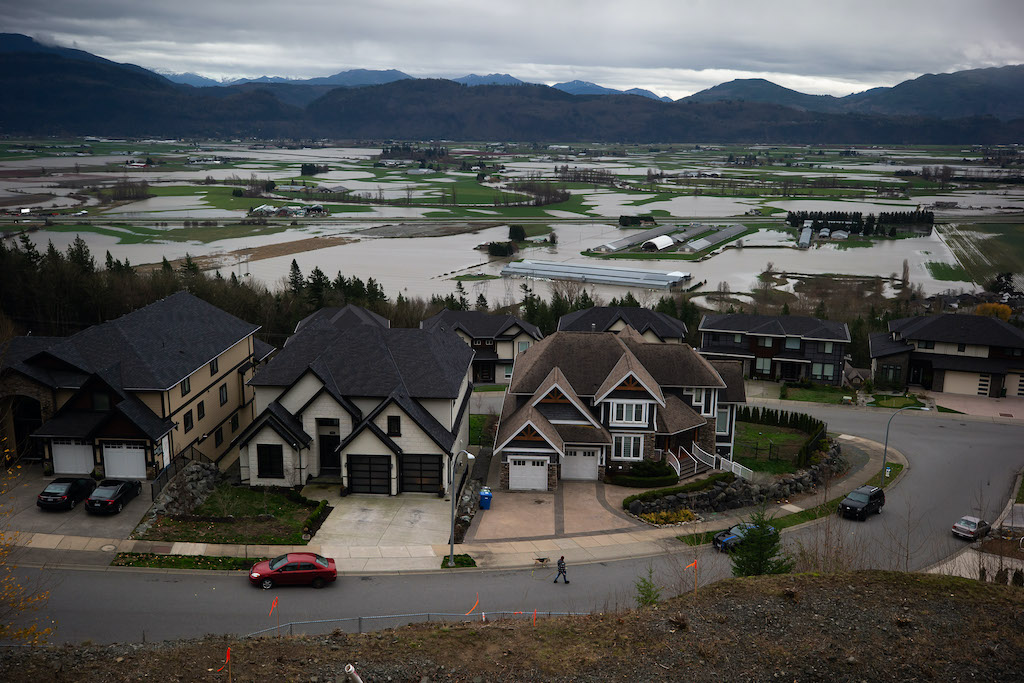
The Intact Centre is seeking to lay some of the groundwork. A recent project drew on real estate records to put numbers on the effects of a recent flood on a community’s property values. Comparing similar neighbourhoods, Feltmate said, it found a flood depressed prices by 8.2 per cent, reduced listings by 44.3 per cent and meant properties stayed unsold 19.8 per cent longer.
“This is not modelling, this is not theory, this is not scenario planning,” Feltmate said. “This is observed fact.”
The research found no increase in mortgage arrears, suggesting that broader economic damage wasn’t a big factor—just that properties that had flooded were markedly less desirable. Properties at risk of flooding ought to be the same, Feltmate said, and that ought to provoke public support for projects that protect them.
“When you see the sandbags spring out in communities en masse, that means nobody was prepared,” he said.
This can motivate people to do things like install backflow valves to keep overflowing sewers from filling their basements, sometimes with government subsidies. It’s not enough, said van Dijk.
“It’s sort of fun that the government gives you $5,000 if you take certain measures, but it is all individuals—everybody’s got to file for that,” he said. Effective adaptation measures are big and expensive and need to be done at scale, he said.
Canada is working on a national adaptation strategy, due by the end of this year. Mobilizing serious capital will take demonstrable increases in value that can be turned into profitable securities. Part of that is setting rules that “internalize externalities,” van Dijk said, such as with carbon taxes and cap-and-trade systems for emissions, and applying costs to moves that lessen communities’ resilience and rewards for those that improve it.
“You need some accounting rules. Yeah, it’s complicated. But, you know, we’ve learned double-entry bookkeeping. In business, we build whole capital markets around it,” van Dijk said. “Transparency, disclosure—that’s why that’s so important. Shine a big light on it, and people start understanding it.”
When it comes to paying for the adaptation projects that remain, charities and non-profits with different motivations than money can be part of the picture (like the way the Nature Conservancy of Canada accumulates land for environmental protection), and governments can fill gaps, he said. They’re insurers of last resort; armed with estimates of the costs of climate damage, they could budget for heading it off, instead.
“We all recognize this is a worthwhile thing to do,” Feltmate said. “Now how do we do it?”