Skip to content


News
Why the surge in Canada’s overseas aluminum exports will be hard to sustain
As U.S. prices catch up with Trump’s tariffs, multinationals with smelters in Canada are looking south once again
Alouette’s plant in Sept-Îles, Que.; some of Canada’s biggest aluminum producers also have operations in Europe. Photo: The Canadian Press/Jacques Boissinot
OTTAWA — Canada exported a higher share of its aluminum overseas this year due to steep U.S. tariffs, but a close look at the operations of multinational giants with smelters in Quebec suggests the shift is not here to stay.
“When the price is best in Europe, they ship to Europe, but normally it’s always been better in the U.S., because of logistics, because of integrated value chains and stuff like that,” said Jean Simard, president and CEO of the Aluminium Association of Canada.
Talking Points
- A greater share of Canada’s aluminum exports have headed to non-U.S. countries this year, including in Europe, as companies tried to mitigate the cost of tariffs
- Jean Simard of the Aluminium Association of Canada suggests it had more to do with waiting for the price to catch up with the tariffs than diversifying exports over the long term
Canada’s aluminum exports this year peaked at $1.4 billion in March, with 97 per cent going that month to the U.S. as firms rushed inventory across the border to get ahead of President Donald Trump’s 25 per cent national security tariffs—a rate he doubled in June. Exports then declined, averaging about $848 million per month from April to August, according to Statistics Canada.
At the same time, Canada’s non-U.S. exports of aluminum have grown, especially to countries in Europe. The Netherlands has already taken in 74 per cent more aluminum during that April-to-August period than it did all of last year. Exports to Italy have nearly doubled, and those to Poland quadrupled.
Related Articles
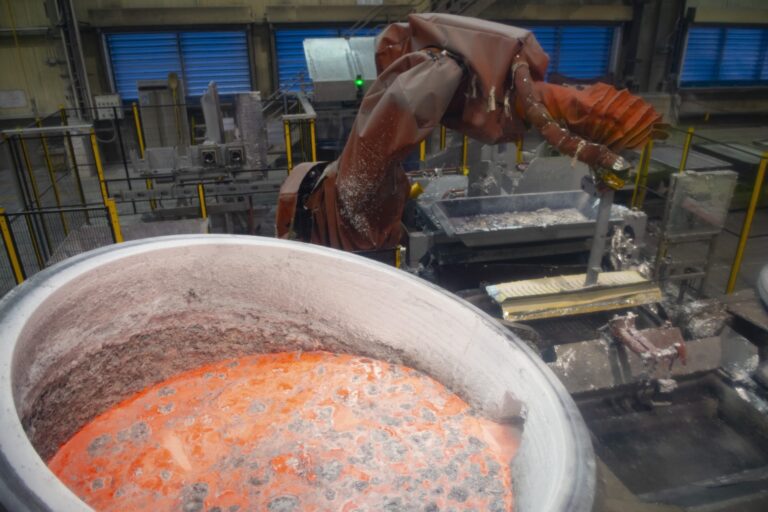
Some 83 per cent of Canada’s aluminum still went to the United States over that time, but the shift to overseas markets was a sharp break from the 94 per cent that went to the U.S. last year. A large majority of that came from Quebec, where production is concentrated due to the province’s relatively cheap hydroelectric power.
The three aluminum giants with operations in Quebec—Rio Tinto, Alcoa and Aluminerie Alouette—did not provide The Logic with data on their exports to Europe this year, although publicly available information shows it has been one of their responses to Trump’s tariffs.
Jérôme Pécresse, the CEO of the aluminum and lithium division at Rio Tinto, told La Presse in October that the British-Australian mining company had redirected some of the aluminum produced at its smelter in Saguenay, Que., to Europe. Simon Letendre, a spokesperson for Rio Tinto, told The Logic this was “to maximize the value of our products in the current commercial environment.”
Alouette, which is 40 per cent owned by Rio Tinto and operates the smelter in Sept-Îles, Que., told Bloomberg that Europe took in 57 per cent of its shipments in the second quarter of this year, compared to four per cent in the first quarter. In July, Alcoa CEO Bill Oplinger told analysts on a second-quarter earnings call that, since March, the company had sold more than 100,000 tonnes of Canadian aluminum that would have normally gone to the U.S. to clients in other countries because of the tariffs.
That might be encouraging news to the federal Liberal government as it works to reduce Canada’s economic reliance on the U.S. Yet a closer look at the reasons those shipments were diverted suggests the shift is not an opportunity for long-term growth for Canada’s industry.
The cost of buying aluminum in the U.S. is generally set by the benchmark price on the London Metal Exchange, plus a markup known as the U.S. Midwest premium. Earlier this year, the Midwest premium spiked ahead of the 25 per cent duties on aluminum, which meant the added cost was absorbed quickly. It was slower to respond to the hike to 50 per cent in June. Both Rio Tinto and Alcoa pointed to this being a factor in choosing which markets to sell their aluminum. After prices surged to record highs, driven by the 50 per cent tariffs, they have been directing shipments back to the U.S.
“While we continue to evaluate the most profitable placement of our spot volumes and direct those shipments accordingly, the Midwest premium now covers costs on the shipments to our U.S. customers on contracts supplied by our Canadian smelters,” Alcoa’s Oplinger said Oct. 22 on an earnings call.
Simard said Canada’s maritime access makes it relatively easy for producers here to divert their aluminum to take advantage of the best price. So does the fact they have operations or partners in Europe, Simard added, because they already have relationships with buyers there and can move inventory around as needed. Alcoa, for one, has smelters in Iceland and Norway, with one in Spain in the process of restarting. Rio Tinto’s smelter in Iceland is primarily supplying the European market. Alouette has no European smelters, but AMAG Austria Metall AG and Norway’s Hydro Aluminium each have a 20 per cent stake in its ownership consortium.
Combined with the fact that Canada’s aluminum smelters are already producing at capacity, Simard said shipping to Europe is unlikely to be a long-term play. “What I ship there, I take away from an existing client,” he said. “And I have to move someone away from an existing business relationship somewhere else in the world.”



Loading...
Thanks for sharing!
You have shared 5 articles this month and reached the maximum amount of shares available.
CloseThis account has reached its share limit.
If you would like to purchase a sharing license please contact The Logic support at [email protected].
CloseGift the full article!
You have gifted 0 article(s) this month and have 5 remaining.
Recipients will be able to read the full text of the article after submitting their email address. They will not have access to other articles or subscriber benefits.
Photo: The Canadian Press/Jacques Boissinot
Most Popular This Week




In-depth, agenda-setting reporting
Great journalism delivered straight to your inbox.
Commentary
Carmichael: Canadian ignorance about India is a strategic weakness
Briefing
Aritzia shares pop after earnings rise 204%
First Nation in Alberta goes to court over fast-tracked oil pipeline
Chinese EV maker Geely Auto Group to launch in Canadian market in 2027
Best business newsletter in Canada
Get up to speed in minutes with insights and analysis on the most important stories of the day, every weekday.
Exclusive events
See the bigger picture with reporters and industry experts in subscriber-exclusive events.
Membership in The Logic Council
Membership provides access to our popular Slack channel, participation in subscriber surveys and invitations to exclusive events with our journalists and special guests.





