MONTREAL — Donald Trump is far worse than a liar. So outsized and consistent are his lies that they form their own delirious reality in which we are all forced to live, to one extent or another.
Skip to content


Commentary: Quebec Ink
The hot, hard truth that’s undermining Donald Trump’s trade war
Only a few things can pierce the U.S. president’s delusion. Nine of them live in Quebec.
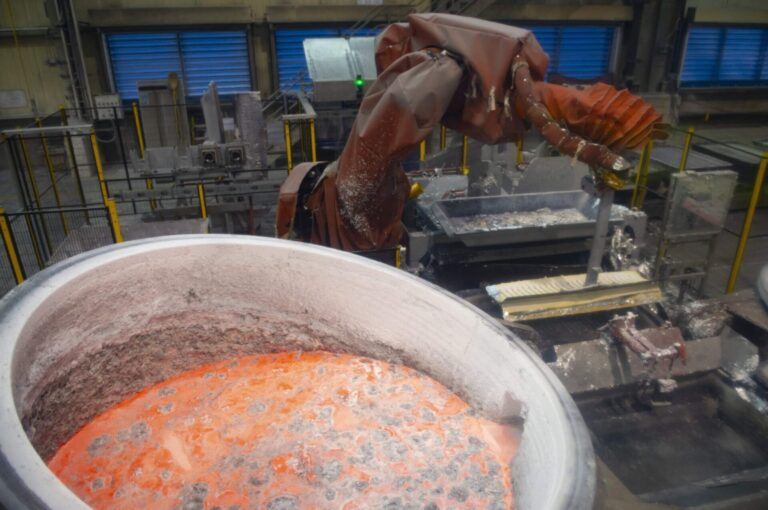
Aluminum in a smelter at the Alouette aluminum plant in Sept-Iles, Que. The province produces three million tons of the metal each year. Photo: The Canadian Press/Jacques Boissinot
MONTREAL — Donald Trump is far worse than a liar. So outsized and consistent are his lies that they form their own delirious reality in which we are all forced to live, to one extent or another.
It’s why, when the U.S. president says fentanyl is “pouring” into the U.S. from Canada, the well-being of the Canadian economy depends on officials pretending to believe him. On that note, take a much deserved bow, Kevin Brosseau, who as Canada’s first fentanyl czar is charged with stanching the practically non-existent flow of the drug across a very real border.
A few things can pierce Donald Trump’s delusion. Nine of them live in Quebec. They are aluminum smelters, and together they produce three million tons of something the U.S. cannot get as cheaply and easily anywhere else in the world. Nor, crucially, can Trump’s trade war magic into existence a similarly powerful aluminium industry stateside, mainly due to Quebec’s cheap and plentiful hydroelectric power, the not-so-secret ingredient that makes its energy-hungry smelters roar.
Quebec’s aluminium bounty, meanwhile, can easily find customers in hungry markets across Europe and beyond. Indeed, it already has. In this respect it is not nearly as beholden to American appetites as, say, crude oil. In short, Quebec’s aluminum sector constitutes one of the few realities that Trump can’t bend to suit his purposes. And wow, does the sector ever know it.
Related Articles

“The U.S. can’t replace us,” Aluminium Association of Canada president Jean Simard told me recently. “Americans are going to pay more for their aluminum, which will render their products less competitive and ultimately lead to the destruction of their own market.”
Simard’s certainty boils down to numbers, big numbers. There are 10 aluminum smelters and one refinery in Canada, which collectively pump out 3.3 million tonnes of the stuff a year. The U.S. is home to four smelters, which produced about 675,000 tonnes in 2024, despite the country needing roughly five million tonnes. That number is only going one way and is expected to increase up to 40 per cent over the next decade.
For your average Trumpist, this is a textbook argument for tariffs. By taxing the bejesus out of Canuckian metal, so the theory goes, Trump is essentially compelling companies to produce aluminum in the U.S. Again, though, reality—real reality, not the delirious kind—makes that almost impossible.
American aluminum plants are old and dirty simply because bedrock market forces haven’t allowed the industry to modernize. The newest U.S. aluminum smelter is older than Diet Coke, and the last effort to build one came via the Inflation Reduction Act and Bipartisan Infrastructure Law, with an earmark of US$500 million. This is about a tenth of the cost of an actual aluminum smelter.
That’s just to build the thing. Producing aluminum is an energy-intensive affair. Doing so profitably requires predictable, long-term energy contracts of the kind that are increasingly rare in the U.S., thanks in large part because Amazon, Meta and other Big Tech energy hogs are gobbling up large swaths of the country’s grid.
This isn’t a bad thing, per se, unless your president is trying to force the market to do something it can’t. And it really can’t: Simard’s back of the envelope calculations suggest the U.S. would need to produce an extra 40 million megawatt hours of power per year—the equivalent of about ten Hoover Dams—to make up for the aluminum Canada sends across the border every year.
Despite all this, Trump’s trade war can still hurt Canada’s aluminium industry. The current supply chain dictates that aluminium products often pass over the U.S.-Canada border several times before they are finished and sold. They used to do so freely. Now, they run a gauntlet of tariffs and counter-tariffs with every pass. The result: companies will opt for U.S.-sourced finished products instead. That spells trouble for Quebec’s aerospace industry, among others, as it does for Ontario-built automotive parts.
Still, it’s worth remembering that Trump has chickened out on Canadian aluminum, as well as steel, before—in 2019, when he dropped tariffs on both after a year of diplomatic petulance. Strangely, the U.S. president doesn’t seem to recognize that the market forces are near-identical today as they were six years ago. Unfortunately for him, Quebec’s aluminium powerhouse is hot, hard proof that some things can’t be bullied out of existence.
Martin Patriquin is The Logic’s Quebec correspondent. He joined in 2019 after 10 years as Quebec bureau chief for Maclean’s. A National Magazine Award and SABEW winner, he has written for The New York Times, The Guardian, The Walrus, Vice, BuzzFeed and The Globe and Mail, among others. He is also a panelist on CBC’s “Power & Politics.”



Loading...
Thanks for sharing!
You have shared 5 articles this month and reached the maximum amount of shares available.
CloseThis account has reached its share limit.
If you would like to purchase a sharing license please contact The Logic support at [email protected].
CloseGift the full article!
You have gifted 0 article(s) this month and have 5 remaining.
Recipients will be able to read the full text of the article after submitting their email address. They will not have access to other articles or subscriber benefits.
Photo: The Canadian Press/Jacques Boissinot
Most Popular This Week




In-depth, agenda-setting reporting
Great journalism delivered straight to your inbox.
Commentary
Carmichael: Canadian ignorance about India is a strategic weakness
Briefing
Aritzia shares pop after earnings rise 204%
First Nation in Alberta goes to court over fast-tracked oil pipeline
Chinese EV maker Geely Auto Group to launch in Canadian market in 2027
Best business newsletter in Canada
Get up to speed in minutes with insights and analysis on the most important stories of the day, every weekday.
Exclusive events
See the bigger picture with reporters and industry experts in subscriber-exclusive events.
Membership in The Logic Council
Membership provides access to our popular Slack channel, participation in subscriber surveys and invitations to exclusive events with our journalists and special guests.





