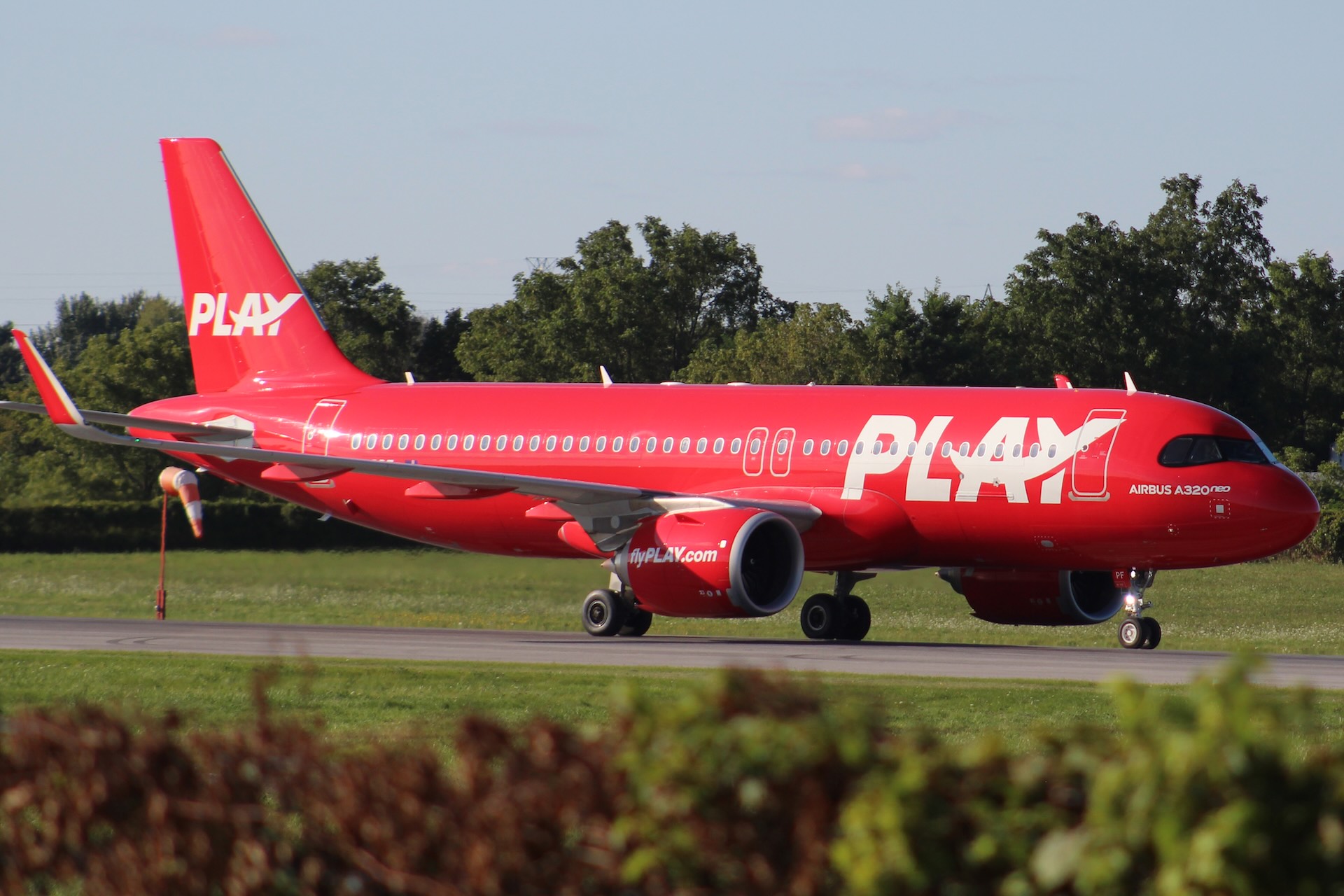
Canadians wanting a low-cost way to fly have lost another budget carrier with Play Airlines quitting the country. The Icelandic airline had operated flights between Canada and European destinations for under two years. Play spokesperson Birgir Olgeirsson said that “underwhelming results” over the summer had played their part. But it’s more complex than that.
Skip to content
News
Why Canada keeps killing budget airlines
Play Airlines just quit Canada, adding to an ever-growing graveyard of failed budget airlines
Play Airlines recently joined an ever-growing list of budget airlines that have quit Canada, including Swoop and Lynx Air. Photo: The Canadian Press/Sean Vokey
Canadians wanting a low-cost way to fly have lost another budget carrier with Play Airlines quitting the country. The Icelandic airline had operated flights between Canada and European destinations for under two years. Play spokesperson Birgir Olgeirsson said that “underwhelming results” over the summer had played their part. But it’s more complex than that.
The airline’s retreat is far from unique. At least eight other airlines have shut up shop or stopped servicing Canadian airports since the year 2000. The budget airline graveyard includes Swoop, WestJet’s ultra-low-cost carrier that was subsumed back into its parent company in October 2023, and Calgary-based Lynx, formerly known as Enerjet, which went to the wall in February 2024.
Talking Points
- Geography, high fees and the dominance of big airlines have combined to confound a number of budget airlines trying to crack the Canadian market
- Budget airlines, which operate on wafer-thin margins, struggle to make money on both international and domestic routes in Canada. There’s little sign that will change anytime soon.
Canada is a tough nut to crack for budget airlines. For one, its geographical size and comparatively small population, most of which is concentrated close to the U.S. border, make it challenging to serve for airlines. As a result, there’s a lower volume of passengers and flights compared to markets where budget airlines endure, such as the U.S.
Canada’s air sector is also very seasonal and peaks in the summer months, said John Strickland of JLS Consulting, a UK airline industry consultant, which can be tricky for airlines to balance.
The business available in those built-up areas is also fiercely contested and dominated by bigger beasts—domestically Air Canada, and elsewhere long-established names like British Airways and American Airlines. That’s as big a problem in Canada as it is around the world. Using economies of scale, those larger carriers can serve more markets and more customers. They have also figured out how to drive down prices to very similar levels to budget airlines, said Bob Mann of R.W. Mann & Company, a New York-based airline industry analyst.
Related Articles

Covid also hit Canada’s aviation industry harder than others: while the total number of flights tracked by Jefferies in the U.S. is 5 per cent lower this month than in 2019, flights in Canada remain 27 per cent lower than pre-Covid.
Still, Canadians shouldn’t grumble all that much. Canada punches above its weight in terms of how well it’s served by major carriers, Mann said. Despite its size, the U.S. doesn’t have 10 major carriers, while Canada has Air Canada and WestJet alongside smaller, more specialist carriers like Porter Airlines, operating out of Toronto, and Flair Airlines, the ultra-low-cost carrier based in Edmonton. It’s just that those big names, the biggest of which was until recently government-backed, are more dominant, so they squeeze out smaller competition.
Canada also struggles to offer an economic case for airlines beyond those that can either carve out a niche in the case of Flair, or achieve the scale of WestJet. “The cost structure that an airline faces in Canada is very different,” said Mann. “and is frankly much higher than you see in the U.S.” WestJet has previously said that these third-party fees, which include airport costs, air traffic management costs and third-party handling costs, are more than twice as high as those it faces in the U.S.
Cumulatively, fees add more than $75, including GST, to the cost of a one-way ticket to or from a Canadian airport. Such high fees are a “significant barrier to competition,” WestJet executive Andrew Gibbons said in a submission to a 2024 Competition Bureau study of Canada’s airline industry.
“The cost structure that an airline faces in Canada is very different, and is frankly much higher than you see in the U.S.”
The average fee levied on departing passengers from an airport in the U.S., converted into Canadian dollars? $6.16, according to a Queen’s Business Review report. The amount paid by passengers leaving Toronto Pearson? $35. Every minute an Air Canada flight sits on the tarmac at Pearson, the airline pays $2.91. As Mann puts it, “there are some unique competitive circumstances in Canada that don’t necessarily mirror what happens in the US.”
The operating costs are the killer for Canadian airlines, experts say—particularly low-cost ones, which already operate on lower margins because they have to knock down the price of their airfares to compete. “Low-cost airlines are driven by offering low fares. You have to be productive to do that, and costs in Canada are pretty high,” said Strickland. “That’s why there’s a big hit, particularly on domestic, low-cost success in Canada.”
In its Competition Bureau submission, WestJet said direct fees airlines pay, and have to pass on to passengers, had increased 65 per cent between 1995 and 2024, while airfares themselves had decreased by 49 per cent. The portion of total airfare comprised of fees went up from 9.5 per cent to 25.3 per cent in the same time period. WestJet claimed reducing those fees would “stimulate enough new demand to support a new airline of comparable size to WestJet.”
Slashing fees—which are higher than many other countries—would go some way to helping, Strickland said. It’s about the only thing that could be changed to try and ensure Canada doesn’t remain a graveyard for budget airlines. “Canada’s distances can’t be changed,” he added.



Loading...
Thanks for sharing!
You have shared 5 articles this month and reached the maximum amount of shares available.
CloseThis account has reached its share limit.
If you would like to purchase a sharing license please contact The Logic support at [email protected].
CloseGift the full article!
You have gifted 0 article(s) this month and have 5 remaining.
Recipients will be able to read the full text of the article after submitting their email address. They will not have access to other articles or subscriber benefits.
Photo: The Canadian Press/Sean Vokey
Most Popular This Week




In-depth, agenda-setting reporting
Great journalism delivered straight to your inbox.
Commentary
Carmichael: Being boxed in will help Canada focus on what matters
Briefing
Rio Tinto gets nearly $165M in additional federal funds for Quebec aluminum
U.S. to lift tariffs on some Canadian products crucial to Maine: Collins
Carney warns of tech dependence after Starlink disruptions in Ukraine
Best business newsletter in Canada
Get up to speed in minutes with insights and analysis on the most important stories of the day, every weekday.
Exclusive events
See the bigger picture with reporters and industry experts in subscriber-exclusive events.
Membership in The Logic Council
Membership provides access to our popular Slack channel, participation in subscriber surveys and invitations to exclusive events with our journalists and special guests.






