MONTREAL—Bombardier used to have the kind of clout that bent wills and opened wallets. Rarely has the company famous for its snow machines had trouble selling governments on the merits of its other vehicles, thanks in no small part to the political importance of its Quebec postal code. Between 1966 and 2017, according to a Montreal Economics Institute study, the firm raked in over $4 billion from governments of varying levels and differing stripes.
Skip to content
Commentary: Quebec Ink
Bombardier is smaller and less powerful than it used to be. That’s a good thing.
The company can focus on what it does best, while governments resist the urge to play favourites in Quebec
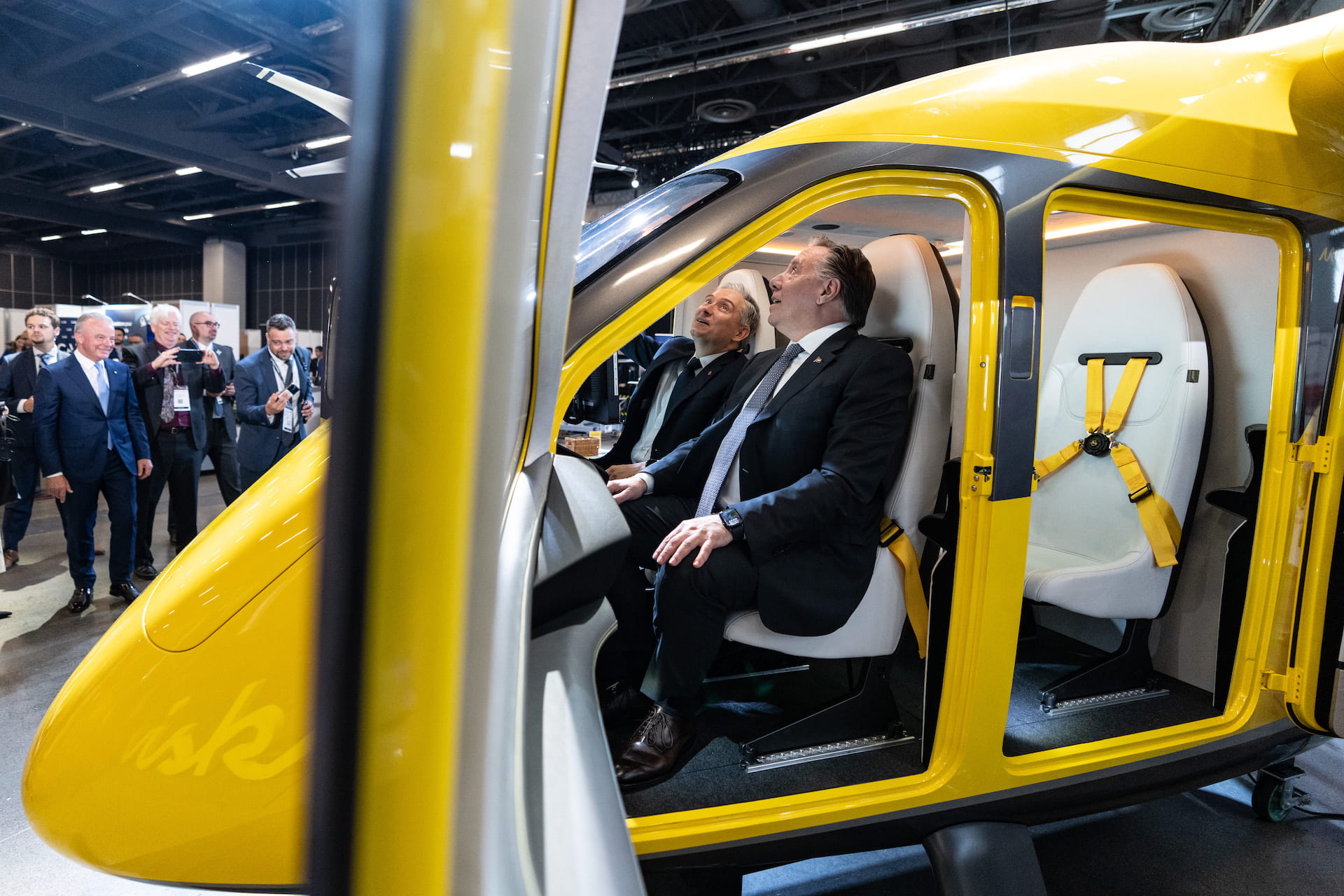
Quebec Premier François Legault, right, and federal Innovation Minister François-Philippe Champagne sit in a Wisk, an autonomous electric air taxi made by Boeing, at the International Aerospace Innovation Forum in Montreal, on May 21, 2024. Photo: The Canadian Press/Christinne Muschi
MONTREAL—Bombardier used to have the kind of clout that bent wills and opened wallets. Rarely has the company famous for its snow machines had trouble selling governments on the merits of its other vehicles, thanks in no small part to the political importance of its Quebec postal code. Between 1966 and 2017, according to a Montreal Economics Institute study, the firm raked in over $4 billion from governments of varying levels and differing stripes.
If Bombardier has long been the favoured child of Canadian governments, scenes from a recent photo op at the recent Aero Montreal show told a different story. The pictures show Quebec Premier François Legault, federal Innovation Minister François-Philippe Champagne and his provincial counterpart Pierre Fitzgibbon grinning alongside an assortment of other grandees.
The event was the launch of Espace Aéro, the fourth of Quebec’s “innovation zones.” Modelled on areas like Silicon Valley, they aim to attract academics and match them with entrepreneurs, with the goal of commercializing their research. They are meant in part to showcase made-in-Quebec talent. In aerospace, one made-in-Quebec name sticks out: Bombardier.
Except the aircraft in the photo wasn’t Bombardier’s newest offering. Instead, it was a prototype of the Wisk, an electric, autonomous passenger air taxi developed by its archrival, Boeing. Fitzgibbon went on to throw some industrial-grade shade on Bombardier, underscoring that the province didn’t have to cut cheques to coax Boeing to its shores. “It’s excellent news,” Fitzgibbon wrote in a subsequent LinkedIn message, ”especially since Boeing didn’t ask for anything from Quebec.” (Quebec is instead funding $85 million for various aerospace initiatives unrelated to Boeing.)
Related Articles


As a heavyweight in the production of planes, trains and snowmobiles, Bombardier is among the largest pieces of ink on Quebec Inc.’s mighty bicep, so hosting another aerospace giant on its home territory was a notable slight. That the aerospace giant in question was Boeing was received as an out-and-out betrayal, for more than one reason.
In 2017, Boeing launched a trade dispute against Bombardier, accusing the Montreal-based company of “aggressively dumping” its C-Series aircraft—selling it below cost to gain market share with U.S. airlines. Though Boeing ultimately lost, the dispute further hampered the long-delayed rollout of the C Series. Bombardier sold the C Series to Airbus two years later. It has since become a runaway hit for the French aviation company.
Justin Trudeau swore his government wouldn’t do business with Boeing while the company was “busy trying to sue us.” Six years later, with the pesky dispute in its rearview mirror, the federal government unclenched its fist, awarding Boeing a sole-sourced, $8-billion contract to replace its fleet of military surveillance aircraft. Bombardier was duly miffed, but Ottawa’s decision boiled down to simple economics. Boeing, as airline industry analyst Ernest Arvai told me, could do it “better, faster and cheaper.”
It is a measure of the extent to which Bombardier has shrunk, both in size and influence. Once upon a time (1986, to be exact) the company convinced the federal government to award it the contract to service its fighter jets, despite a lower bid from a Winnipeg company. Ottawa forked over $350 million in loans to help the company develop the C Series shortly before an election just over two decades later. The Quebec government invested $1.3 billion eight years after that, in a failed attempt to keep the C-Series dream alive.
Today, the company no longer manufactures trains, having sold its rail division to France-based Alstom in 2021, and its airplane production is limited to private jets. Its vaunted Ski-Doos, meanwhile, are produced alongside ATVs, Sea-Doos, boats and three-wheeled Boomer machines by BRP, a Bombardier spinoff that remains an exception to the company’s historically underwhelming stock performance. Bombardier had nearly 70,000 employees in 2017. Today, it has about 18,000.
Dunking on Bombardier’s apparent addiction to government largesse is well and good, but it’s worth remembering that Boeing is arguably even more addicted. It received more than $90 billion in subsidies, loans and bailouts from various levels of U.S. governments between 1994 and 2024, according to data from corporate and government accountability tracker Good Jobs First. Corporately and otherwise, Boeing is a hot mess, owing to two high-profile crashes that led to hundreds of deaths. More recently, one of its airplanes shed critical pieces mid-flight.
Finally, though many of us have kvetched about the practice—yours truly included—subsidizing Bombardier has yielded demonstrable benefits to the province. Along with Bell Helicopter, the company was a pioneer in the Montreal-centred sector, which is now home to more than 200 companies doing $20.9 billion in annual sales and supporting nearly 42,000 well-paying jobs. Montreal remains one of the few places in the world capable of producing an entire airplane “from A to Z”, as Geneviève Dalcourt, a director at École de technologie supérieure, told me. If anything, its business model proves a truism: aeronautics is a pay-to-play industry, whether you’re in Embraer’s Sāo Paulo, Boeing’s Seattle or Airbus’s Toulouse, France.
As for Bombardier’s shrinking footprint and influence, there’s a benefit to that, too. It has forced the company to focus on its core (high-margin) business of selling corporate jets, alongside high-margin ATVs and the like—”a very, very strong business strategy,” as Dalcourt put it to me. If success in any business is knowing your strength, then perhaps a diminished Bombardier is exactly what Bombardier needs, size and Boeing be damned.
Martin Patriquin is The Logic’s Quebec correspondent. He joined in 2019 after 10 years as Quebec bureau chief for Maclean’s. A National Magazine Award and SABEW winner, he has written for The New York Times, The Guardian, The Walrus, Vice, BuzzFeed and The Globe and Mail, among others. He is also a panelist on CBC’s “Power & Politics.”



Loading...
Thanks for sharing!
You have shared 5 articles this month and reached the maximum amount of shares available.
CloseThis account has reached its share limit.
If you would like to purchase a sharing license please contact The Logic support at [email protected].
CloseGift the full article!
You have gifted 0 article(s) this month and have 5 remaining.
Recipients will be able to read the full text of the article after submitting their email address. They will not have access to other articles or subscriber benefits.
Photo: The Canadian Press/Christinne Muschi
Most Popular This Week




In-depth, agenda-setting reporting
Great journalism delivered straight to your inbox.
News
Canada faces a satellite-launch crunch as SpaceX retires its workhorse rocket
Briefing
Rio Tinto gets nearly $165M in additional federal funds for Quebec aluminum
U.S. to lift tariffs on some Canadian products crucial to Maine: Collins
Carney warns of tech dependence after Starlink disruptions in Ukraine
Best business newsletter in Canada
Get up to speed in minutes with insights and analysis on the most important stories of the day, every weekday.
Exclusive events
See the bigger picture with reporters and industry experts in subscriber-exclusive events.
Membership in The Logic Council
Membership provides access to our popular Slack channel, participation in subscriber surveys and invitations to exclusive events with our journalists and special guests.