OTTAWA — Finance Minister Chrystia Freeland is putting the country’s perennial productivity problem back in businesses’ court, calling on Canadian firms to invest more at home. Here’s what you need to know:
Skip to content
 Finance Minister Chrystia Freeland in Ottawa on Tuesday. Photo: The Canadian Press/Adrian Wyld

News
Freeland calls on Canadian businesses to tackle ‘urgent’ productivity challenge
Finance minister urges companies to invest more at home
Finance Minister Chrystia Freeland in Ottawa on Tuesday. Photo: The Canadian Press/Adrian Wyld
OTTAWA — Finance Minister Chrystia Freeland is putting the country’s perennial productivity problem back in businesses’ court, calling on Canadian firms to invest more at home. Here’s what you need to know:
The message: Economic growth, business investment growth and productivity remain an “urgent challenge” for Canada, Freeland told reporters at a Tuesday press conference. While she rhymed off rosy figures—including estimated GDP growth of 1.5 per cent in 2023, employment and wage gains, and gobs of foreign direct investment (FDI)—relative economic output continues to lag.
Freeland focused on where the spending is going, and who is doing it. FDI is flowing into fields like EV batteries, for example. But “we’d like to see more Canadian businesses investing more in Canada,” she said, citing a budget proposal to “collaboratively” get the country’s pension funds to allocate more money domestically. The Liberal government’s child-care and affordability measures are also productivity-boosting investments, Freeland said. (She also announced another $99 million for rent support for low-income tenants.)
Related Articles
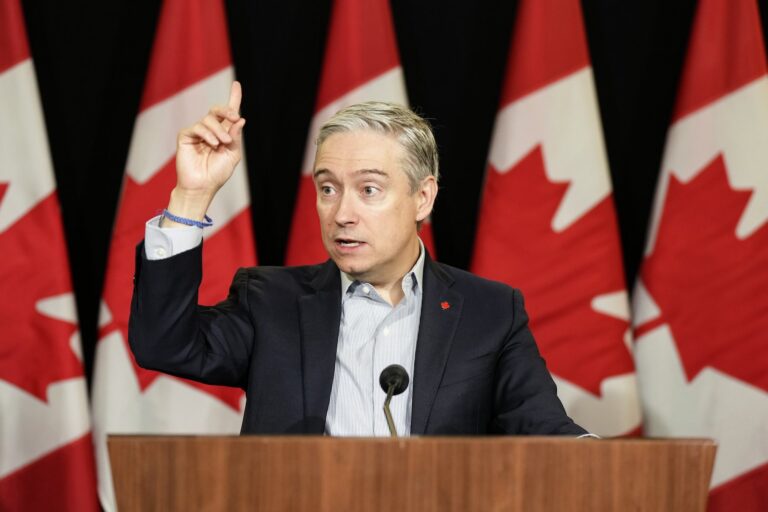

One seat over, Innovation Minister François-Philippe Champagne touted Ottawa’s national strategies for AI and quantum R&D, and its digital adoption funding program. “Technology is going to allow us to become more productive,” he said.
Public, private: Business groups have attributed investment shortfalls to regulatory uncertainty, poorly designed incentives and a lack of growth-focused policy thinking. Liberal ministers have pushed back on the latest round of criticism and pointed to programs they’ve already offered.
At his cabinet retreat last month, Prime Minister Justin Trudeau dismissed business concerns over whether the government can achieve its federal fiscal anchor as a call for austerity. “My priority … is to make sure that Canadians are supported,” Trudeau said.
Champagne, meanwhile, noted that businesses’ underinvestment in R&D and new technologies is limiting productivity growth. “Innovation is about the private sector,” he said at the retreat.
That “urgent challenge”: Labour productivity—a measure of economic output per hour worked—has fallen for the last six quarters for which Statistics Canada has published data, through to the third quarter of last year. Following an early-pandemic bump, it’s back to 2017 levels. The country’s businesses also spend significantly less on R&D in proportion to the size of the economy than the OECD average.
In her budget speech two years ago, Freeland said Canada was “falling behind” on economic productivity, and proposed a new agency to tackle the “insidious” problem via business supports. In December, Ottawa punted on that program, now called the Canada Innovation Corporation.
Businesses have heard this kind of thing before: The Liberals’ latest exhortations to invest and innovate aren’t quite as strongly worded as the Bank of Canada’s then-governor Mark Carney’s comments in August 2012. Carney called out corporate Canada for sitting on the “dead money” on their balance sheets and reminded them that “their job is to put money to work.”



Loading...
Thanks for sharing!
You have shared 5 articles this month and reached the maximum amount of shares available.
CloseThis account has reached its share limit.
If you would like to purchase a sharing license please contact The Logic support at [email protected].
CloseGift the full article!
You have gifted 0 article(s) this month and have 5 remaining.
Recipients will be able to read the full text of the article after submitting their email address. They will not have access to other articles or subscriber benefits.
Photo: The Canadian Press/Adrian Wyld
Most Popular This Week




In-depth, agenda-setting reporting
Great journalism delivered straight to your inbox.
The Big Read
Alberta’s referendum is just the start of the turmoil
Briefing
EverWind plans $10B data centre and wind development in Nova Scotia
Canada ready to force Stelco to sell its Canadian operations, Joly says
Feds plan a 60 MW defence-oriented data centre for Ottawa
Best business newsletter in Canada
Get up to speed in minutes with insights and analysis on the most important stories of the day, every weekday.
Exclusive events
See the bigger picture with reporters and industry experts in subscriber-exclusive events.
Membership in The Logic Council
Membership provides access to our popular Slack channel, participation in subscriber surveys and invitations to exclusive events with our journalists and special guests.






