MONTREAL — Last fall, with local businesses struggling under the effects of the COVID-19 pandemic, Quebec’s Charlevoix region began experimenting with a Depression-era idea to boost its local economy: issuing its own currency, “la Chouenne.” Residents were invited to trade dollars for digital credits or physical notes, which they could use at businesses in the area that participated in the program.
Skip to content

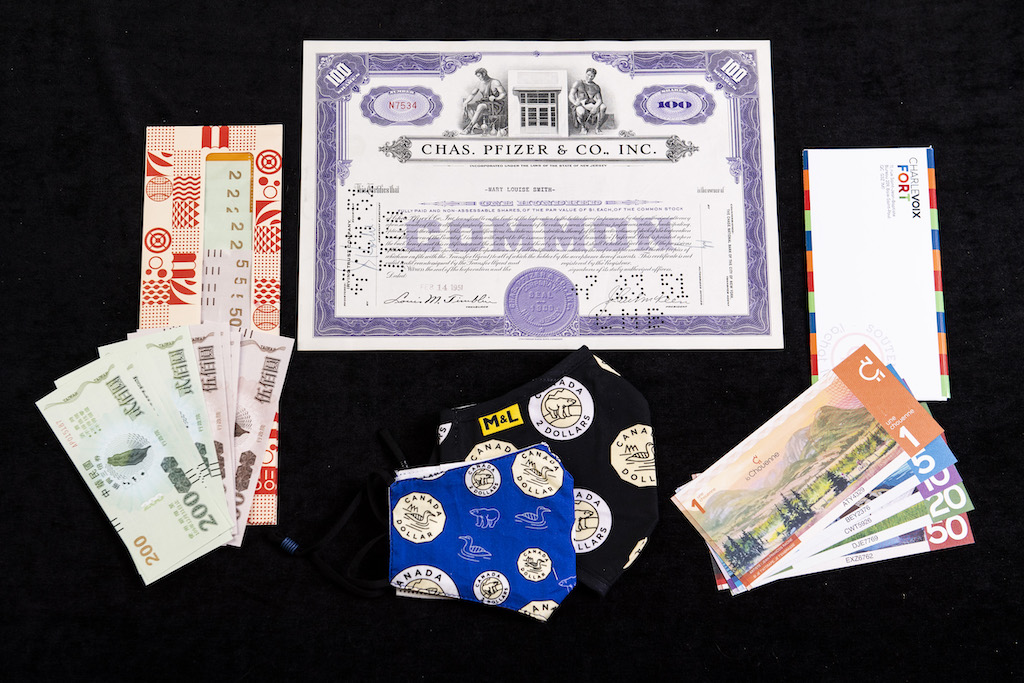 Objects from a pandemic collection that will be part of the National Currency Collection, at the Bank of Canada in March 2022. Clockwise from left: pandemic stimulus vouchers issued by the government of Taiwan, a Pfizer stock certificate from 1951, vouchers to be used at local stores from the Charlevoix region in Quebec and money-themed face masks. Photo: Justin Tang for The Logic
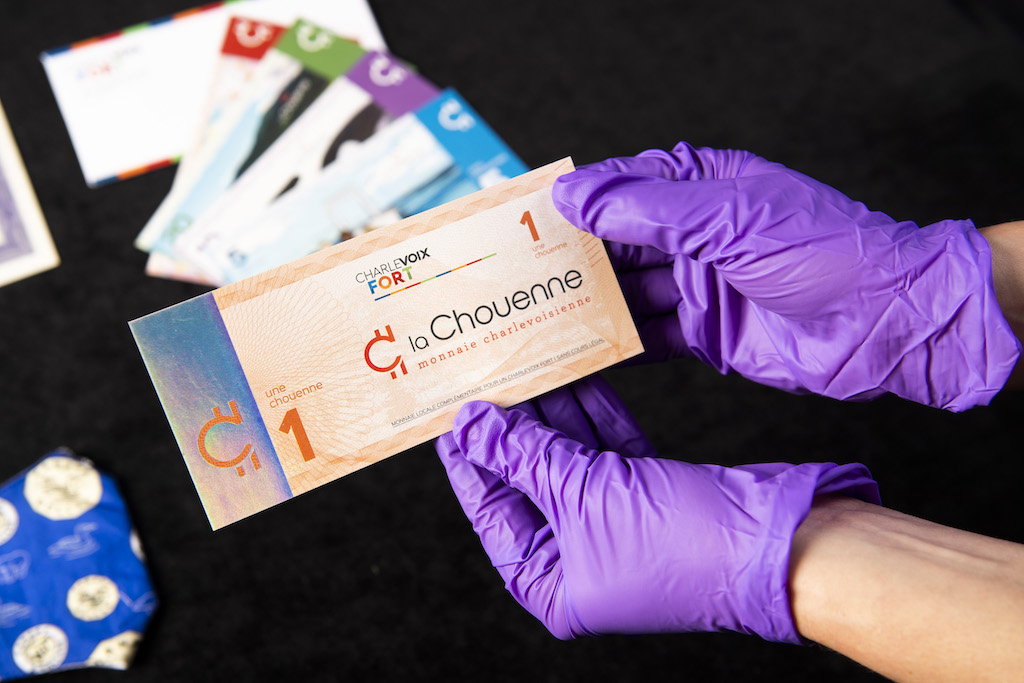 “La Chouenne” notes, part of an initiative to boost the local economy in Quebec’s Charlevoix region, part of a pandemic collection of the National Currency Collection, are shown at the Bank of Canada, in March 2022. Photo: Justin Tang for The Logic
News
Bank of Canada Museum builds new collection of artifacts from the COVID-19 pandemic
Krista Broeckx, assistant curator at the Bank of Canada Museum, sets out objects from a pandemic collection that will be part of the National Currency Collection, at the Bank of Canada, in March 2022. Photo: Justin Tang for The Logic
MONTREAL — Last fall, with local businesses struggling under the effects of the COVID-19 pandemic, Quebec’s Charlevoix region began experimenting with a Depression-era idea to boost its local economy: issuing its own currency, “la Chouenne.” Residents were invited to trade dollars for digital credits or physical notes, which they could use at businesses in the area that participated in the program.
Some of the notes have since made their way to Ottawa. The Bank of Canada Museum has added them to its new pandemic collection, which seeks to memorialize the ways the Canadian economy adapted to a changed world.
Talking Point
The Bank of Canada Museum’s new pandemic-related holdings provide the first glimpse at how the central bank will document its impact for future generations.
“For us, at the end of the day, it really is about that human side of the story,” said Krista Broeckx, an assistant curator at the museum. “The economy for a lot of people is a very intangible or impersonal thing, so it’s really important for us to put those human stories, put people, at the front and centre of the work that we’re doing.”
The effort is still in its early stages. A subset of the national-currency collection, which includes coins and bank notes from earlier epochs in Canada’s history, the pandemic collection so far consists of just a handful of objects. The Bank of Canada Museum began collecting artifacts in the 1950s and now has more than 110,000 objects in its collection.
Still, the new pandemic-related holdings provide the first glimpse at how the central bank will document its impact for future generations.
Among the museum’s acquisitions are money-themed face masks created by Montreal entrepreneurs who pivoted their business in the early days of the pandemic. It has also acquired pandemic stimulus vouchers issued by the Taiwanese government and a Pfizer stock certificate from 1951, reflecting the pharmaceutical company’s role in producing the first COVID-19 vaccine approved for use in Canada.
“We are pleased to be included,” Pfizer spokesperson Christina Antoniou said, “and proud of our efforts in delivering the world’s first mRNA vaccine against COVID-19, and most recently, an oral therapeutic to treat COVID-19 to help bring an end to this devastating pandemic.”
As the collection grows, the museum would like to include more artifacts related to the effects of lockdowns and the changes that businesses made to their operations in light of public health measures, Broeckx said. It is also looking to address the downstream economic effects of the pandemic, like supply-chain issues and inflation, she added.
Central banks around the world played a starring role in the pandemic response, lowering interest rates to near zero in an effort to avoid a prolonged recession. At the same time, the public health impacts of the virus and extraordinary government interventions contributed to disruptions in global commerce, such as lengthy shipping delays, higher costs of living and a movement toward remote work and other online services.
In Charlevoix, as in other places around the world, the pandemic prompted residents to do more of their shopping online through services like Amazon. That shift has had a devastating impact on small businesses, many of which had been slow to move their operations online. In the first year of the pandemic, over one-quarter of Canadian businesses with less than 100 employees reported that revenues dropped at least 30 per cent, according to Statistics Canada.
“Delivery trucks were widespread in the region,” said Maude Bêty, a project manager at the Charlevoix Chamber of Commerce who led the rollout of its new currency. Others were driving into nearby Quebec City to do their shopping, she added. “We wanted to find a way to put a stop to that.”
Residents and visitors who trade their dollars to chouennes receive an equal amount plus five per cent in the currency, which is accepted by more than 150 stores and restaurants in the area—a number the local chamber of commerce is looking to grow even as pandemic restrictions ease, Bêty said. The currency’s name comes from the term for a local dialect of French that is spoken in the Charlevoix region.
The Bank of Canada Museum is still working on how it will display the Charlevoix notes and other pandemic-related acquisitions. The museum has been closed to visitors since March 2020, and hasn’t yet set a reopening date. In the meantime, though, its curators have continued acquiring and cataloging artifacts to eventually exhibit to the public.
“The question that’s always in the back of our mind is, ‘50 or 100 years from now, what are people going to want to know about this moment?’” Broeckx said. “Sometimes it’s not about an object. Sometimes it is really just about a story, and that’s equally important as having something physical in your hand.”



Loading...
Thanks for sharing!
You have shared 5 articles this month and reached the maximum amount of shares available.
CloseThis account has reached its share limit.
If you would like to purchase a sharing license please contact The Logic support at [email protected].
CloseGift the full article!
You have gifted 0 article(s) this month and have 5 remaining.
Recipients will be able to read the full text of the article after submitting their email address. They will not have access to other articles or subscriber benefits.
Photo: Justin Tang for The Logic
Objects from a pandemic collection that will be part of the National Currency Collection, at the Bank of Canada in March 2022. Clockwise from left: pandemic stimulus vouchers issued by the government of Taiwan, a Pfizer stock certificate from 1951, vouchers to be used at local stores from the Charlevoix region in Quebec and money-themed face masks.
“La Chouenne” notes, part of an initiative to boost the local economy in Quebec’s Charlevoix region, part of a pandemic collection of the National Currency Collection, are shown at the Bank of Canada, in March 2022.
Most Popular This Week




In-depth, agenda-setting reporting
Great journalism delivered straight to your inbox.
Commentary
Carmichael: Being boxed in will help Canada focus on what matters
Briefing
Rio Tinto gets nearly $165M in additional federal funds for Quebec aluminum
U.S. to lift tariffs on some Canadian products crucial to Maine: Collins
Carney warns of tech dependence after Starlink disruptions in Ukraine
Best business newsletter in Canada
Get up to speed in minutes with insights and analysis on the most important stories of the day, every weekday.
Exclusive events
See the bigger picture with reporters and industry experts in subscriber-exclusive events.
Membership in The Logic Council
Membership provides access to our popular Slack channel, participation in subscriber surveys and invitations to exclusive events with our journalists and special guests.






