The Bank of Canada cut its benchmark interest rate by half a percentage point to 3.75 per cent, an unusually aggressive shift in policy that is typically saved for times of stress. Governor Tiff Macklem said more cuts are coming, but wouldn’t commit to a timeline.
Skip to content


News
Bank of Canada’s aggressive half-point cut drops key interest rate to 3.75%
Macklem wants ‘to see growth strengthen’ after return to low inflation
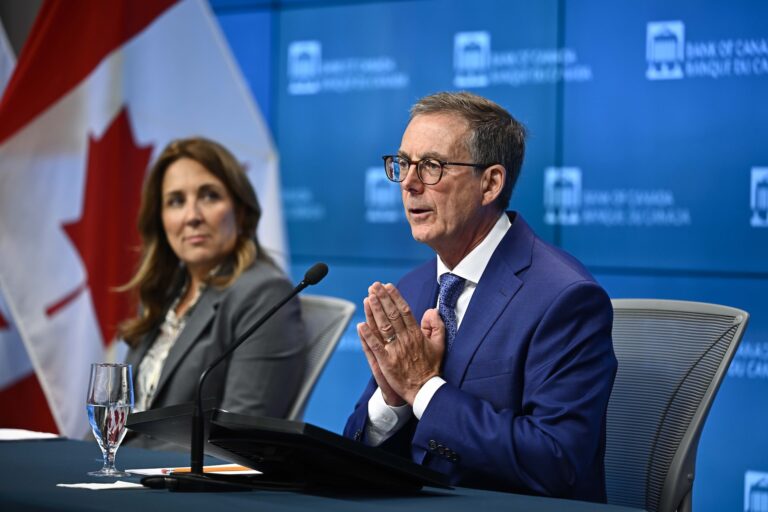
Bank of Canada governor Tiff Macklem in Ottawa, in September 2024. Photo: The Canadian Press/Justin Tang
The Bank of Canada cut its benchmark interest rate by half a percentage point to 3.75 per cent, an unusually aggressive shift in policy that is typically saved for times of stress. Governor Tiff Macklem said more cuts are coming, but wouldn’t commit to a timeline.
Victory: The Bank of Canada released a new economic outlook that has year-over-year changes in the consumer price index averaging 2.1 per cent over the fourth quarter, and inflation at the two per cent target over 2025 and 2026.
There are still some hot spots, especially in services where higher wages are putting upward pressure on prices. But inflation for many components of the consumer price basket is now below historical averages. Prices remain significantly higher than a few years ago, but the rapid pace of increase is over, giving wage gains a chance to catch up to the elevated cost of living.
Related Articles

“All this suggests we are back to low inflation,” Macklem said in prepared remarks. “Now our focus is to maintain low, stable inflation. We need to stick the landing.”
New fight: Sticking the landing will require some lift from the economy. The last inflation reading was 1.6 per cent—below target, suggesting higher interest rates may have squeezed demand too much.
Indeed, the Bank of Canada slashed its estimate of third-quarter growth to an annual rate of 1.5 per cent from an earlier estimate of 2.8 per cent, mostly because of weaker household consumption. Macklem said the economy was in a state of “excess supply,” meaning companies have idle capacity, and he described the labour market as “soft.” The forecast projects growth will accelerate in the fourth quarter, but mostly because of stronger exports.
“The upward and downward forces on inflation need to balance out,” Macklem said. “With inflation back at two per cent, we want to see growth strengthen.”
Bottom line: Macklem called the risks to the inflation forecast “reasonably” balanced, suggesting a certain lack of conviction in where the economy is headed. The forecast flagged sticky services prices and geopolitics as potential sources of inflation, and persistently weak household spending as the main downside risk. The outsized rate cut shows the central bank was more concerned about the latter threat this week. But that could change by the time policymakers conclude their next round of deliberation on Dec. 11.
The wars in Ukraine and the Middle East could reignite energy prices, or the outcome of the U.S. election could introduce uncertainty that causes business investment to retreat. Interest rates will continue to come down. How much and how fast remains to be seen.



Loading...
Thanks for sharing!
You have shared 5 articles this month and reached the maximum amount of shares available.
CloseThis account has reached its share limit.
If you would like to purchase a sharing license please contact The Logic support at [email protected].
CloseGift the full article!
You have gifted 0 article(s) this month and have 5 remaining.
Recipients will be able to read the full text of the article after submitting their email address. They will not have access to other articles or subscriber benefits.
Photo: The Canadian Press/Justin Tang
Most Popular This Week




In-depth, agenda-setting reporting
Great journalism delivered straight to your inbox.
The Big Read
Alberta’s referendum is just the start of the turmoil
Briefing
EverWind plans $10B data centre and wind development in Nova Scotia
Canada ready to force Stelco to sell its Canadian operations, Joly says
Feds plan a 60 MW defence-oriented data centre for Ottawa
Best business newsletter in Canada
Get up to speed in minutes with insights and analysis on the most important stories of the day, every weekday.
Exclusive events
See the bigger picture with reporters and industry experts in subscriber-exclusive events.
Membership in The Logic Council
Membership provides access to our popular Slack channel, participation in subscriber surveys and invitations to exclusive events with our journalists and special guests.