TORONTO — “Making AI helpful for everyone,” promises a sign on Google’s pavilion, located metres away from centre stage at the Collision tech conference in Toronto. Artificial intelligence has already provided one form of assistance to its more than 36,000 attendees this week: A boost of optimism.
Skip to content

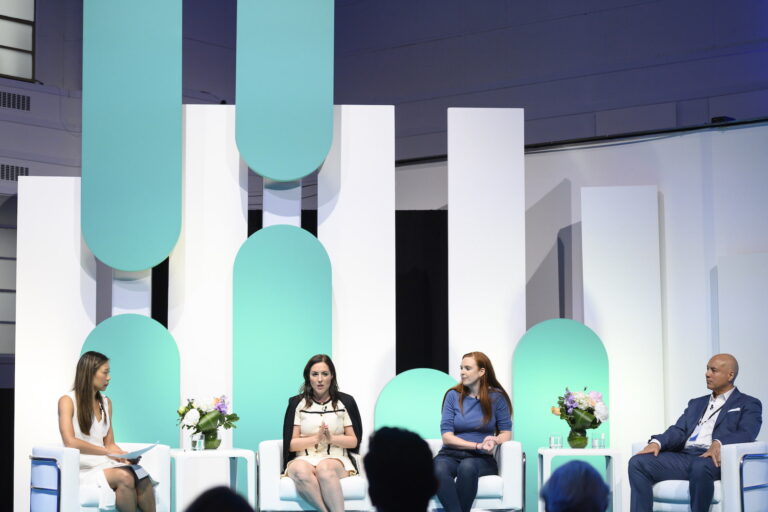
 Khosla Ventures partner Kanu Gulati speaks on a panel at Collision on June 27, 2023. Photo: Christopher Katsarov Luna for The Logic
News
At Collision, AI optimism meets business realities
‘There’s not going to be one model to rule them all’
Google's booth at the Collision tech conference in Toronto on June 27, 2023. Photo: Christopher Katsarov Luna for The Logic
TORONTO — “Making AI helpful for everyone,” promises a sign on Google’s pavilion, located metres away from centre stage at the Collision tech conference in Toronto. Artificial intelligence has already provided one form of assistance to its more than 36,000 attendees this week: A boost of optimism.
The interest: Ankita Patel said she came to Collision mainly to see AI researcher Geoffrey Hinton speak tomorrow. “As students, we need to know where we need to upskill ourselves,” said Patel, a master’s student in information systems from Northeastern University. Another attendee, Tom Vair, a community development officer for Sault Ste. Marie, Ont., said he wants to learn how AI will impact local businesses.
The money: Large language models (LLMs) are here, but the industry is still figuring out the business strategy. Google and Microsoft—with its stake in OpenAI—had made the early running, but Adam Selipsky, CEO of cloud titan Amazon Web Services (AWS), projected serenity amid the AI race. “There’s not going to be one model to rule them all,” he said onstage Tuesday morning, noting that different customers will need systems for their own use cases.
Related Articles

AWS is building an AI technology stack it can dish out to clients, including chips for training and running systems; a marketplace for the offerings of generative startups like Anthropic and Stability AI; and its own Titan-branded models, a moniker Selipsky said the firm picked “a while ago,” before the recent tragedy that befell the submersible of the same name. “So many companies already have their data in AWS,” Selipsky said. “You’re going to need data to feed into LLMs, so it really all becomes part of a single data strategy.”
Avoiding ‘shallow applications’: The buzz is translating to demand for AI products, executives said. But “there’s risk of low-quality revenue” amid the rush, said Mike Murchison, CEO of Ada, a Toronto-based customer-service automation platform. “There’s a lot of people who are purchasing generative AI-based software just simply by virtue of it having generative AI.” That revenue in hand now could prove dangerous for firms whose products don’t meet a need once the fad passes.
AI will flip the model for SaaS businesses, Murchison said. Instead of human labour enabled by the software, platforms will be powered by the machine, assisted by workers. Ada is set up to let customers “steadily improve their AI over time, via coaching mechanisms.”
Menlo Park, Calif.-based Khosla Ventures is avoiding “shallow applications” of AI, said partner Kanu Gulati. A company using an LLM API to offer content summarization in its product “is not exciting enough anymore,” said Gulati, who led the firm’s investment in Toronto-based Waabi, an autonomous driving startup. “You have to really rethink the application—what is this fundamentally changing?”



Loading...
Thanks for sharing!
You have shared 5 articles this month and reached the maximum amount of shares available.
CloseThis account has reached its share limit.
If you would like to purchase a sharing license please contact The Logic support at [email protected].
CloseGift the full article!
You have gifted 0 article(s) this month and have 5 remaining.
Recipients will be able to read the full text of the article after submitting their email address. They will not have access to other articles or subscriber benefits.
Photo: Christopher Katsarov Luna for The Logic
Khosla Ventures partner Kanu Gulati speaks on a panel at Collision on June 27, 2023.
Most Popular This Week




In-depth, agenda-setting reporting
Great journalism delivered straight to your inbox.
Commentary
Carmichael: Being boxed in will help Canada focus on what matters
Briefing
Rio Tinto gets nearly $165M in additional federal funds for Quebec aluminum
U.S. to lift tariffs on some Canadian products crucial to Maine: Collins
Carney warns of tech dependence after Starlink disruptions in Ukraine
Best business newsletter in Canada
Get up to speed in minutes with insights and analysis on the most important stories of the day, every weekday.
Exclusive events
See the bigger picture with reporters and industry experts in subscriber-exclusive events.
Membership in The Logic Council
Membership provides access to our popular Slack channel, participation in subscriber surveys and invitations to exclusive events with our journalists and special guests.






