As the auto industry goes electric, the shift will require enough batteries to power more than 31 million vehicles by 2030. In 2019, the battery industry only needed enough for roughly two million EVs and hybrids, according to Deloitte. That’s left Canadian battery companies—some of which are used to research-focused workforces and hiring people with PhDs—scrambling to staff entire assembly lines as they face a talent crunch that could slow the sector’s ambitions.
Skip to content

News
As cash floods into the battery business, companies face a battle for talent
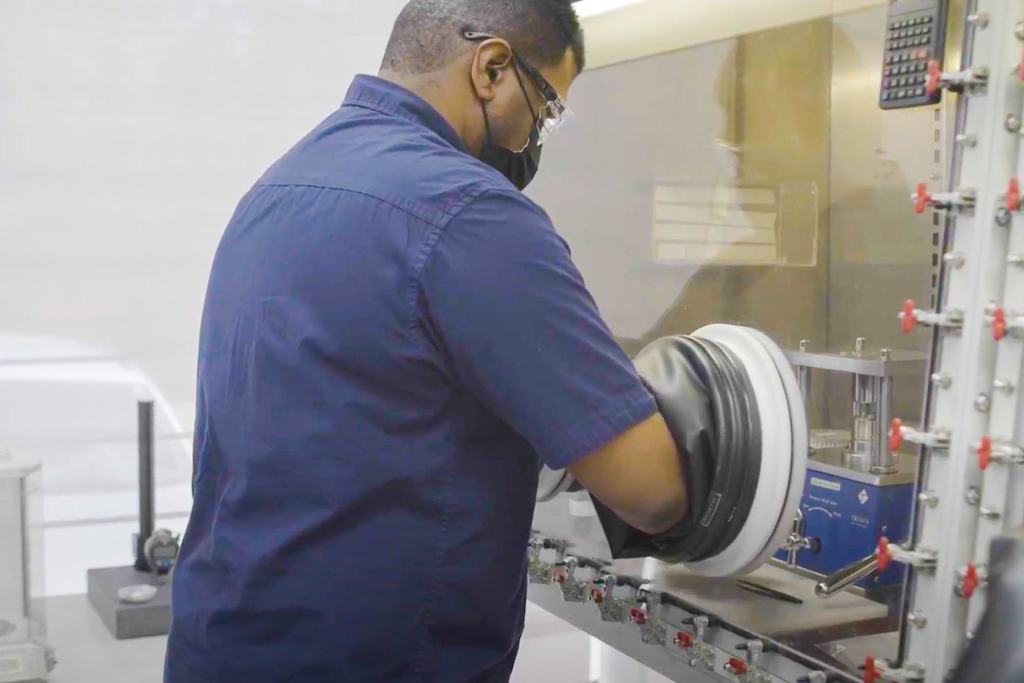
A worker at Nano One Materials battery-materials lab and pilot facility in Burnaby, B.C. Photo: Nano One | Handout
As the auto industry goes electric, the shift will require enough batteries to power more than 31 million vehicles by 2030. In 2019, the battery industry only needed enough for roughly two million EVs and hybrids, according to Deloitte. That’s left Canadian battery companies—some of which are used to research-focused workforces and hiring people with PhDs—scrambling to staff entire assembly lines as they face a talent crunch that could slow the sector’s ambitions.
“The biggest challenge right now is people: there aren’t enough people in this sector now,” said Chris Burns, the chief executive officer of Novonix and a former Tesla engineer. The competition for talent in the industry is heating up, he said, especially given the number of companies that have raised large amounts of capital, or that are getting government funding.
Talking Point
Finding talent is an issue for many industries—but not all of those industries are expected to grow to 15 times their size in less than a decade. That’s the conundrum battery makers are facing as the auto industry goes electric.
“Everything from high-level, specialized PhDs, to the people that will operate the plants and help maintain facilities, because this will become such a huge sector of the economy over the course of this decade.”
The North American battery workforce today is tiny. In the first half of 2021, more than 90 per cent of EV battery capacity globally came from seven Asia-based cell makers, according to Toronto-based research firm Adamas Intelligence. But that’s quickly changing.
Stellantis alone is planning to hire over 650 engineers in Canada for electrification-related roles as it builds a new battery-testing lab in Windsor, on top of 2,500 workers for the battery plant itself.
Dean Frankel, chief commercial officer at the Ontario-based Li-Metal, said the battery-material company has 20 workers, easily doubling its workforce from a year ago but he expects that if it moves toward becoming an auto-qualified supplier, its headcount would need to grow to the “low hundreds.”
Data the job-search platform Indeed prepared for The Logic showed that in April, there were 65 battery-engineer jobs per one million jobs posted in the U.S., up 114 per cent from April 2021, when there were 30 per million. The Boston-based hedge fund Snow Bull Capital found that Tesla’s worldwide job postings that included the word “cell” spiked from a handful to nearly 80 after the company’s Battery Day event, with a similar, smaller spike in postings for electrode-related jobs.
Many battery-making jobs are relatively simple for someone versed in manufacturing—like making a metal sandwich, Frankel said. But North America’s manufacturing workforce has been steadily hollowed out over the decades, and Frankel said many workers with translatable skills from outside the auto industry, such as those who worked with similar machinery to make paper or film, are of retirement age, and haven’t been replaced as those industries have declined.
He said trade-school courses with exposure to basic battery labs would be a first step in the right direction.
“We have to retrain a new generation of workers,” said Frankel. “That critical knowledge gap is being effectively put on steroids in order to scale up for the battery industry.”
The Ontario Vehicle Innovation Network (OVIN), an Ontario government-supported organization formerly called the Autonomous Vehicle Innovation Network, found in a recent report that battery knowledge is among the “emerging” skills likely to be in demand in the next five to 10 years.
The OVIN launched a program earlier this year to map the skill pathways needed to fill what it anticipates will be a 30,000-plus-worker gap in the automotive industry by 2030, starting with students as young as middle school. The Stellantis battery plant in Windsor, still a rumour when the program was created, exemplified the “exact purpose” of the website, said Raed Kadri, head of the Ontario Vehicle Innovation Network, adding at a January press conference that he was seeing “rapidly broadening” skill requirements for areas like mineral extraction and powertrain chemistry.
The talent crunch is affecting companies in all parts of the battery supply chain. Amanda Hall, CEO and founder of Summit Nanotech in Calgary, works on technology that she calls a “bullet train” for the extraction of lithium, a metal critical to the manufacture of many EV batteries, with the potential to about double the yield in a fraction of the time of traditional brines.
She said talent is one of the biggest challenges she expects to face over the next year, after doubling her staff in 2020 and again in 2021. She said her company needs not only strong candidates from academics, but those that have experience innovating in an industrial setting.
“Lithium extraction is such a unique sector, and there’s not a lot of people that know how to do it. And so we’re basically plucking professionals out of the oil and gas sector, and retraining them,” she said.
“To put it into a battery the purity levels we have to get to are, like, 99.9999 per cent purity. That’s where I find where the talent is most lacking: we don’t know a lot of people that can do that. … We can do it at bench scale, but can we do it at an industrial scale? That’s an area where I think a lot more training and consideration needs to be given.”
And it’s an issue that’s likely to extend beyond the battery supply chain and into other aspects of the EV industry, like the software that monitors battery-charging levels. Electric-vehicle companies in Quebec told the Information and Communications Technology Council and Propulsion Québec that research and development was the area they anticipated the most employment growth, naming software developers as well as mechanical, electrical and chemical engineers as the most in-demand roles.
“Several interviewees … described long wait times to find key senior engineering and software-development roles, and even stated that hiring candidates with engineering or software development skills and EV domain knowledge is ‘near to impossible,’” said the April report, which analyzed the Ontario workforces of Tesla and GM and found that 81.3 per cent of Tesla workers specialized in non-routine cognitive occupations, a category that comprised just 43.2 per cent of GM’s workforce.
Economy and Innovation Minister Pierre Fitzgibbon has said he has spoken with officials at the Université du Québec à Trois-Rivières about the need to train thousands of students in the province to fulfill the battery sector’s needs.
In a submission before last month’s federal budget, B.C. battery-technology firm Nano One Materials urged the federal government to pursue the cleantech training program outlined in the mandate letter for Employment Minister Carla Qualtrough, which also instructs her to “address gaps in training and upskilling” in the sustainable-battery industry. CEO Dan Blondal said in an interview that the industry needs human capital, but like many extractive resources like lumber and minerals, Canada has historically been an exporter of brainpower.
“This isn’t just about making higher energy density, better materials. That’s important—and that’s happening everywhere in the world. But I think one of our really big advantages here is to do it in an environmental way. … That will help drive a tremendous amount of stickiness to the Canadian ecosystem for that brainpower,” he said.
While Canada has achieved a lot on research and materials innovation, Blondal said, “the key is getting to a manufacturing level that really helps differentiate us. And that’s what’s going to keep the brainpower here.”
Burns said one competitive edge the industry has in recruiting is its reputation for clean manufacturing.
“We are interviewing people for non-technical roles who are saying the thing that they’re most excited about is they don’t want to work for companies that aren’t focused on climate change,” Burns said.



Loading...
Thanks for sharing!
You have shared 5 articles this month and reached the maximum amount of shares available.
CloseThis account has reached its share limit.
If you would like to purchase a sharing license please contact The Logic support at [email protected].
CloseGift the full article!
You have gifted 0 article(s) this month and have 5 remaining.
Recipients will be able to read the full text of the article after submitting their email address. They will not have access to other articles or subscriber benefits.
Photo: Nano One | Handout
Most Popular This Week



In-depth, agenda-setting reporting
Great journalism delivered straight to your inbox.
News
Panel decries Canada’s chaotic way of funding world-class science
Briefing
AI is pushing insurers to become asset managers, Canadian CEOs say
Trump administration faces lawsuit over 50% tariffs on Canadian goods
Canada-U.S. trade war to reduce real GDP by 1.4% over 2024 levels after five years: PBO
Best business newsletter in Canada
Get up to speed in minutes with insights and analysis on the most important stories of the day, every weekday.
Exclusive events
See the bigger picture with reporters and industry experts in subscriber-exclusive events.
Membership in The Logic Council
Membership provides access to our popular Slack channel, participation in subscriber surveys and invitations to exclusive events with our journalists and special guests.





