Artificial intelligence could be key to measuring the Indigenous economy and recognizing its full value, Indigenous leaders and policymakers said at a Toronto conference on Friday.
Skip to content

News
This AI tool aims to show the true scale of Canada’s $100B Indigenous economy
Carol Anne Hilton, CEO of Indigenomics Institute, said conventional metrics like GDP obscure Indigenous economic activity
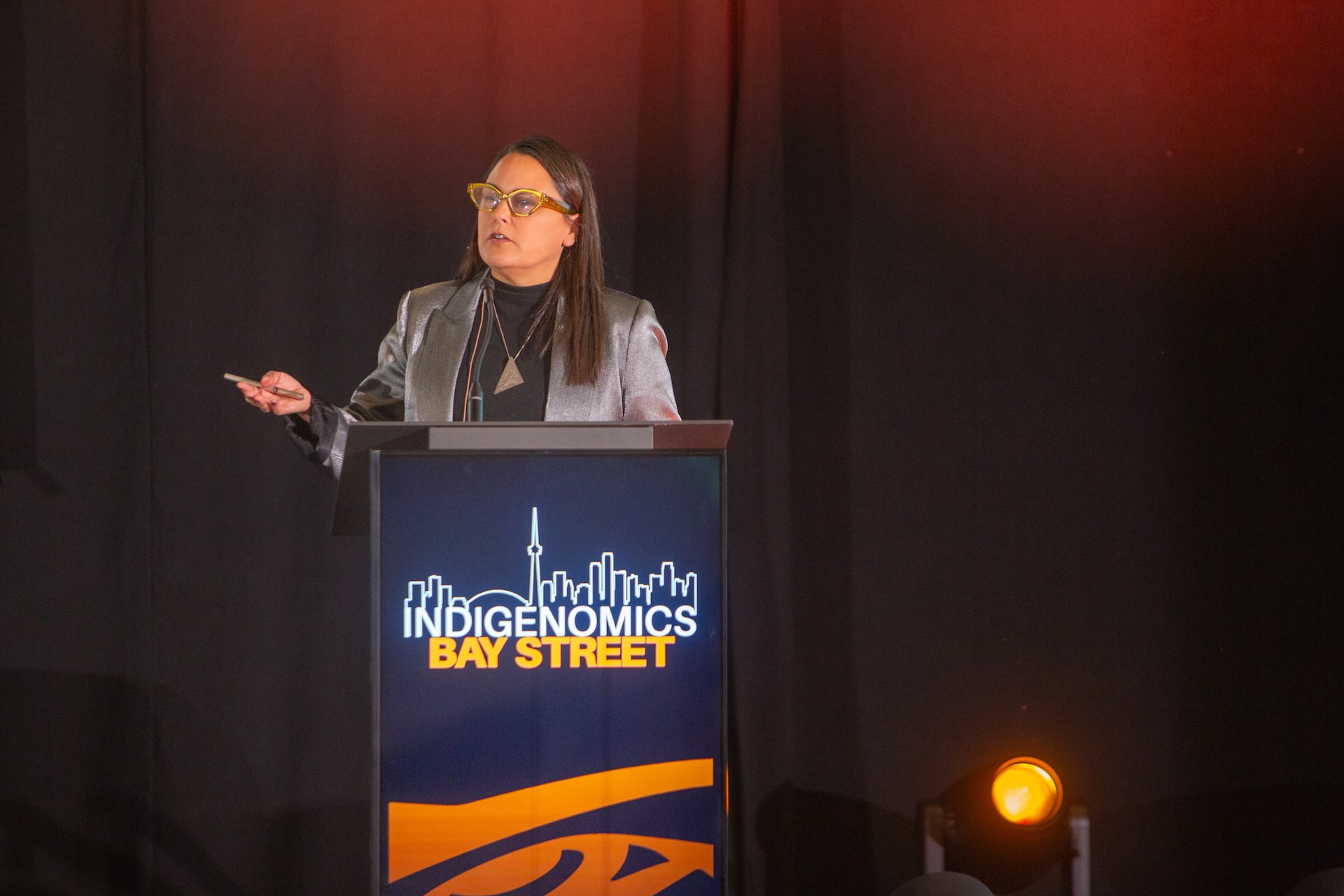
Carol Anne Hilton, CEO and founder of the Indigenomics Institute, speaking at the Indigenomics Bay Street conference in Toronto on Thursday, Oct. 18, 2024. Photo: Handout/Indigenomics Institute/Kris Krüg
Artificial intelligence could be key to measuring the Indigenous economy and recognizing its full value, Indigenous leaders and policymakers said at a Toronto conference on Friday.
The Indigenomics Bay Street conference comes days after the first federal budget tabled under Prime Minister Mark Carney. Ottawa has pledged $2.3 billion over three years to a First Nations water safety program, along with $19 billion in infrastructure investments for Indigenous communities and municipal infrastructure. Two Indigenous programs face a 2 per cent cut, with some leaders expressing concern that it overlooks key reconciliation programs, including lower drinking water funding.
Related Articles

Friday’s panels highlighted how Indigenous communities are building economic power through direct ownership of critical infrastructure, growing entrepreneurship, and the role of AI.
Indigenomics’ AI play: Carol Anne Hilton, CEO of the Indigenomics Institute said traditional frameworks used to measure economic activity—particularly GDP—do not substantially reflect the scale and complexity of Indigenous financial participation to the overall economy.
Hilton developed an AI-powered platform that quantifies Indigenous economic activity and shows how economic value is created in the digital age. Indigenomics and Telus announced in October that the dashboard will use Telus’s computing power to keep Indigenous data and intellectual property secure. “It’s easily demonstrated within our Indigenomics AI [tool] that we’re operating in a $100 billion Indigenous economy now, and it’s undervalued,” she said in an interview with The Logic.
Getting people to use AI, however, could be a challenge. There is a level of fear among some indigenous circles around the technology’s adoption, Shadrak Gobert, an Indigenous augmented reality designer, said on a panel. The concern is rooted in worries that, without Indigenous buy-in, the technology could repeat historical patterns of knowledge extraction and lack of partnerships. “If we aren’t the ones also helping to design and push forward these tools from our Indigenous world views, they’re going to be infinitely worse,” he said.
Marissa Nobauer, director of reconciliation and community engagement at Telus, said part of that concern stems from mistrust in the data used to train large AI models, increasing the risk of misrepresentation or erasure of Indigenous perspectives. She added that this mistrust can only be alleviated through building trust with communities first, not by simply introducing new technology. Telus had declared last year that it will not use AI to generate or replicate Indigenous artworks as part of its commitment to reconciliation.
The Indian Act’s “irrelevance”: Hilton first outlined the scale of Indigenous economic power in her 2021 book Indigenomics: Taking a seat at the economic table, in which she argued that Canada would see the emergence of a $100-billion Indigenous-led economy if the federal government stopped resisting treaty settlements and land restitution.
Her new book, published in May 2025, goes further, making the case that as the Indigenous economy grows and strengthens, the Indian Act is becoming economically “irrelevant.” She describes the legislation as “failing the Canadian economy,” and questions its ethical framework. “Is the Indian Act relevant in the growth of the Canadian economy and globalization?” she said Friday.
Hilton said she remains confident in the strength of Indigenous capital flows—including land transfers, revenue sharing, partnership agreements and increasing investment activity, even as Canada faces economic headwinds.



Loading...
Thanks for sharing!
You have shared 5 articles this month and reached the maximum amount of shares available.
CloseThis account has reached its share limit.
If you would like to purchase a sharing license please contact The Logic support at [email protected].
CloseGift the full article!
You have gifted 0 article(s) this month and have 5 remaining.
Recipients will be able to read the full text of the article after submitting their email address. They will not have access to other articles or subscriber benefits.
Photo: Handout/Indigenomics Institute/Kris Krüg
Most Popular This Week




In-depth, agenda-setting reporting
Great journalism delivered straight to your inbox.
Commentary
Carmichael: Canadian ignorance about India is a strategic weakness
Briefing
Aritzia shares pop after earnings rise 204%
First Nation in Alberta goes to court over fast-tracked oil pipeline
Chinese EV maker Geely Auto Group to launch in Canadian market in 2027
Best business newsletter in Canada
Get up to speed in minutes with insights and analysis on the most important stories of the day, every weekday.
Exclusive events
See the bigger picture with reporters and industry experts in subscriber-exclusive events.
Membership in The Logic Council
Membership provides access to our popular Slack channel, participation in subscriber surveys and invitations to exclusive events with our journalists and special guests.





