Skip to content

Canada's Business and Tech Newsroom

  • Professional Subscription
  • Partnerships & Advertising
  • Licensing & Syndication
Log In Subscribe
Welcome,
  • My Account
  • Log Out
  • Business
  • Tech
  • National
  • The Big Read
  • Briefings
  • Commentary
Search
Log In Subscribe
Welcome,
  • My Account
  • Log Out
News

These Canadian firms reckon that physical AI is where the money is at

Listen Now
0:00
News

These Canadian firms reckon that physical AI is where the money is at

A growing cohort of firms believe they can export ideas rather than commodities by using AI to improve advanced manufacturing

By Joanna Smith
Workers in bright orange safety gear walk through a spacious industrial warehouse with machinery surrounded by yellow railings and a Canadian flag overhead.
A number of smaller Canadian firms believe that they can compete in the global AI race by developing physical AI tools for advanced manufacturing. Photo: The Canadian Press/Nathan Denette
May 19, 2026
A A
A Small A Medium A Large
Share

Gift

Share

Listen Now
0:00

HANNOVER, GERMANY — Scores of Canadian companies hoping to compete in international markets are focusing on how artificial intelligence could speed up and improve advanced manufacturing—without needing to hand over sensitive data to the cloud.

“We live in a world where if you talk to all the CEOs of all the AI companies, we’ll all be out of a job in five years. That’s the doom and gloom side of the story,” said Matthew Lowe, the CEO of ZeroKey. “Most of our technology makes humans more efficient at what they do.”

Talking Points

  • Physical AI applications for advanced manufacturing could be the best bet for Canadian firms looking to enter new markets amidst the AI boom
  • Matthew Lowe, CEO of Calgary-based ZeroKey, says he welcomes competition from China but wishes mid-market Canadian firms had better access to capital to help them scale and compete

His Calgary-based firm, which was one of about 100 Canadian exhibitors at the international trade fair Hannover Messe last month hoping to expand their business in Europe, is making a bet on how AI and humans can work together. Using trackers and sensors, ZeroKey aims to minimize errors on factory floors and make it easier for humans to complete complex tasks.

In a demonstration of how the system works, Lowe put tracking devices on his wrists and stood at a mock-up of a workstation, where small bins filled with different machinery parts were stacked on either side of a computer monitor. The system showed him what to do next, with nearby sensors detecting the location of his hands with 1.5 millimetre accuracy.

As Lowe stood at the workstation, a diagram on the monitor showed him which part to pick up from which bin, at which stage in the process. When he got it right, the monitor flashed green. If his hand entered the wrong bin at the wrong time, it flashed red to alert him to an error.

Related Articles
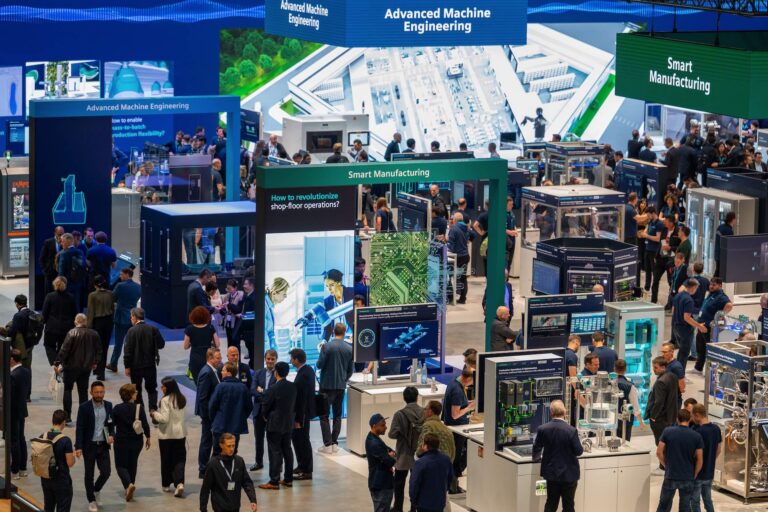
A high-angle shot of one of the pavilions at Hannover Messe, showing people lingering at a variety of robotics and technological display booths. Signs reading "Advanced Machine Engineering" and "Smart Manufacturing" hang from the ceiling.

At Hannover Messe, Canadian firms try to turn Carney’s global trade talk into reality

By Joanna Smith
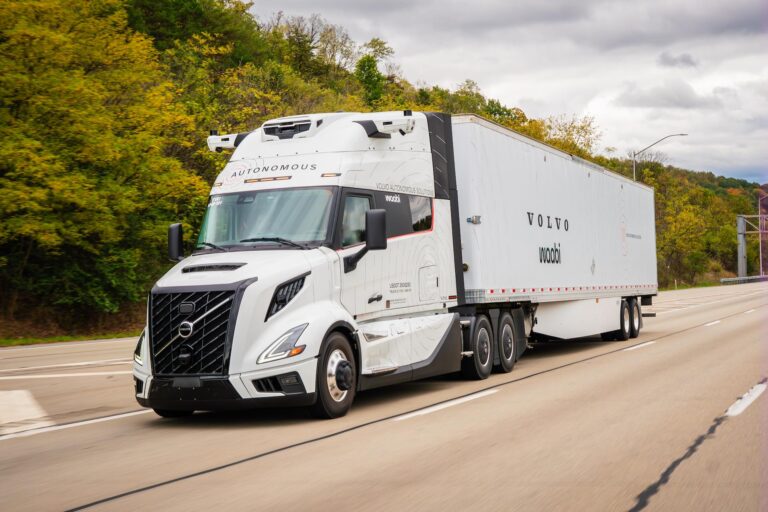
A photo of a white, tandem-axle truck pulling a semi trailer bearing the Volvo and Waabi logos. The truck appears to be on a major highway.

Canada’s internal trade barriers are blocking the road to driverless trucking

By Joanna Smith

The idea is to catch a mistake in real time—fast enough to correct it in the moment, or at least well before the product would ever reach the consumer. A loose bolt, Lowe explained, can be the difference between a safe ride home and a car seat flying out of place during a sudden stop.

Industry Minister Mélanie Joly has said the world is going through another “industrial revolution” driven by AI. The federal government is hoping to make it easier for Canadian firms to compete, including as part of efforts to diversify exports amid the trade war, but it can be challenging for those companies to stand out against far larger firms in the United States and China. The Canadian firms arrived at Hannover Messe just days before Toronto-based Cohere, which had its own booth at the Canadian pavilion, announced its merger with German AI firm Aleph Alpha. Before heading to Germany, Joly had told The Logic that such partnerships could play a role in helping Canada find a way forward amid U.S. protectionism and powerful hyperscalers.
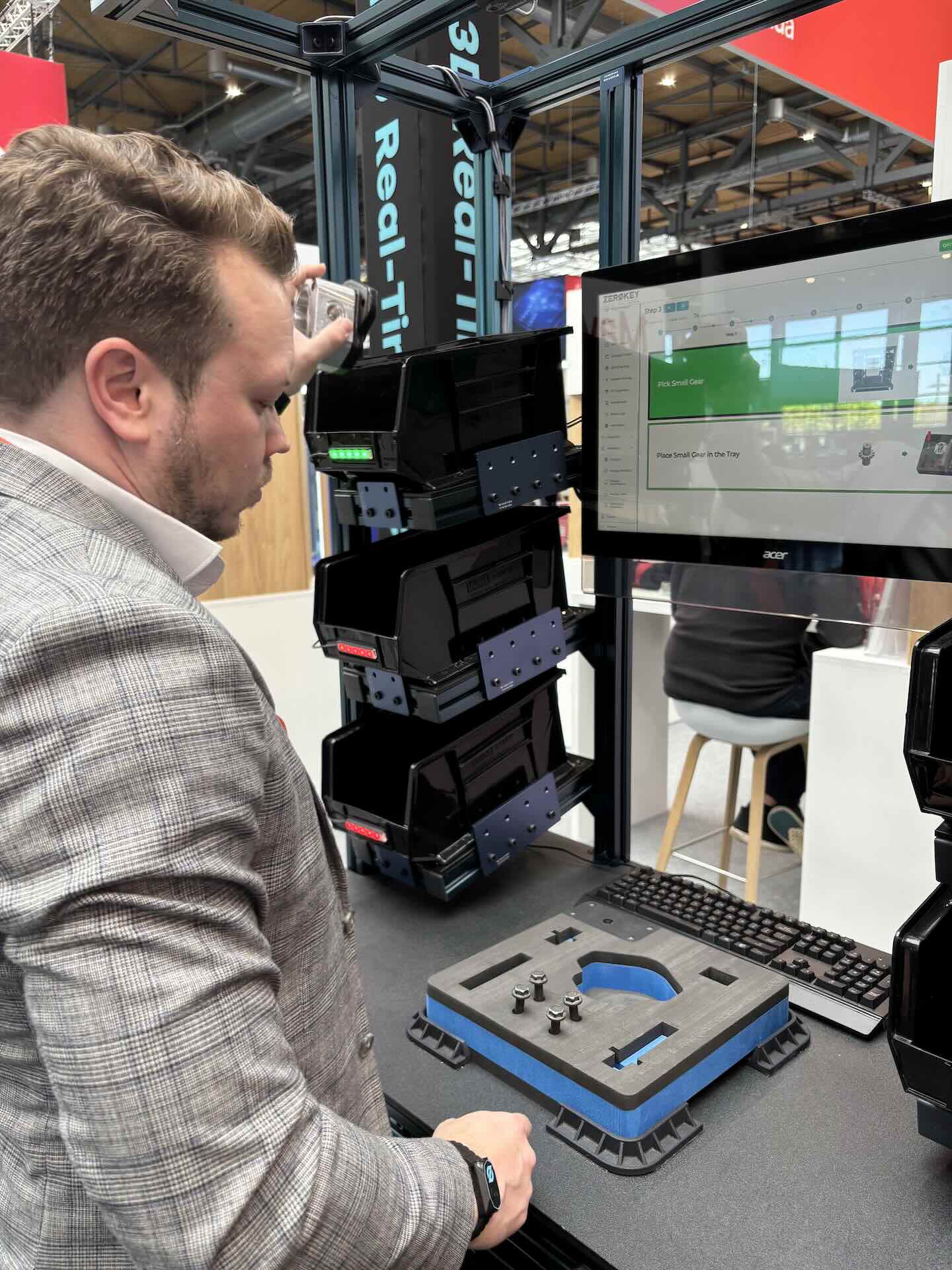
A man wearing a gray plaid jacket interacts with a computer setup at a trade show. The screen displays software, and black storage bins are stacked on either side of a keyboard and device.
Matthew Lowe, CEO of Calgary-based ZeroKey, demonstrates his company’s real-time location system at the Hannover Messe industrial tech fair in Germany. Photo: Joanna Smith for The Logic

For ZeroKey, and many of the other Canadian firms at the sprawling industrial tech fair in northern Germany, however, the game isn’t to compete with the hyperscalers. It’s to own the final application of AI. Jensen Huang, president and CEO of Nvidia, thinks of the AI industry as a “five-layer cake.” Energy and chips are at the bottom, followed by infrastructure. Then come the models, such as those developed by OpenAI, Anthropic and Cohere. “At the top are applications, where economic value is created,” Huang wrote in March.

Julien Billot, the CEO of supercluster Scale AI, says success for Canadian firms will likely come from that top layer. “If you want to be sovereign,” he said, “you need to own the final customer application.” That is where ZeroKey comes in, along with many of the other Canadian firms that were at Hannover Messe last month promoting physical AI tools for advanced manufacturing.

One of them was Montreal-based robotics company Vention. Its physical AI software product, known as GRIIP, teaches robots to handle unstructured tasks in a factory using perception and reason, without the need for weeks of training and data collection. CEO Etienne Lacroix, whose company expanded to Germany in 2022, noted that unlike generative AI, most physical AI runs on the edge, outside the cloud. “Manufacturers and clients keep their own data. It’s not shared,” he said.

M2M Tech, based in Surrey, B.C., focuses on helping manufacturers and other companies deploy AI solutions. It has a similar sovereign-focused pitch. Its platform uses digital twins, which let companies test and troubleshoot in a virtual environment before they ever build anything on the factory floor or in a foreign-based cloud. Edouard Romeus, chief product officer, said that’s key for manufacturers that have a lot of proprietary data but cannot afford to avoid using AI to boost their productivity. “These manufacturers have no choice but to innovate, or they go out of business.”
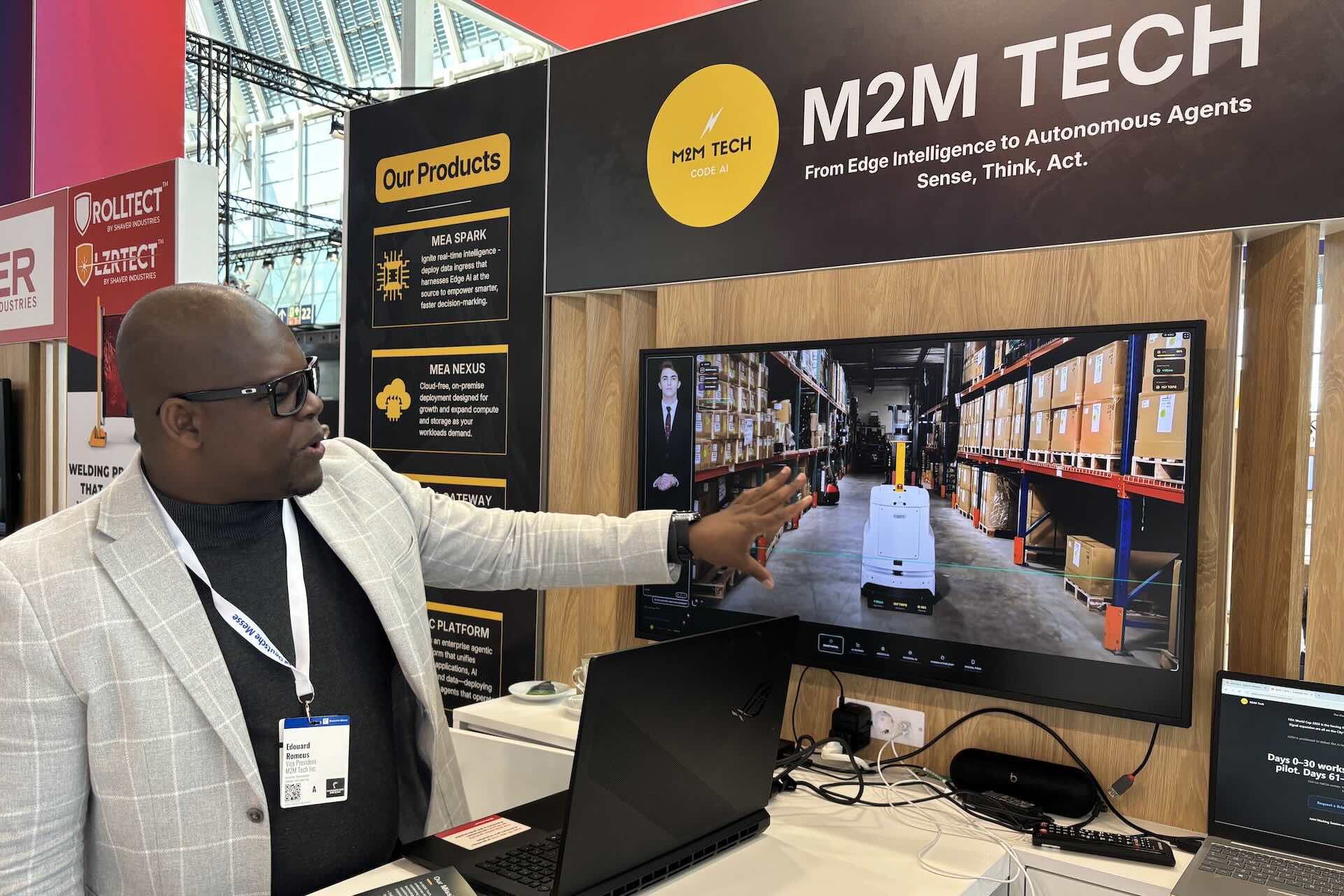
A man in a white blazer gestures towards a screen displaying a warehouse scene with a robot. A sign with "M2M Tech" is at the top of the booth.
Edouard Romeus, chief product officer at Surrey-based M2M Tech, was at Hannover Messe to show how his firm uses digital twins to design and test manufacturing processes. Photo: Joanna Smith for The Logic

As the Liberal government seeks to double non-U.S. exports by 2035, trade expert Danielle Goldfarb has been encouraging Canadians to think beyond physical goods like beef and gold. “The most valuable parts of trade today are really the data, the algorithms, the intelligence that is either sold on its own or embedded in any product,” Goldfarb said at a trade conference earlier this month. 

Jayson Myers, CEO of Next Generation Manufacturing Canada, or NGen, the industry-led non-profit that organized the Canadian mission to Hannover, has said it can be easier for Canadian companies to enter new markets by fitting into existing supply chains. The results of those efforts, however, are not always easy to see—or easily identifiable as Canadian.

One homegrown success story at Hannover Messe was ATS, based in Cambridge, Ont. Its SuperTrak Conveyance system was on prominent display inside the massive exhibition space for German multinational Siemens, where it is used in an AI-powered visual inspection system. Joris Myny, the senior vice-president of digital industries at Siemens Canada, called it a “marvellous piece of engineering,” but just like many Hollywood stars who grew up in Toronto, visitors from around the world would not immediately recognize the technology as Canadian.

Other Canadian exhibitors that spoke to The Logic at Hannover Messe were feeling optimistic about meetings with Siemens, which employs about 4,600 people in Canada. “We don’t see Siemens as a competitor,” said Romeus. “We see them as a partner.”

Gift the full article

ZeroKey, which says it has raised some $17 million in funding since it launched in 2016 and has sold its technology to major manufacturers around the world, including automakers, had one of the more eye-catching demonstration booths at the Canadian pavilion inside the cavernous AI-focused exhibition hall at Hannover Messe. Yet a walk through the trade fair showed a myriad of companies from all over the world promoting physical AI solutions and humanoid robots, including many from China.

“Personally, I’m pro-competition—always have been,” Lowe said. “The certain protectionist measures on trade that would limit China’s entry inevitably lead to lack of innovation.” Another big challenge, Lowe said, is homegrown. Unlike the U.S., Lowe said, Canada has a mid-market funding gap, as well as the strings attached to government funding, that can make it harder for a Canadian startup to get the capital it needs to scale up, or survive. “If any of the dots on that path are broken, that company doesn’t make it to that stage.”


#artificial intelligence #manufacturing #robotics #startups #Tech

Loading...

Thanks for sharing!

You have shared 5 articles this month and reached the maximum amount of shares available.

Close
This account has reached its share limit.

If you would like to purchase a sharing license please contact The Logic support at [email protected].

Close
Want to share this article?

Upgrade to all-access now

Close
Gift the full article!

You have gifted 0 article(s) this month and have 5 remaining.

Copy link and gift
Copy Link
Email to a friend
Send Email
Gift on Social Media

Recipients will be able to read the full text of the article after submitting their email address. They will not have access to other articles or subscriber benefits.

Workers in bright orange safety gear walk through a spacious industrial warehouse with machinery surrounded by yellow railings and a Canadian flag overhead.

Photo: The Canadian Press/Nathan Denette

A man wearing a gray plaid jacket interacts with a computer setup at a trade show. The screen displays software, and black storage bins are stacked on either side of a keyboard and device.

Matthew Lowe, CEO of Calgary-based ZeroKey, demonstrates his company’s real-time location system at the Hannover Messe industrial tech fair in Germany.

A man in a white blazer gestures towards a screen displaying a warehouse scene with a robot. A sign with "M2M Tech" is at the top of the booth.

Edouard Romeus, chief product officer at Surrey-based M2M Tech, was at Hannover Messe to show how his firm uses digital twins to design and test manufacturing processes.

Most Popular This Week

A yellow ambulance is pictured outside of a hospital in Montreal. A red sign in the foreground reads, “Urgence / Emergency.”
Commentary: Quebec Ink

Quebec just found out what not having digital sovereignty really means

By Martin Patriquin
An image of Mark Carney standing in front of a red podium with the words "AI for All / L'IA pour tous." He is wearing a suit and tie. In the background, people wearing scrubs and white coats are visible.
Special Report

Canada’s new AI strategy sets lofty goals for adoption and growth

By Murad Hemmadi and Laura Osman
Exclusive

Canada’s new AI strategy includes $500M fund to back key firms

By Murad Hemmadi and Catherine McIntyre
The Big Read

Canada’s AI boom is about to collide with a major labour shortage

By Catherine McIntyre

In-depth, agenda-setting reporting

Great journalism delivered straight to your inbox.

Minister Marc Miller wears a blue suit and tie. He stands while speaking and gesturing.
News

Online harms bill would give new regulator power to slap massive fines on AI, social media giants

By Laura Osman and Martin Patriquin

Briefing

Cenovus’s Jon McKenzie says there’s no financial case for a new pipeline and major carbon capture

By David Reevely   |   Jun 10, 2026 | 3:46 PM ET

Ubisoft shuts down Winnipeg studio

By Brendan Sinclair   |   Jun 10, 2026 | 3:08 PM ET

Quebec invested over $760M in battery companies that eventually went under, report says

By Martin Patriquin   |   Jun 10, 2026 | 2:59 PM ET

Best business newsletter in Canada

Get up to speed in minutes with insights and analysis on the most important stories of the day, every weekday.

Exclusive events

See the bigger picture with reporters and industry experts in subscriber-exclusive events.

Membership in The Logic Council

Membership provides access to our popular Slack channel, participation in subscriber surveys and invitations to exclusive events with our journalists and special guests.

Recent Popular Stories

Commentary: Quebec Ink

Quebec just found out what not having digital sovereignty really means

By Martin Patriquin   |   Jun 8, 2026
A yellow ambulance is pictured outside of a hospital in Montreal. A red sign in the foreground reads, “Urgence / Emergency.”
News

Canada’s surprise plan to buy Saab command jets leaves competitors seeking answers

By David Reevely   |   May 29, 2026
A closeup of a scale model of a jet covered in pixellated camouflage, with sensor equipment attached to the top of its fuselage. There are civilians and uniformed military personnel milling in the background.
Exclusive

Canada’s new AI strategy includes $500M fund to back key firms

By Murad Hemmadi and Catherine McIntyre   |   Jun 3, 2026
The Big Read

We found every data centre in Canada

By Murad Hemmadi, David Reevely, Aleksandra Sagan, Chaimae Chouiekh, Martin Patriquin and Catherine McIntyre   |   Apr 8, 2026
Four vertical slices of aerial view photos. From left, a building in downtown Toronto housing several data centres, a picture of the Albertan wilderness where the proposed Wonder Valley data centre would go, a lit-up QScale data centre in Quebec, and a data centre at a Hydro-Quebec dam.
The Big Read

ApplyBoard faces a reckoning as Canada’s immigration boom turns into a bust

By Claire Brownell and David Reevely   |   May 27, 2026
News

A Canadian leader in nuclear fusion comes home—with big plans to make power

By David Reevely   |   Jun 4, 2026
A selfie taken by Spencer Pitcher inside a nuclear fusion facility. He is wearing a blue hardhat with the ITER logo on it, and is standing in front of a cavernous chamber full of fusion reactor equipment.

Canada's most influential executives and policymakers are reading The Logic

  • CPP Investments
  • Sun Life Financial
  • C100
  • Amazon
  • Telus
  • Mastercard
  • bdc
  • Shopify
  • Rogers
  • RBC
  • General Motors
  • MaRS
  • Government of Canada
  • Uber
  • Loblaw Companies Limited
logic-logo

Canada's Business and Tech Newsroom

100% human-crafted journalism

Newsroom

  • News Tips
  • AI Policy
  • Editorial Disclosures
  • Story Pitches

Company

  • About Us
  • Terms of Service
  • Privacy Statement
  • Corporate Information

Contact

  • Contact Us
  • Advertise
  • FAQs
  • Work at The Logic

© 2026 The Logic Inc. All Rights Reserved.

Trusted by leaders

Error

Account creation failed.

Please email us at [email protected].

Create Account

[wppb-register form_name=”cozmo-registration-form-for-modal”]

I do have an account
Login
or

[wppb-login]

I don’t have an account