Skip to content


Analysis
How the Carney era has changed lobbying in Ottawa
Economic development has pushed environmental issues aside, and defence is on the rise as the government pursues new priorities
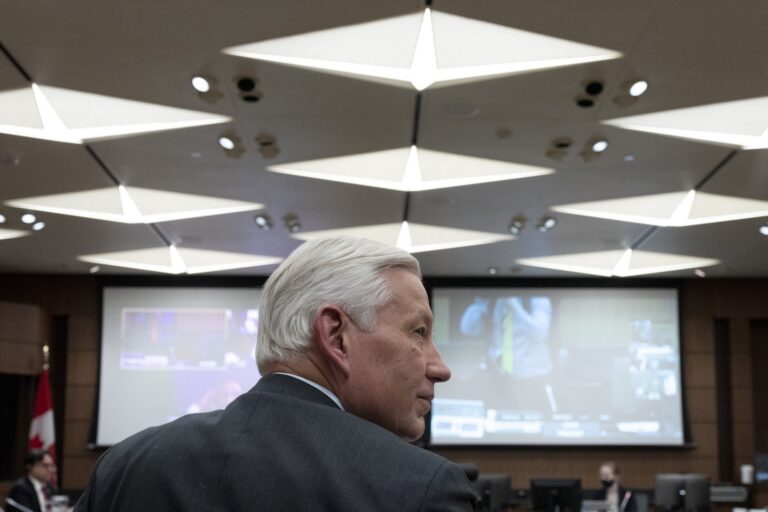
The subjects lobbyists raised in Ottawa shifted discernibly after Prime Minister Mark Carney and the Liberals won the election. Photo: AFP via Getty Images/Stefan Rousseau
OTTAWA — Economic issues shot past environmental ones this past year as Ottawa lobbyists tried to bend Prime Minister Mark Carney’s new government to their employers’ and clients’ wills, according to The Logic’s analysis of federal lobbying records.
The Logic examined publicly registered lobbying contacts made between May 13 and Nov. 30 of this year and reported as of Dec. 9, and compared them to the same period in 2024. (May 13 was chosen because it was the day in 2025 that members of Carney’s post-election cabinet were sworn in.)
Talking Points
- A new government with new priorities and a new administration in the United States means people seeking to exercise influence in Ottawa have had to make different cases
- Defence, long a stable sector without very much going on, is bringing new clients through lobbyists’ doors who want some of the billions in new dollars Mark Carney’s government is spending
In 2024, those were the months when Justin Trudeau’s hold on the prime ministership was failing, and most of the time preceded the Nov. 5 election that returned Donald Trump to the U.S. presidency.
In 2025, May to November was when the freshly elected Carney was beginning to turn election promises into policies and dealing with Trump in the White House.
Related Articles


Lobbyists describe their own activities in those reports, including by choosing from a broad but limited list of subjects like “energy,” “government procurement” or “immigration.” A single contact can have multiple subjects: A lobbyist for a port operator looking for funding for a new terminal, for example, could tag one meeting as covering economic development, international trade, agriculture and transportation.
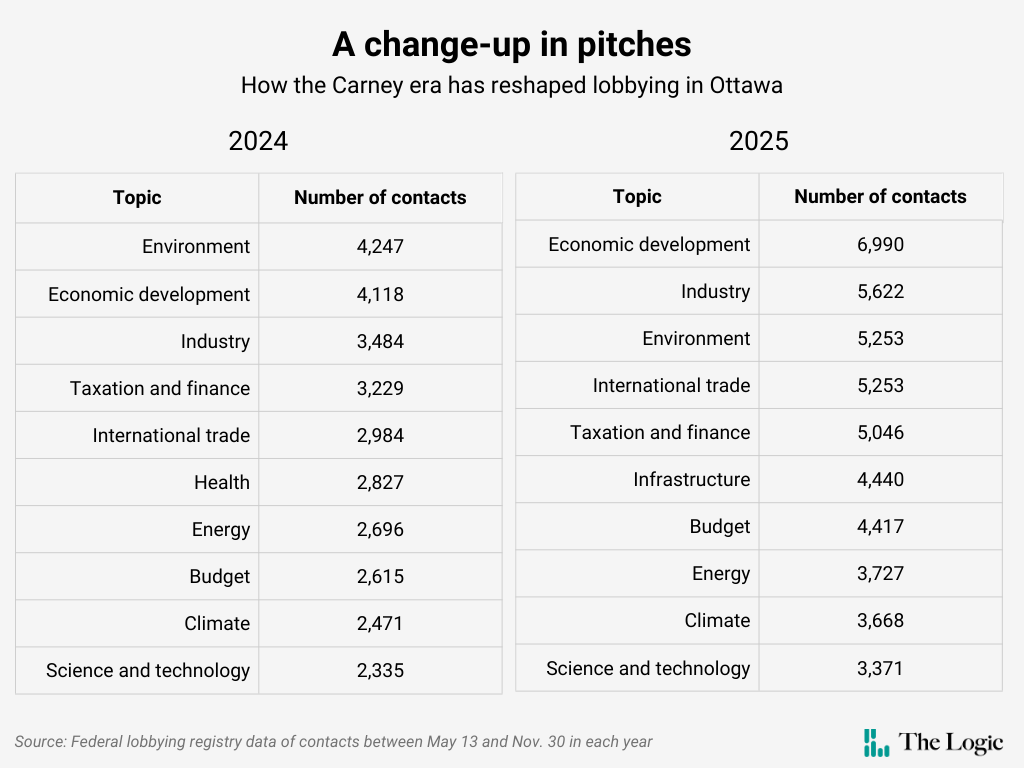
The total number of contacts in the two years was similar: 19,216 in 2024 versus 20,460 in 2025. But the balance shifted, with “economic development” and “industry” becoming the top subjects for lobbying, knocking “environment” down to third.
Infrastructure pushed into the top 10 in 2025 and health fell from sixth to 12th. (Lobbyists also were freer with the ranges of subjects they claimed their work related to, with the total number of subject tags soaring from 65,038 to 102,473.)
“The changes are real and palpable,” said Marci Surkes, a longtime Liberal staffer. She was in charge of policy and cabinet affairs in Trudeau’s office before joining government-relations firm Compass Rose, where she’s now managing director and chief strategy officer.
“What I see coming through my business, in terms of clients and their interests in this government, are considerably different and very heavily weighted toward items that the government has held as marquee items in the most recent budget and in the time leading up to that,” she said.
That means economic development, infrastructure, defence and major-project proposals that combine those three subjects.
Sometimes clients’ basic goals haven’t changed but their pitches have—and in many cases those changes are not superficial. That hypothetical port expansion doesn’t become a defence project just because the navy might be able to dock a ship there, in other words. The port operator needs to think about how to serve the navy’s actual needs and revise its proposal accordingly.
“It’s not just a fresh coat of paint on the barn. It is, in many instances, reimagining their relationship with the government.”
“People who are engaging with the government get that and they’re not coming in with the same-old-same-old,” Surkes said. “It’s not just a fresh coat of paint on the barn. It is, in many instances, reimagining their relationship with the government.”
Defence, a major priority for Carney’s government, didn’t come close to breaking the top 10 subjects in either year. But it climbed from 31st to 25th and the raw number of defence-related lobbying contacts nearly doubled, from 775 to 1,570.
That’s a meaningful jump for an industry that’s been relatively stable for years, with a handful of established companies, said Yaroslav Baran. He worked at multiple companies that lobby before co-founding his own, Pendulum Group, and was chief of staff to the House leader in Stephen Harper’s government.
More companies, and new ones, want shares of the new defence money sloshing around.
“We now have incentives for new defence startups in Canada, something that wasn’t previously the case,” Baran said. “You’re going to see opportunities for scale-up by existing smaller and medium-sized defence companies. So that’s going to generate a lot more [lobbying] activity, some of which you’ve already started to see.”
The Carney government’s defence spending is bringing new clients in, Surkes agreed, many of whom are not directly in the weapons business.
“It’s all of those good spinoff effects that people are interested in. So whether that’s parts, whether that’s real estate, whether that’s technology—it’s really across the board,” she said.
Baran pointed out another way 2025 has been different from 2024: a federal election isn’t definitely imminent. A national vote was due by this past October no matter what, the Liberals under Trudeau were low in the polls, and lobbyists, their clients and people in the government all knew it.
In 2024, “stakeholders were starting to shift their focus towards election readiness and potentially government-transition readiness,” Baran said. That meant seeking to influence party platforms rather than government decisions. “In 2025, things kind of went back to normal… Now we can focus on day-to-day, normal, ‘peacetime’ government relations.”



Loading...
Thanks for sharing!
You have shared 5 articles this month and reached the maximum amount of shares available.
CloseThis account has reached its share limit.
If you would like to purchase a sharing license please contact The Logic support at [email protected].
CloseGift the full article!
You have gifted 0 article(s) this month and have 5 remaining.
Recipients will be able to read the full text of the article after submitting their email address. They will not have access to other articles or subscriber benefits.
Photo: AFP via Getty Images/Stefan Rousseau
Most Popular This Week



In-depth, agenda-setting reporting
Great journalism delivered straight to your inbox.
News
ApplyBoard was the worst-performing Canadian startup in Fidelity’s portfolio in 2026
Briefing
Defence Investment Agency to be a Crown corporation so it can get deeper into Canada’s military industry
Mark Carney says he’ll work with Quebec separatist premier-to-be on housing, infrastructure, big projects
Mistral claims its new AI model closes the gap with leading Chinese developers
Best business newsletter in Canada
Get up to speed in minutes with insights and analysis on the most important stories of the day, every weekday.
Exclusive events
See the bigger picture with reporters and industry experts in subscriber-exclusive events.
Membership in The Logic Council
Membership provides access to our popular Slack channel, participation in subscriber surveys and invitations to exclusive events with our journalists and special guests.