
Listen Now
0:00
Nearly 58 per cent of respondents to The Logic’s latest subscriber survey said they do not support legalization of prediction markets in Canada, and more than half do not think sports-betting platforms are appropriately regulated in the country.
While single-game online sports betting has been legal in Canada since 2021, prediction markets, or exchanges that allow users to bet on the outcomes of real-world events, remain heavily restricted. Toronto fintech Wealthsimple received regulatory approval earlier this year to offer prediction markets trading limited to three topics: climate trends, financial markets and economic indicators. Last month, Wealthsimple announced the launch of a prediction markets trading app where it will offer Canadians access to nearly 4,000 event contracts on popular U.S. predictions exchange Kalshi this summer. (Wealthsimple made the announcement partway through The Logic’s survey period.)
Related Articles



Only nine per cent of readers said they have participated in prediction markets trading before, while roughly 91 per cent said they have not.
“It’s hard to see the overall benefit [of prediction markets], except for the companies that create and run the platforms,” wrote one reader. “Sure, a few people might get rich or at least make money, but likely the majority will not.”
In the U.S., prediction markets like Kalshi and Polymarket are broadly legal and booming. Trading volume on U.S. prediction markets grew from US$15.8 billion to US$63.5 billion between 2024 and 2025 according to Web3 security company CertiK, largely driven by the popular sports and elections categories, which are still not allowed in Canada.
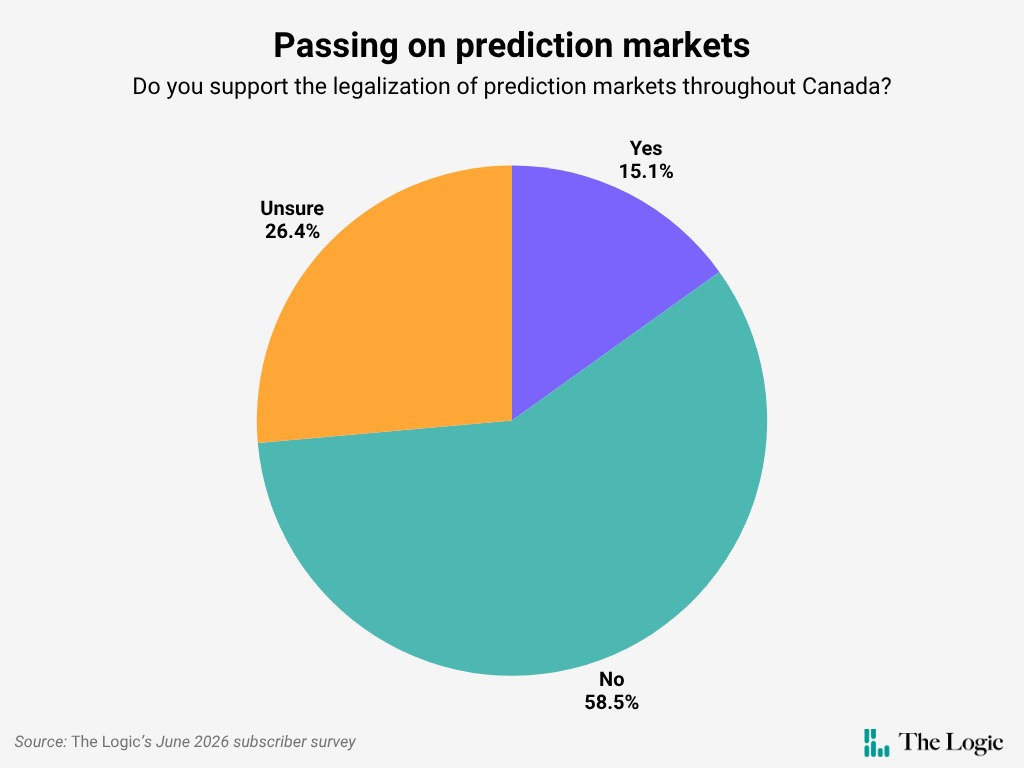
Both Kalshi and Polymarket have recently come under scrutiny, with regulators considering tighter insider trading controls and other parameters. Trading on controversial topics such as geopolitical conflicts and natural disasters has raised ethical concerns. Many readers cited similar market manipulation concerns as reasons they oppose legalization. Prediction markets create “incentives for well-placed agents to behave differently to benefit from their own prediction bets,” wrote one reader, while another said the platforms are “wide open to abuse” by people with insider information.
Almost 53 per cent of subscribers also said sports-betting platforms are not appropriately regulated in Canada, with only 13 per cent saying they are. Canadian law treats prediction market contracts as financial derivatives, rather than as a form of gambling like sports betting. Many of The Logic’s readers said they felt prediction markets were closer to gambling than trading and that stricter regulations were needed as a result.
Readers opposed prediction markets in part because of concerns it could compound problem gambling already evident in the country’s US$4.1-billion sports-betting market. One reader said they don’t want prediction markets in Canada because they have family members who struggle with gambling addiction. “The house always wins. Gambling has destroyed many lives,” wrote another reader.
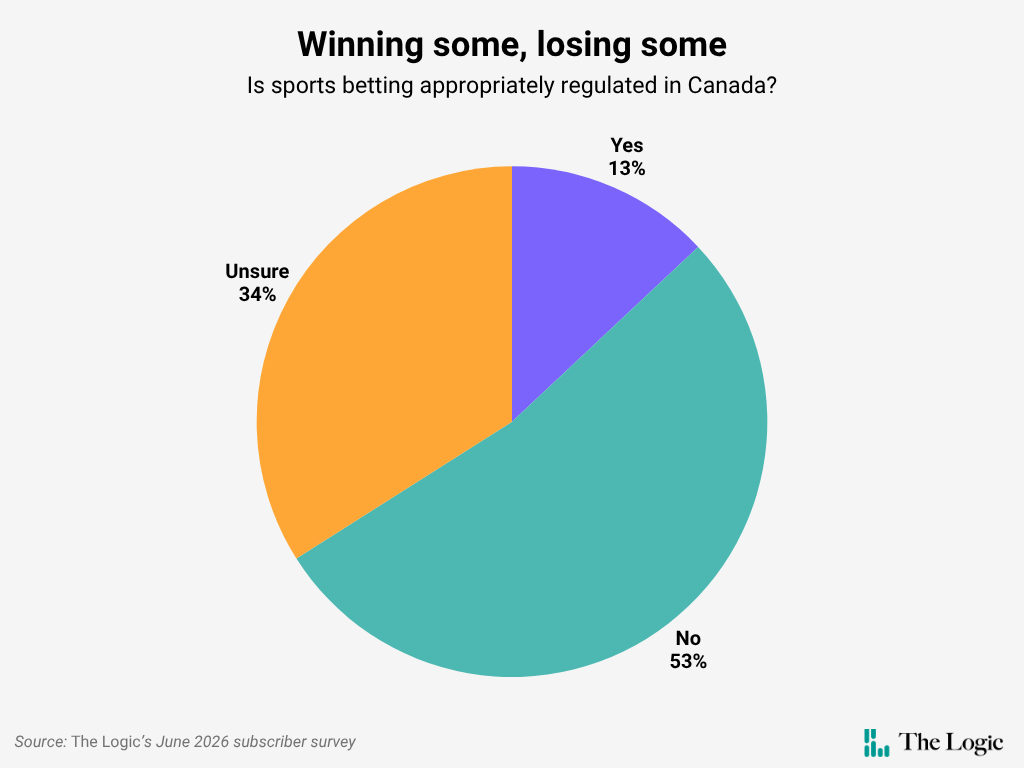
Some subscribers pointed to the proliferation of sports-betting advertisements on streaming platforms, from online sportsbooks like Bet365 and FanDuel, as evidence of the problem. One reader wrote that the volume of sports-betting ads “is ample evidence that the door has swung open too wide.” Another said they find the “omnipresence” of sports-betting ads “nauseating.”
Some readers felt prediction markets are inherently unethical, with one reader calling them “cruel and inhumane.” Another subscriber said they felt that prediction markets seek to “financialize all human behaviour,” which they called “fundamentally anti-human.”
“It treats events like entertainment, rather than consequential matters that affect people’s lives,” wrote one subscriber. “I believe betting on real-world events decreases empathy and desensitizes people from the impact beyond [their] winnings.”
Proponents of prediction markets say they’re sources of potentially valuable crowd-sourced data that could be used to improve business forecasting. Readers who said they supported legalization of prediction markets cited tax revenue and data collection as reasons. “Group wisdom is by far the best predictor of actual outcomes,” wrote one subscriber. “The fact that there are bad actors should not stop adoption.”
Only about a quarter of readers believed prediction markets have value beyond serving as trading platforms.
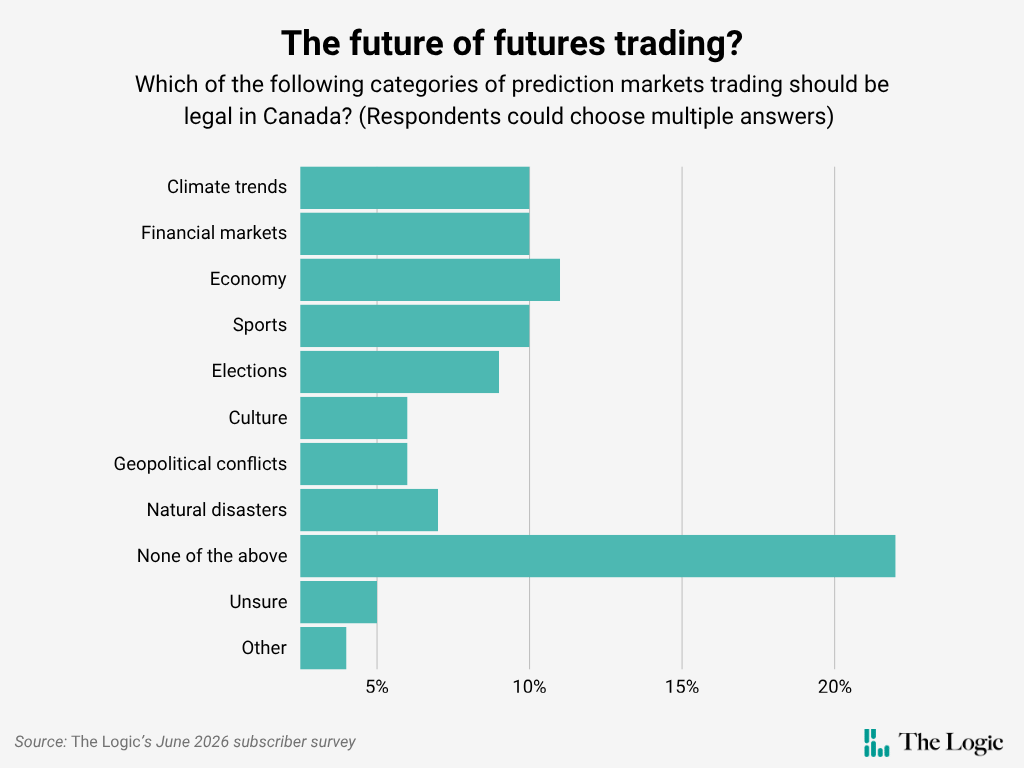
Twenty-two per cent of readers said they did not support the legalization of any of the prediction market contract topics included in the poll. Only a fraction of subscribers said they support the legalization of betting on the economy (11 per cent), financial markets (10 per cent) or climate trends (10 per cent)—the three prediction contract topics currently allowed in Canada.
One reader said that while they could support broader legalization of prediction markets if certain regulatory conditions were met, the chances those criteria could be satisfied are slim. “Placing the odd bet isn’t technically hurting [anyone], but the safeguards to protect those with gambling addictions or financial difficulties simply aren’t there—and it’s unlikely they ever could be,” they wrote.
Prediction markets are “filling in a gap left by the failed policies that eroded traditional paths to prosperity,” wrote another subscriber. “They are a symptom of a broken social contract.”













