Nearly two-thirds of subscribers aren’t expecting to return to the office full time, The Logic’s latest survey has found, with most saying their employer will likely choose flexible in-person and remote-work arrangements.
Skip to content



Subscriber Survey
Most employers opting for flexible work arrangements, subscribers say
Photo: Unsplash
Nearly two-thirds of subscribers aren’t expecting to return to the office full time, The Logic’s latest survey has found, with most saying their employer will likely choose flexible in-person and remote-work arrangements.
The Logic’s March survey found that nearly 64 per cent of respondents expect their companies to opt for flexible remote work. About 29 per cent said a mandatory hybrid remote-office schedule, where a certain number of days are required to be in-person per week, is most likely.
Methodology
The Logic emailed subscribers a private link to an online survey on March 21 and the survey closed March 23. Respondents’ identities were kept anonymous and duplicates were removed as needed. Subscribers were asked, “Does your organization plan to return to the office full time?” and could select: “Yes,” “No,” “Maybe” or “I don’t know.” For subscribers who answered yes, they were asked, “When are you expected to return to the office full time?” and their choices were: “I have already returned,” “Spring/Summer 2022,” “Fall/Winter 2022,” “Later than the above,” or “No set date.” And for subscribers who answered no, they were asked, “What alternatives is your organization considering?” and they could select: “Mandatory full-time remote work,” “Mandatory hybrid remote/office work schedule,” “Flexible remote/office work,” “I don’t know,” or “Other.” Subscribers were also asked “Has your company introduced any perks to bring you back to the office?” and could select: “Yes,” “No,” or “I don’t know.” Lastly, subscribers were asked, “How would or do you feel about a full-time return to the office at your organization?” Their choices were: “Very negatively,” “Somewhat negatively,” “Neither,” “Somewhat positively,” or “Very positively.”
One subscriber said a mandatory hybrid schedule was put in place as a “transition period until [the] fall,” for in-person work.
“We have always had [flexible] options where it was generally fine for people to work from home if they had no other meetings and [had to] catch up on paperwork and email. We are returning to that culture,” another subscriber wrote about their workplace.
Just 4.4 per cent of respondents not fully returning to the office are shifting to mandated full-time remote work.
The results come as many parts of Canada ease restrictions, despite signs of a sixth wave as COVID-19 cases tick up again. Major financial institutions like Manulife, Scotiabank and CIBC have started reintroducing in-person work on a voluntary basis, allowing for hybrid arrangements.
Meanwhile, Apple has set an April 11 deadline for corporate staff to return to the office at least one day per week, ultimately requiring in-person work at least three days a week by May 23. There are other signs that office life may not be a thing of the past: Big Tech companies have been a boon to commercial real estate demand during COVID-19, with Google last month making the biggest single-building commercial real estate deal in New York City since the pandemic began.
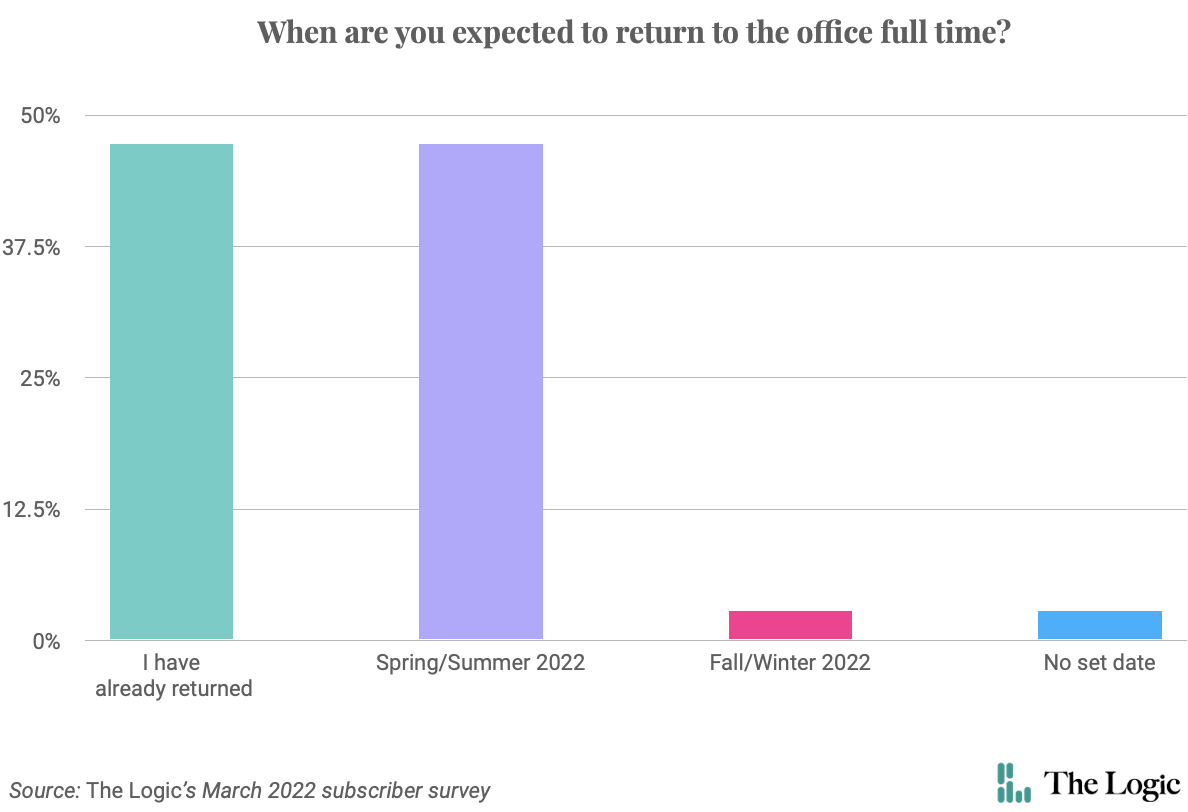
About 47 per cent of respondents said they have already returned to the office full time. Another 47 per cent said they expect to be working five days a week in an office by the spring or summer.
Other companies are implementing a slower transition to in-office work.
“[It is] more a hybrid model [with] one to two days a week, with [the] office more like a co-working space compared to a formal, fixed-office assignment,” said a subscriber.
Hootsuite, a social media management platform based in Vancouver, has adjusted its workspace, promoting wellness, relaxation and flexibility, after many of its employees expressed wanting to work in-person occasionally.
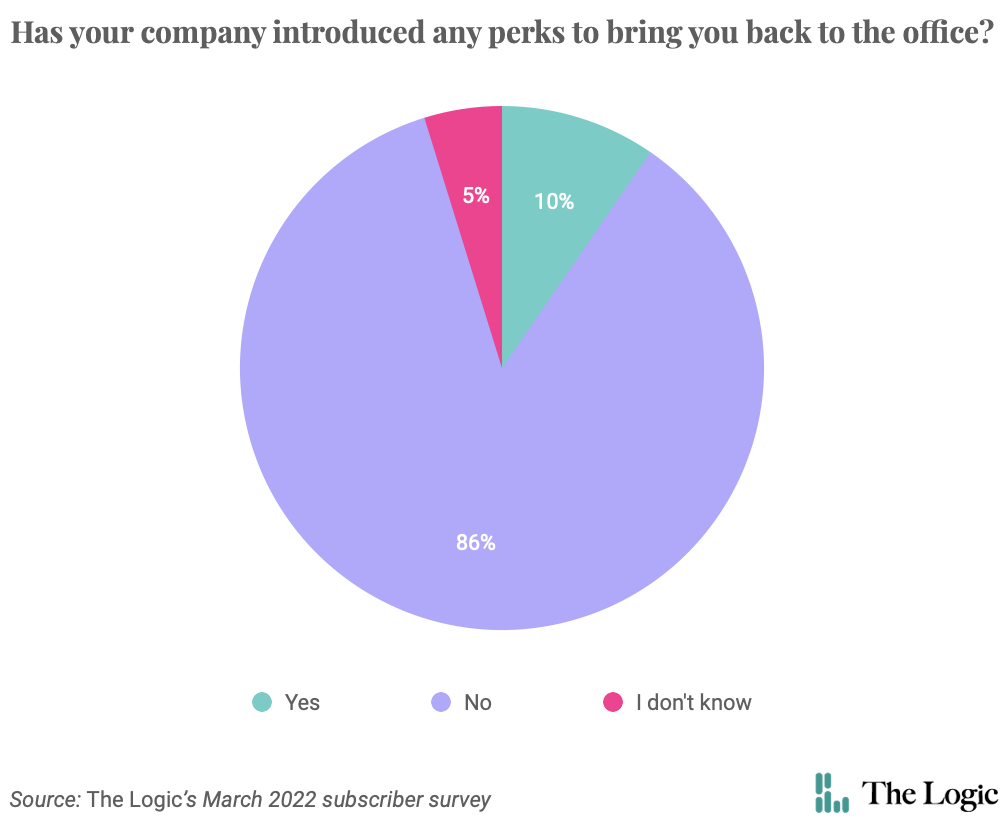
When asked whether they were offered any perks to return to the office, about 86 per cent of respondents said they were not. Of the 9.6 per cent who were, a few perks mentioned were social events, flexible time and a newly renovated workplace.
About 40 per cent of respondents said they feel very negatively about returning full time to the office, up from 37 per cent from The Logic’s July 2021 survey. Nearly 30 per cent said they feel somewhat negatively.
“Our company grew through the pandemic so many of our staff are outside our founding city. It wouldn’t even be feasible to ask everyone to come back into the office,” one subscriber wrote.
Around 15 per cent of subscribers said they feel very positively about returning to full-time in-person work, and 11 per cent said somewhat positively.
A subscriber said, “Trying to get anyone to collaborate or work together when they are working remotely is an impossibility. The ability for new people to integrate or get mentored is also affected.”
One respondent wrote simply that they “miss the human interaction.”



Loading...
Thanks for sharing!
You have shared 5 articles this month and reached the maximum amount of shares available.
CloseThis account has reached its share limit.
If you would like to purchase a sharing license please contact The Logic support at [email protected].
CloseGift the full article!
You have gifted 0 article(s) this month and have 5 remaining.
Recipients will be able to read the full text of the article after submitting their email address. They will not have access to other articles or subscriber benefits.
Photo: Unsplash
Most Popular This Week




In-depth, agenda-setting reporting
Great journalism delivered straight to your inbox.
News
Adam Waterous proposes massive crude exports to Asia by rail through northern B.C.
Briefing
Rivals may be ‘horrified’ to realize how exposed their investments are to AI, Aviva CIO warns
Shopify, Sequoia co-lead US$200M investment in online-selling platform Whop
Amid revenue gains, 1Password bets on tools to protect data from AI agents
Best business newsletter in Canada
Get up to speed in minutes with insights and analysis on the most important stories of the day, every weekday.
Exclusive events
See the bigger picture with reporters and industry experts in subscriber-exclusive events.
Membership in The Logic Council
Membership provides access to our popular Slack channel, participation in subscriber surveys and invitations to exclusive events with our journalists and special guests.







