Most subscribers don’t expect to return to office-based work full time once the COVID-19 pandemic has passed, The Logic’s latest survey has found, with nearly three-quarters expecting that hybrid arrangements of in-person and remote work will stick.
Skip to content


Subscriber Survey
Putting off return-to-office plans is fine by us, subscribers say
Most subscribers don’t expect to return to office-based work full time once the COVID-19 pandemic has passed, The Logic’s latest survey has found. Photo: Yasmina H/Unsplash
Most subscribers don’t expect to return to office-based work full time once the COVID-19 pandemic has passed, The Logic’s latest survey has found, with nearly three-quarters expecting that hybrid arrangements of in-person and remote work will stick.
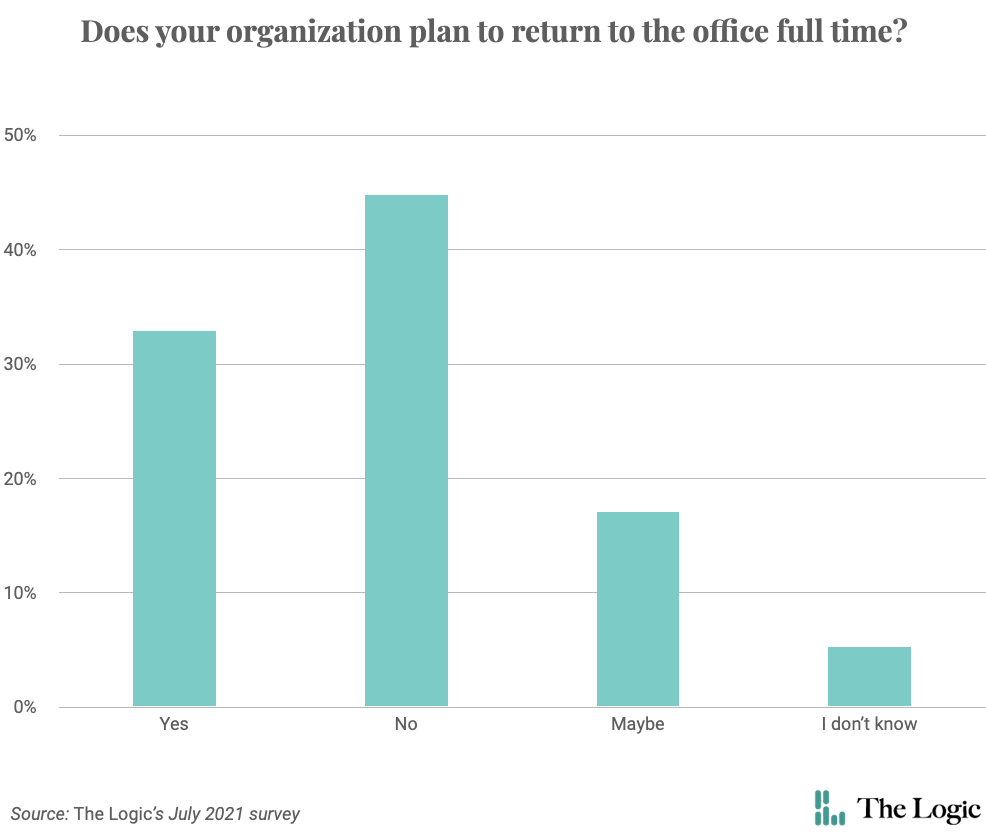
Nearly 45 per cent of respondents in the July survey said their organizations don’t have full return-to-work plans. Thirty-three per cent said theirs do and 17 per cent said theirs might.
Of those that do have return-to-the-office plans, half of respondents said they’re going back this fall. A further 16 per cent of respondents are expecting to return in winter.
“We have been remote since March 13, 2020. We moved 500 employees to [working from home] and haven’t missed a beat. We’ll employ our new hybrid approach starting with a return to office in January 2022,” wrote one respondent.
Methodology
The Logic emailed subscribers a private link to an online survey on July 27 and the survey closed July 29. Respondents’ identities were kept anonymous and duplicates were removed as needed. Subscribers were asked: “Does your organization plan to return to the office full time?” Their choices were: “Yes,” “No,” “Maybe” and “I don’t know.” Those whose organizations aren’t planning to return full time were asked to indicate the alternatives they’re considering, including “Full-time remote work,” “Optional return to the office,” “Hybrid remote/office work schedule,” “Flexible remote/office work,” “I don’t know” and “Other.” Those whose organizations are expecting to return full time were asked when, with the options being “Have returned already,” “Summer 2021,” “Fall 2021,” “Winter 2021-2,” “Spring 2022,” “No set date,” “Not planning a return” and “I don’t know.”
“We have started to return to the office in some regions and are evaluating the results and required protocols,” another respondent wrote.
Alphabet CEO Sundar Pichai wrote publicly this week about how the global tech giant is grappling with the situation.
“I have to say it’s been great to see Googlers brainstorming around whiteboards and enjoying meals in cafes again in the many offices that have already re-opened globally,” he said in an internal email the company posted publicly. But Google is also extending its worldwide voluntary work-from-home policy until at least Oct. 18 and anyone who does go back to a Google office will need to be vaccinated against COVID-19, he added.
The tech giant isn’t alone in taking such precautions. Apple is reportedly pushing its return-to-the-office plans back to at least October. LinkedIn said Thursday its leaders have changed their minds on workers returning to the office.
This is a tricky time to make plans, anyway: “The details have not been fully published and communicated,” wrote another respondent to The Logic’s survey, who expects a return to offices in the autumn. “Summer leave has priority.”
And with COVID-19 still not vanquished—Australia is struggling with a severe outbreak, Japan is seeing its highest case counts yet amid its Tokyo Summer Olympics, and what might happen when children too young to be vaccinated return to school in the fall isn’t clear—a broader uncertainty still applies.
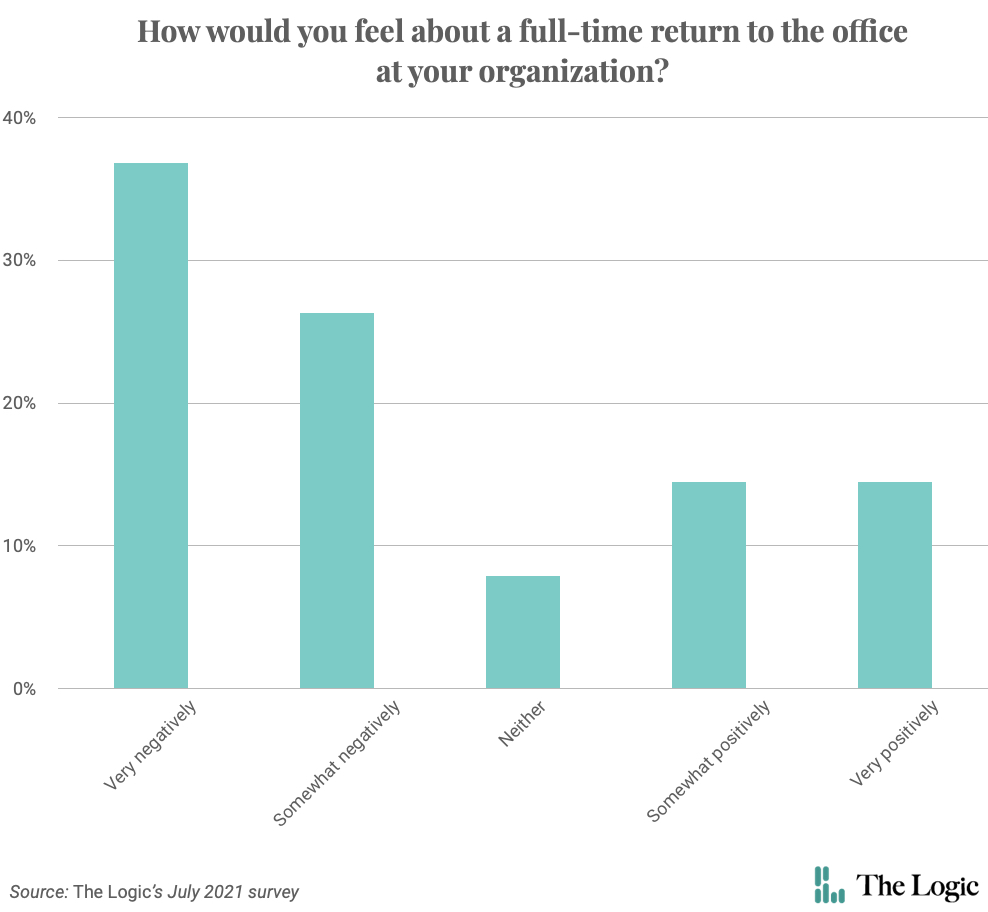
Nearly 37 per cent of respondents said they would regard a full-time return to the office very negatively, and 26 per cent would see it somewhat negatively. About 15 per cent each would see it either somewhat or very positively.
Business measures adopted in the midst of an emergency are still in use and some subscribers are concerned about how they’ll be adapted as permanent conditions.
“They have talked a lot about hybrid and remote but not really invested in the management support mechanisms and communication channels,” one subscriber wrote.
“Some of us have returned already, although I note management hasn’t!” wrote another.
However this part of post-pandemic life shakes out, subscribers are overwhelmingly positive about the capacity of the Canadian economy to bounce back, with 51 per cent saying they were somewhat optimistic and 32 per cent very optimistic.
“A lot of people are itching to spend some money,” was one respondent’s optimistic view.
On the negative: “The recovery is going to be lumpy/uneven. Some sectors will recover well and others are booming (tech) while others will really struggle (and have been).”
As for the longer-term future, 72 per cent of respondents either somewhat or strongly agreed with the idea that the pandemic will lead to prolonged, structural reorganization of the global economy. Several of those who offered specifics noted that both large companies and countries have seen that it can be hazardous to rely on foreign suppliers in times of crisis.
We’ll see “more nationalism and less globalization,” one respondent wrote. ”Countries need to have their own supply chain for critical supplies.”
Another wrote that battle lines are being drawn between the United States and its allies and China and its allies, leading to “the end of globalization as we know it.”



Loading...
Thanks for sharing!
You have shared 5 articles this month and reached the maximum amount of shares available.
CloseThis account has reached its share limit.
If you would like to purchase a sharing license please contact The Logic support at [email protected].
CloseGift the full article!
You have gifted 0 article(s) this month and have 5 remaining.
Recipients will be able to read the full text of the article after submitting their email address. They will not have access to other articles or subscriber benefits.
Photo: Yasmina H/Unsplash
Most Popular This Week




In-depth, agenda-setting reporting
Great journalism delivered straight to your inbox.
The Big Read
Beacon is building an AI empire by fixing Main Street’s software
Briefing
Canadian auto workers at Stellantis overwhelmingly support strike mandate
Inflation edges higher ahead of next BoC rate decision
EverWind plans $10B data centre and wind development in Nova Scotia
Best business newsletter in Canada
Get up to speed in minutes with insights and analysis on the most important stories of the day, every weekday.
Exclusive events
See the bigger picture with reporters and industry experts in subscriber-exclusive events.
Membership in The Logic Council
Membership provides access to our popular Slack channel, participation in subscriber surveys and invitations to exclusive events with our journalists and special guests.







