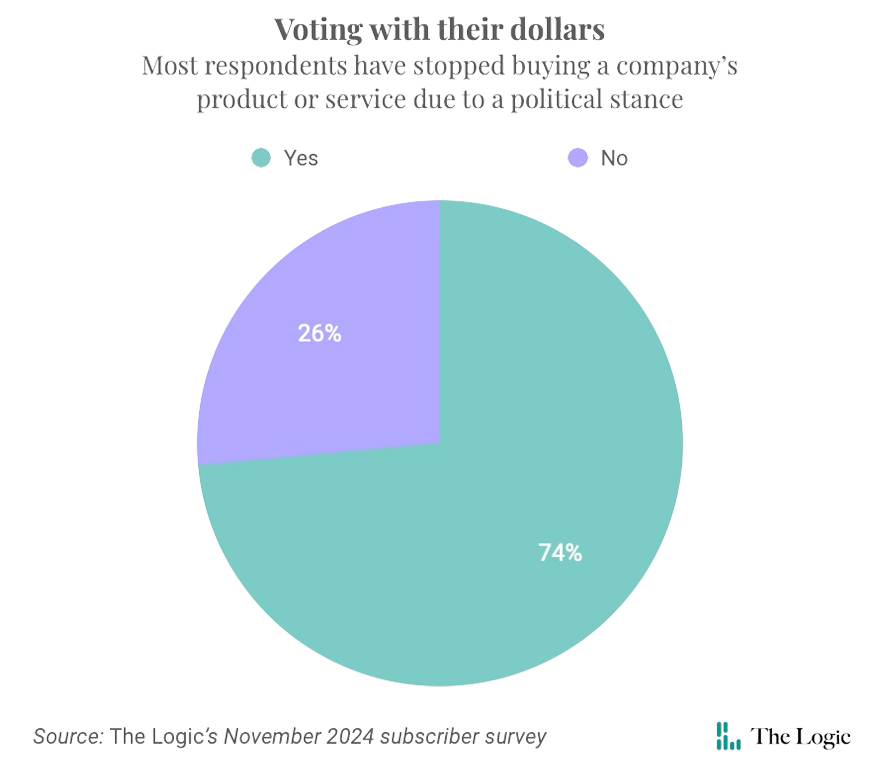
Almost three-quarters of respondents to The Logic’s latest survey say they have stopped buying a product based on a company’s political stance, such as avoiding or abstaining from Tesla, X, Starbucks, Ben & Jerry’s and Loblaw.
Skip to content
 Elon Musk speaks before Donald Trump at a campaign rally at Madison Square Garden, on Oct. 27, 2024, in New York. Photo: The Associated Press/Evan Vucci

Subscriber Survey
People might work for a company they don’t agree with—but they won’t buy from them
Almost 75% of respondents to The Logic’s subscriber survey say they’ve dropped a company’s products over a political stance
Elon Musk speaks before Donald Trump at a campaign rally at Madison Square Garden, on Oct. 27, 2024, in New York. Photo: The Associated Press/Evan Vucci
Almost three-quarters of respondents to The Logic’s latest survey say they have stopped buying a product based on a company’s political stance, such as avoiding or abstaining from Tesla, X, Starbucks, Ben & Jerry’s and Loblaw.
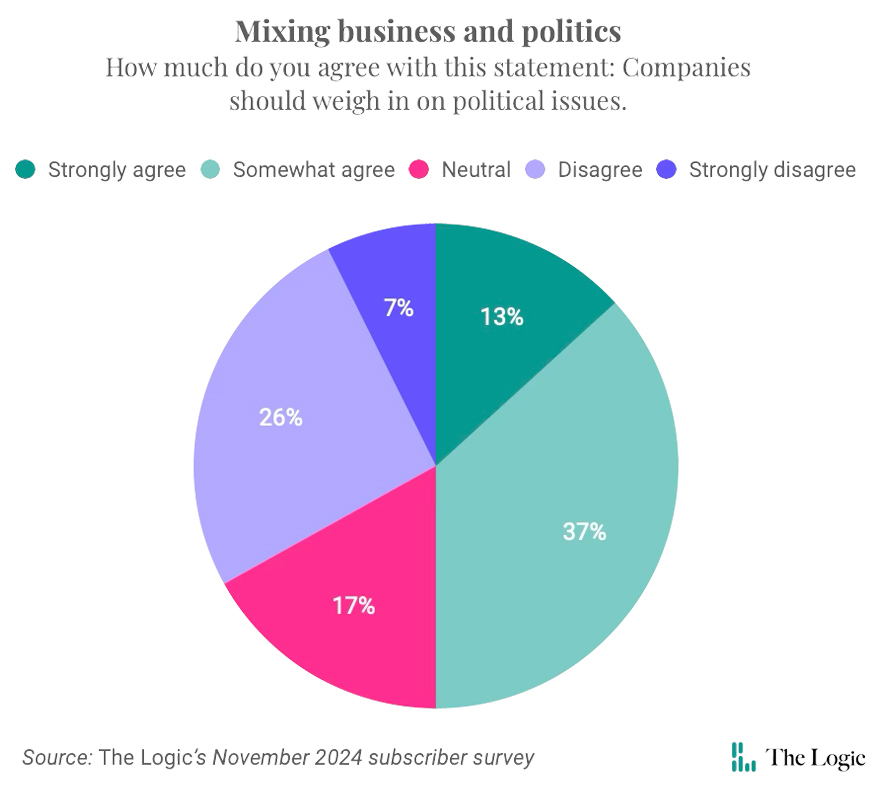
Half of respondents also said the political stance of a company somewhat affects their willingness to buy or use the product, and that they agree to some degree that companies should take political stances (compared to 33 per cent who disagree).
This month, The Logic asked subscribers what they think of such stances in the workplace and marketplace. Companies are increasingly entangled in social and political issues, from customer boycotts, to Elon Musk’s support of U.S. president-elect Donald Trump and Shopify CEO Tobi Lütke’s criticism of the recent Canada Post strike.
Subscribers’ reasons for abstaining from products varied. One respondent said they didn’t buy South African wines during apartheid, which ended in 1994, and another said they didn’t go to U.S. restaurant Cracker Barrel because of its “anti-gay hiring policies” in the early 1990s. Several expressed negative opinions towards anti-competitive or “greedy” grocery and food companies, and one respondent said they weren’t buying from businesses that supported the Freedom Convoy protest in early 2022.
Related Articles


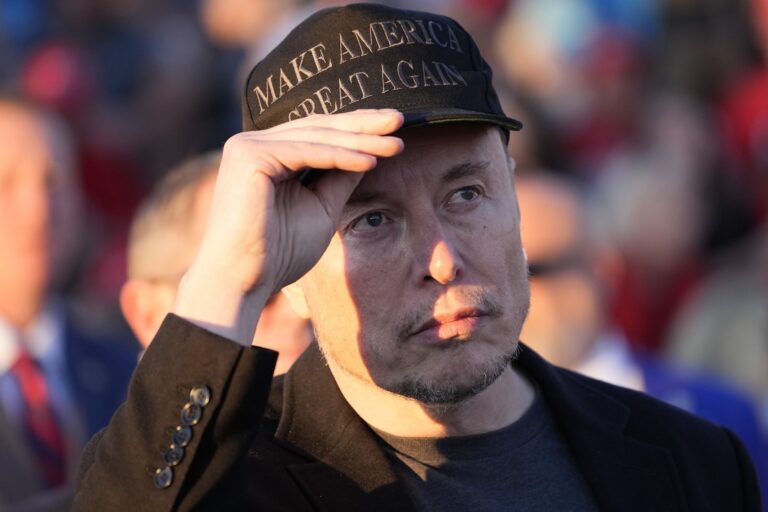
Some respondents said they now avoid using Musk’s products, including X and Tesla. X’s competitor Bluesky saw a 500 per cent increase in traffic as more than 115,000 users jumped from Musk’s platform in the days after he was tapped for Trump’s “Department of Government Efficiency.”
One reader “deliberately” chose not to purchase Musk’s vehicle last year when purchasing an EV for the first time. Another said: “I now have a bumper sticker on my Tesla that says I bought this before I knew Elon was crazy.”
Subscribers also said they were disappointed with business leaders expressing “self-interested” viewpoints. One said Shopify’s Lütke makes “too many public statements about how Canada should be changed to suit his ideas of increasing his own power.”
Another respondent said they no longer read The Washington Post, which is owned by Amazon founder Jeff Bezos. Some said they had stopped buying from Amazon—something that was “actually really inconvenient since there is no reasonable competition to this service.”
Their purchasing habits didn’t always line up with their values, one reader said: ”I talk the talk, but don’t fully walk the walk. I have ceased to purchase products, but this often amounts to a boycott for a year or two then returning to the fold.”
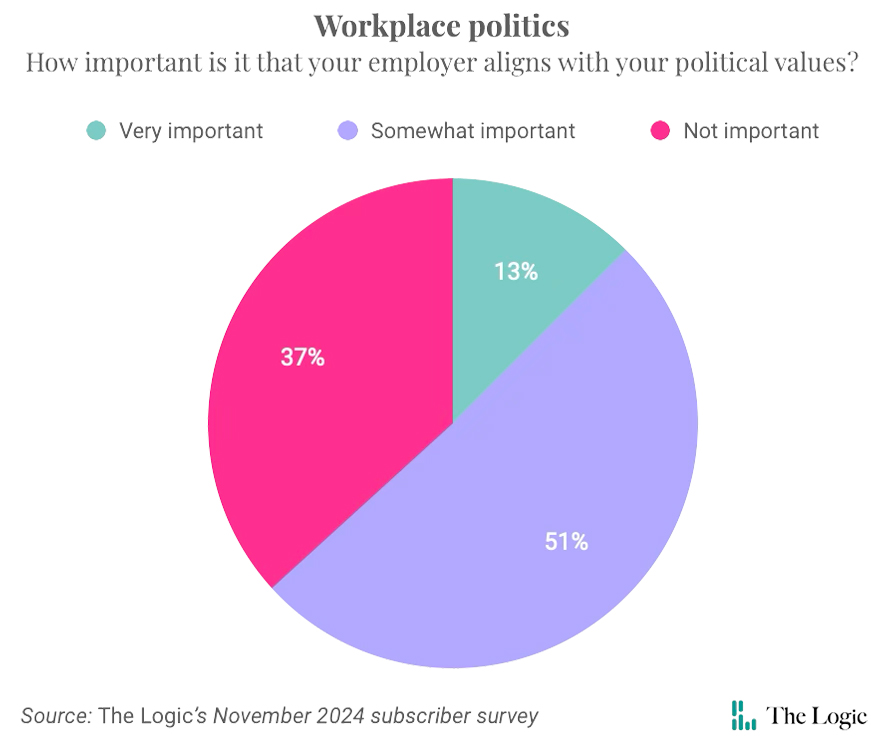
Subscribers disagreed on the importance of an employer aligning publicly with their political values. The top answer was “somewhat” at 50 per cent, followed by “not important” at 37 per cent.
Some respondents were more concerned with the integrity of their employer’s internal practices over their public political beliefs, valuing “quiet actions” over “loud statements.” Another reader said it would be difficult to work for a place that was hostile to their core beliefs.
“It is not realistic to expect a corporate employer to align with my personal political views,” one respondent said. “But there are things that my employer could choose to do that I would lobby internally against and potentially refuse to participate in, even at the peril of my employment.”
CEOs or company leaders who responded to the survey said it was very important to be politically aligned with their company. But others said financial constraints meant they couldn’t afford to be choosy.
One reader said that if they cared “too much” about an employer’s political values, they would have been unemployed for most of their life.
Readers were similarly split on whether companies should have policies on their employees’ public stances, with 57 per cent indicating they should and 43 per cent indicating they shouldn’t.
Workers’ engagement in political action has become increasingly contentious in the past year. In April 2024, Google fired 50 employees for protesting the company’s contract with the Israeli government. In October 2023, Web Summit CEO Paddy Cosgrave stepped down (though he later returned) after he criticized Israel in a post that said, “war crimes are war crimes even when committed by allies.”
“I think it’s in [a company’s] best interest to understand when it makes sense to engage, and when they will not,” one respondent said, adding that companies should share those parameters with staff.
When it comes to corporate responsibility to speak out on politics, many respondents indicated companies should play a part, but ultimately “people vote, not corporations.” Many reflected on the line between what is considered a political or non-political issue—the human rights of women and LGBTQ+ people, for example, should be “supported without hesitation,” one respondent said.
“Companies have a responsibility to engage with social issues because companies are not in a vacuum, but also companies are there to make money,” another said. “We should have regulators and government agencies that protect the rights of the public and the state.”
Methodology
The Logic emailed subscribers a link to a survey on Nov. 20 and the survey closed Nov. 25. Respondents’ identities were kept anonymous. Subscribers were first asked, “How much do you agree with this statement: Companies should weigh in on political issues” and could answer “Strongly agree,” “Somewhat agree,” “Neutral,” “Disagree” or “Strongly Disagree.” Next, they were asked, “How much does the political stance of a company affect your willingness to buy or use their products?” and could answer “Very much,” “Somewhat,” “Very little” or “Not at all.” Next, they were asked, “Have you stopped buying or using a company’s product or service because of their stance on a political issue?” and could answer “Yes” or “No.” Next, they were asked “How important is it to you that your employer aligns publicly with your political values?” and could answer “Very important,” “Somewhat important” or “Not important.”
Finally, readers were asked an open-ended question and invited to provide an answer. The question was: “Do you think companies have a responsibility to engage in political and social issues? Why or why not?”



Loading...
Thanks for sharing!
You have shared 5 articles this month and reached the maximum amount of shares available.
CloseThis account has reached its share limit.
If you would like to purchase a sharing license please contact The Logic support at [email protected].
CloseGift the full article!
You have gifted 0 article(s) this month and have 5 remaining.
Recipients will be able to read the full text of the article after submitting their email address. They will not have access to other articles or subscriber benefits.
Photo: The Associated Press/Evan Vucci
Most Popular This Week




In-depth, agenda-setting reporting
Great journalism delivered straight to your inbox.
News
Anthropic revealed as client for EverWind’s $10B Nova Scotia data centre
Briefing
EverWind plans $10B data centre and wind development in Nova Scotia
Canada ready to force Stelco to sell its Canadian operations, Joly says
Feds plan a 60 MW defence-oriented data centre for Ottawa
Best business newsletter in Canada
Get up to speed in minutes with insights and analysis on the most important stories of the day, every weekday.
Exclusive events
See the bigger picture with reporters and industry experts in subscriber-exclusive events.
Membership in The Logic Council
Membership provides access to our popular Slack channel, participation in subscriber surveys and invitations to exclusive events with our journalists and special guests.






