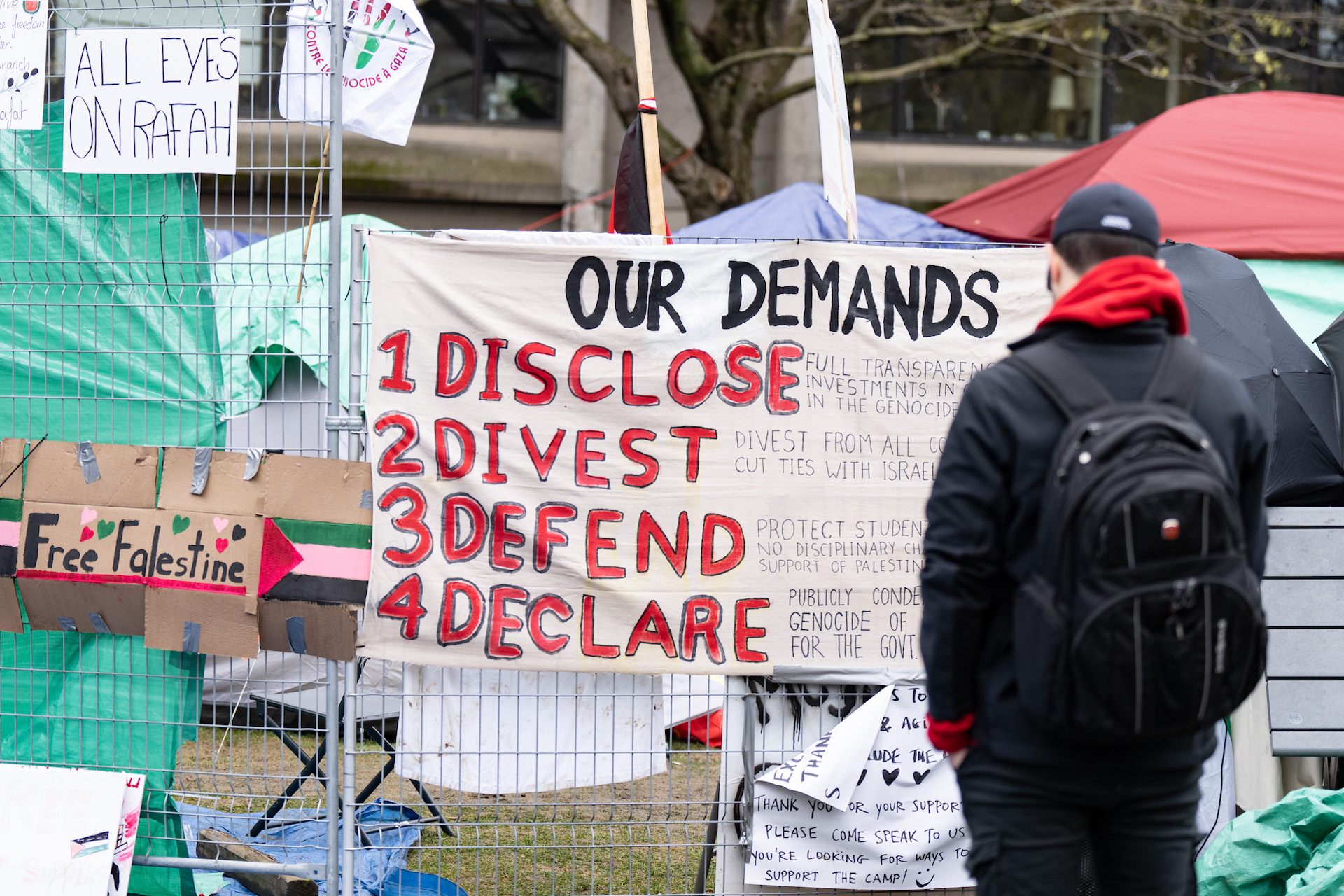
MONTREAL — The protesters entrenched on McGill University’s campus have a straightforward demand: cease investing in Israeli companies as well as those that do business in or with Israel, and unload any existing investment as well. Until then, we are staying put.
Skip to content

Commentary: Quebec Ink
The divestiture campaign at McGill and beyond is bound to fail. Maybe that’s the point
Asking an institution to target companies that don’t deserve it makes little sense—unless you want to make the institution look bad
Demands posted outside the protest encampment on McGill University's campus in Montreal, on April 30, 2024. Photo: The Canadian Press/Christinne Muschi
MONTREAL — The protesters entrenched on McGill University’s campus have a straightforward demand: cease investing in Israeli companies as well as those that do business in or with Israel, and unload any existing investment as well. Until then, we are staying put.
History would seem to shine on the fenced-in cluster of tents huddled just beyond McGill’s Roddick Gates. The university divested itself of investments in tobacco, oil and gas and apartheid-era South Africa, thanks in no small part to student-led pressure campaigns. Ditto the University of British Columbia and University of Toronto. It’s a reminder how purposeful obstinacy, a cornerstone of legitimate protest, tends to work like hell in functioning democracies.
Yet that noise emanating from McGill—as well as UBC and U of T and the University of Ottawa, where similar protests have sprung up—isn’t just heated rhetoric. It’s the sound of frustration, as the history of protest-driven divestment seems poised to take a turn. Make no mistake: the universities won’t cease investing in Israeli companies and those doing business with them. There are several reasons for this, not least that the list of targeted companies is voluminous to the point it suggests delusion on the part of the protesters.
The protests have highlighted the horrors visited upon tens of thousands of civilians killed or wounded since Israel’s devastating attack on Gaza in response to the Hamas-led massacre of Oct. 7. But they’re also a reminder of the complexities behind divestment campaigns—and of Israel’s critical importance in the world of business and tech. “Divestment from Israel is not going to happen,” Christopher Marsicano, the director of the College Crisis Initiative at Davidson College in North Carolina, told me recently.
Related Articles


First, let’s consider the targeted companies. Organizers of the McGill protest have referenced a list of some 50 companies in which McGill has a stake, and which they say make McGill complicit in supporting the “apartheid state” that is Israel. There are a few logical targets on it, including Lockheed Martin and Airbus, both of which have supplied Israel with military hardware.
Also on the list? United Therapeutics Corp, because it partnered with an Israeli company to produce 3D-printed kidneys. Charles River Laboratories makes an appearance, for the sin of practising life sciences in the country, as well as the Toronto Dominion Bank, in part for its stated goal to “support and work along Israeli startups in order to develop the next generation of secure financial technologies and applications.” Shopify also shows up, if only because the Ottawa-based company “plans to develop tools for [the] Israeli e-commerce market.”
Apart from highlighting the absurdity of the divestment demands, the list underscores the importance of Israel’s tech sector on the world stage. The country is known as Start-Up Nation for a reason. It has more than 7,200 startups and tech companies within its borders. This includes more than 850 climate tech companies—which have been crucial to decarbonization efforts, including oil divestment campaigns.
“I wouldn’t consider myself to be particularly pro-Israel,” Marsicano, who researches how higher learning institutions affect public policy, told me. “But you cannot deny the fact that the Israeli economy is high-tech, high-service in ways that are doing innovative things that help with ESG strategy and environmental challenges.”
Oil divestment pushes are simple, in that there is a checklist of fossil fuel companies who’ve been named and shamed many times over. Convincing institutions to boycott a country like Israel is exponentially more difficult, because the vast majority of the companies on the list are doing little more than renting hotel rooms, hawking soda pop and selling soap, among other benign capitalistic endeavours. As such, they are hardly legitimate targets.
Protesters at McGill, UBC and U of T want the world to equate Israel with apartheid-era South Africa, and act accordingly. Yet even if you accept the analogy in moral terms, the economic comparison doesn’t hold. South Africa was a pariah state long before apartheid was snuffed out, with foreign investment collapsing to two per cent of the country’s GDP 17 years before Nelson Mandela was elected president. The same can’t be said for Israel, where foreign investment has risen since the Boycott, Divestment and Sanctions campaign against it began in 2005.
“I think that the leaders of the movement have to take a step back and say, ‘Even if the reasons for protest are understandable, are we perhaps inhibiting progressive economic forces that may help us to achieve other desirable goals?’” as McGill philosophy professor Daniel Weinstock told me.
It’s possible that in making impossible demands of McGill and other universities, the protesters are purposefully setting themselves up for failure—if only to vilify the institutions themselves. If this is the case, they’re well on their way to success.
Martin Patriquin is The Logic’s Quebec correspondent. He joined in 2019 after 10 years as Quebec bureau chief for Maclean’s. A National Magazine Award and SABEW winner, he has written for The New York Times, The Guardian, The Walrus, Vice, BuzzFeed and The Globe and Mail, among others. He is also a panelist on CBC’s “Power & Politics.”



Loading...
Thanks for sharing!
You have shared 5 articles this month and reached the maximum amount of shares available.
CloseThis account has reached its share limit.
If you would like to purchase a sharing license please contact The Logic support at [email protected].
CloseGift the full article!
You have gifted 0 article(s) this month and have 5 remaining.
Recipients will be able to read the full text of the article after submitting their email address. They will not have access to other articles or subscriber benefits.
Photo: The Canadian Press/Christinne Muschi
Most Popular This Week




In-depth, agenda-setting reporting
Great journalism delivered straight to your inbox.
The Big Read
Beacon is building an AI empire by fixing Main Street’s software
Briefing
Inovia raises US$200M for new VC fund as it eyes AI’s impact
43% of eligible Albertans voted ahead of Monday’s referendum
AI chip company Tenstorrent raises US$1.5B, valuing it at US$6.2B
Best business newsletter in Canada
Get up to speed in minutes with insights and analysis on the most important stories of the day, every weekday.
Exclusive events
See the bigger picture with reporters and industry experts in subscriber-exclusive events.
Membership in The Logic Council
Membership provides access to our popular Slack channel, participation in subscriber surveys and invitations to exclusive events with our journalists and special guests.