MONTREAL — The federal government will soon introduce legislation that will let the country’s news publishers bargain collectively with Big Tech companies like Google and Meta, and will compel them into binding arbitration if they can’t come to an agreement on a price for news content published on the companies platforms, multiple sources told The Logic.
Skip to content

Commentary: Quebec Ink
Liberals to give news publishers right to bargain collectively with Big Tech over payments
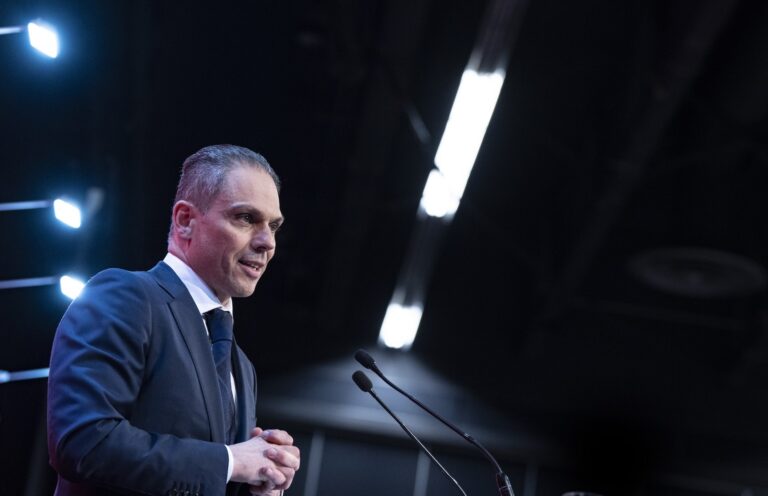
Canadian Heritage Minister Pablo Rodriguez rises during Question Period in December 2021 in Ottawa. Photo: The Canadian Press/Adrian Wyld
MONTREAL — The federal government will soon introduce legislation that will let the country’s news publishers bargain collectively with Big Tech companies like Google and Meta, and will compel them into binding arbitration if they can’t come to an agreement on a price for news content published on the companies platforms, multiple sources told The Logic.
That, folks, is what they call a newsy lede, one I thought I’d be writing a year ago almost to the day, when then-heritage minister Steven Guilbeault was telling everyone—or at least, me—that such a thing was coming.
Talking Point
A year after promising it, the Liberal government is set to introduce legislation that will allow the country’s news publishers to negotiate collectively with Google and Meta—with an arbitrator at the ready, should things go pear-shaped. The proposed law would be a boon to the industry, which has long complained that Big Tech has used its content and starved it of ad revenue.
Except this time, it’s true. According to several stakeholder sources with whom I’ve spoken over the last week, some of whom asked they not be named in exchange for their candour, Heritage Minister Pablo Rodriguez will introduce the legislation as early as Feb. 3, a few days after Parliament wakes from its yuletide slumber. That will fulfill the task, laid out in Rodriguez’s mandate letter, of delivering a legislative solution to the news business’s longstanding gripe that Big Tech has used its content while starving it of ad revenue.
“The ability to negotiate collectively is what makes this valuable,” La Presse president Pierre-Elliott Levasseur told me. The law, he added, “will clearly help us going forward to ensure that we’re able to survive long term.”
The proposed law will be one of several pieces of legislation the Liberals will introduce to regulate the internet, including a successor to the abandoned C-10 that will update the country’s Broadcasting Act for the online age, and another regarding the policing of online harms.
The news-publishers remuneration legislation will be based on the Australian law, which came into effect in February 2021. The broad strokes of the Canadian legislation are simple enough. The big news is the Liberals’ decision to let publishers collectively bargain over the price that the Big Tech behemoths like Google and Facebook parent company Meta will pay for content appearing on their platforms.
Should the parties not come to an agreement, a government-appointed arbitrator will essentially pick a side. Exactly how the arbitrator would determine how much money each publication would receive is still up in the air, but I’m told by a source one possibility would see it be based on the number of editorial staff.
“Journalists, publishers, and news organizations believe that the Australian legislation is fair,” Rodriguez told me via email. “There will be elements in our bill that are specifically Canadian in the legislation we’re going to introduce. Our priority is to hold tech giants accountable in a way that makes the internet fairer and more competitive for Canadian journalists and news organizations.”
News publishers have long pined for this kind of so-called “baseball legislation.” Though some have signed deals with both Meta and Google, others with whom I’ve spoken say the offers they’ve received have been parsimonious.
Nonetheless, giving publishers the ability to bargain collectively presents a problem for lawmakers and stakeholders alike: what, exactly, constitutes a news publisher? According to the people I’ve spoken with, the government will parse this legislative if not existential hurdle by limiting the bargaining unit to “qualified Canadian journalism organizations,” the Canada Revenue Agency designation under which some publishers qualify for tax credits. (The Logic is one of the QCJO qualifying publications.)
To be designated a QCJO, news-gathering organizations must meet criteria which include producing journalism “based on facts and multiple perspectives actively pursued, researched, analyzed and explained by a journalist for the organization.” This language poses its own problems, not the least of which is that it spills from the mouths of bureaucrats, and you can expect the fringey likes of Rebel News and True North to holler “censorship” if and when they are denied access to the club. (Of course, nothing is preventing non-QCJO news gatherers from negotiating independently with Google and Meta.)
The QCJO also excludes broadcast news, though Canadian Association of Broadcasters president Kevin Desjardins told me he’s had “positive indications” from Rodriguez’s office that television and radio news organizations will be included in the bargaining unit. As well, a number of publishers told me that letting rival media companies bargain as a unit will require a change in the Competition Act, which currently makes it an indictable offence to conspire with a competitor to fix prices.
The QCJO business aside, there isn’t a whiff of government intervention to the Australian model—just two sides negotiating, with an arbiter at the ready if things go off the rails.
Rod Sims, the chief legislative architect behind Australia’s model, told me last fall that news publishers were over the moon with the deals they secured after the law came into place, saying they were in some cases exponentially better than anything Google and Meta were offering before it hit the books.
All three major opposition parties have spoken out in favour of such legislation, at least in principle, meaning it could be the law of the land as early as June, after a relatively bump-free ride through Parliament. And while Conservatives will probably take umbrage at the alleged liberticide within Rodriguez’s impending proposed changes to the country’s Broadcasting Act—as they did last year, to great success—getting Big Tech to pay newspapers can’t as easily be construed as a constraint on free speech.
If Big Tech is not thrilled with the Australian model, it seems at least resigned to its imminent arrival in Canada. In the summer of 2020, Kevin Chan, at the time a senior global director and head of public policy for what was still known as Facebook, was at once livid at and dismissive of it, telling a group of publishers that such a thing wouldn’t happen in Canada—“not now not ever,” according to sources with whom I spoke.
That tune has now changed. “We are not able to provide a reaction to legislation until we have seen a draft, but we look forward to collaborating with the government to help find solutions that will empower a diverse range of voices to grow media businesses offering more news, information and entertainment options to Canadians,” Meta Canada spokesperson Lisa Laventure told me in an email last week. While Google Canada spokesperson Lauren Skelly called aspects of the Australian model “unworkable,” she nonetheless told me the company is “supportive of a code of conduct some have referred to as a bargaining code.”
Of course, this being government, things could still go pear-shaped. The Liberals have been talking about righting the media playing field in the country for years. Guilbeault promised a lot one year ago, to no avail. But put it this way: the odds that Google and Meta will pay Canadian publishers for the news appearing on their platforms have not yet been better.



Loading...
Thanks for sharing!
You have shared 5 articles this month and reached the maximum amount of shares available.
CloseThis account has reached its share limit.
If you would like to purchase a sharing license please contact The Logic support at [email protected].
CloseGift the full article!
You have gifted 0 article(s) this month and have 5 remaining.
Recipients will be able to read the full text of the article after submitting their email address. They will not have access to other articles or subscriber benefits.
Photo: The Canadian Press/Adrian Wyld
Most Popular This Week




In-depth, agenda-setting reporting
Great journalism delivered straight to your inbox.
News
National Bank CEO warns AI alone won’t give banks a lasting edge
Briefing
Canada and Ontario commit over $5B to support tariff-hit steel sector
Hackers will see cars as major targets in next 3 years, 83% of car-tech workers say
EA shutting down Edmonton studio BioWare
Best business newsletter in Canada
Get up to speed in minutes with insights and analysis on the most important stories of the day, every weekday.
Exclusive events
See the bigger picture with reporters and industry experts in subscriber-exclusive events.
Membership in The Logic Council
Membership provides access to our popular Slack channel, participation in subscriber surveys and invitations to exclusive events with our journalists and special guests.





