Skip to content

Commentary: Quebec Ink
Quebec shows the rest of North America the true impact of bike lanes
Behold, North America’s most bike-friendly cities of 2025. Number two will shock you.
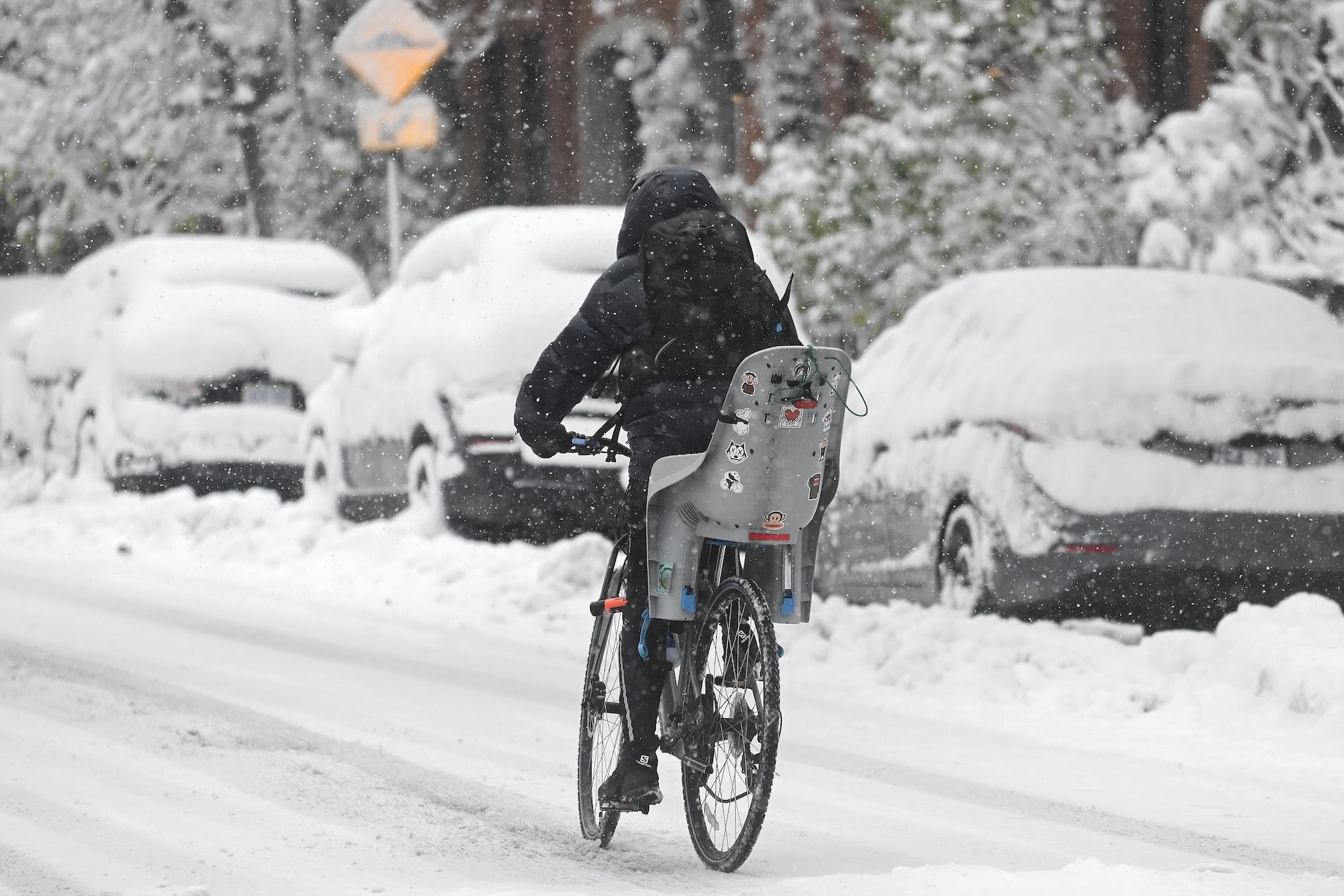
A winter cyclist in Montreal. The city, long-known for its extensive network of bike lanes, has seemingly inspired nearby Quebec City to go all-in on two-wheeled transport. Photo: Graham Hughes/NurPhoto via Getty Images
MONTREAL — November, winter’s prelude, is the beginning of comeuppance season for Quebec cyclists, when the argument for two-wheeled self-transport allegedly descends into a frozen hell. It goes something like this: cyclists, being exposed to the elements, are a fair-weather bunch, more than happy to pedal through sun and heat but not snow and darkness. Ergo, as recently elected city councillor Leslie Roberts argued last August, spending money on bike infrastructure is mostly a waste. “In Montreal, the cars aren’t going anywhere—and neither is winter,” Roberts wrote.
There are literally thousands of data points proving Roberts (and many, many others) wrong. I’ll pick one, on the corner of Saint-Denis and des Carrières in Montreal’s Rosemont neighbourhood. In January 2025, with the average temperature hovering at -8 degrees Celsius, the counter on the southbound bike path registered 13,116 trips—a nearly 90 per cent increase from the same month in 2021, according to City of Montreal data.
Other data points show similarly huge increases in winter ridership. Côte-Ste-Catherine and Stuart? 50 per cent increase during the same period. Viger and Saint-Urbain? A whopping 377 per cent. The amount of bike infrastructure in Montreal itself has increased 23 per cent, to nearly 1,100 kilometres, between 2019 and 2024.
Related Articles

The result: a doubling of the percentage of Montrealers who cycle as a means of transportation in five years—and the title of North America’s best cycling city, according to the Copenhagenize Index, a global tally of such things released last month. Montreal is also the coldest of the world’s best cities for cycling, en passant.
The success is clearly contagious. I nearly went over the bars when I read that Quebec City was ranked the second-best North American cycling metropolis, just below Montreal and above Vancouver. Not only is Quebec City as frigid as Vancouver is balmy—it’s even colder than Montreal—it’s also home to some of the more strident anti-cycling voices in the country.
On Quebec City airwaves, radio hosts regularly denigrate the practice, when not apparently urging their listeners to hit cyclists outright. Rather than bike paths, the city’s suburban population is clamouring for a $7-billion underground tunnel to bring roughly 50,000 cars a day to the downtown core. At $7 billion, it’s an expensive boondoggle-in-the-making that the provincial government wants to build anyway, if only because of the political importance of the suburb in question.
Quebec City has pedalled onward nonetheless. In 2021, the city launched electric bike-sharing platform àVelo. Three years later, those using the service were logging 1.3 million yearly trips. The Corridors VivaCité network is part of the city’s plan to add 150 kilometres of separated and dedicated bike paths by 2034. One of the side effects of its success: bike traffic jams.
All that pedalling has also helped Quebec City’s bottom line. Bicycle and pedestrian traffic has increased by a respective seven per cent and 94 per cent along Chemin St. Foy since the construction of VivaCité’s 2.4-kilometre swath along the downtown corridor. It has resulted in a 10 per cent increase in credit card charges along the strip, according to data from Observatoire du vélo, a provincial government-backed research group.
It’s been much the same experience in Montreal. A similarly dedicated nine-kilometre route along rue St-Denis, inaugurated in 2020, has revitalized the street. Since its inauguration, the retail vacancy rate on the once-ragged north-south thoroughfare has decreased by 40 per cent. If nothing else, these successes lay waste to the idea that bike paths are but woke-y pandering to urban elites, to the detriment of free-flowing car traffic and local businesses alike.
None of this should be politicized to the extent that it is. Too often, the debate is treated as a zero-sum game, with the players boiled down to their respective clichés—car or bike, never both. A century ago, cars were themselves seen as menacing interlopers in cities—loud, fast and deathly scary to horses and their passengers—and it took decades for them to reach ubiquity. Perhaps Montreal and Quebec City, somewhat against the odds with their frigid winters on a car-obsessed continent, are at the beginning of a similar transition with bicycles, at a moment when politics and assumptions still trump data and common sense. But not for long, and certainly not this winter.
Martin Patriquin is The Logic’s Quebec correspondent. He joined in 2019 after 10 years as Quebec bureau chief for Maclean’s. A National Magazine Award and SABEW winner, he has written for The New York Times, The Guardian, The Walrus, Vice, BuzzFeed and The Globe and Mail, among others. He is also a panelist on CBC’s “Power & Politics.”



Loading...
Thanks for sharing!
You have shared 5 articles this month and reached the maximum amount of shares available.
CloseThis account has reached its share limit.
If you would like to purchase a sharing license please contact The Logic support at [email protected].
CloseGift the full article!
You have gifted 0 article(s) this month and have 5 remaining.
Recipients will be able to read the full text of the article after submitting their email address. They will not have access to other articles or subscriber benefits.
Photo: Graham Hughes/NurPhoto via Getty Images
Most Popular This Week




In-depth, agenda-setting reporting
Great journalism delivered straight to your inbox.
News
India wants to buy less Canadian uranium. Canada’s nuclear lab is helping
Briefing
First Nations object to Bell’s Saskatchewan data-centre plans
Oilpatch profits surged 68%, outpacing spending
SEC warns asset managers against co-ordinating activist campaigns
Best business newsletter in Canada
Get up to speed in minutes with insights and analysis on the most important stories of the day, every weekday.
Exclusive events
See the bigger picture with reporters and industry experts in subscriber-exclusive events.
Membership in The Logic Council
Membership provides access to our popular Slack channel, participation in subscriber surveys and invitations to exclusive events with our journalists and special guests.