MONTREAL — In the late 1970s, amid oil shocks and flared trousers, consumers were witness to a war over the hallowed space above or below their television sets. In one corner, the VHS tape, developed by JVC. In the other, Sony’s Betamax. Smaller with higher resolution and recording capacity, Betamax also had the advantage of being first to market. Yet JVC’s technology ultimately won out—and you, fair consumer of a certain age, were forced to change tapes in the middle of Titanic as a result.
Skip to content
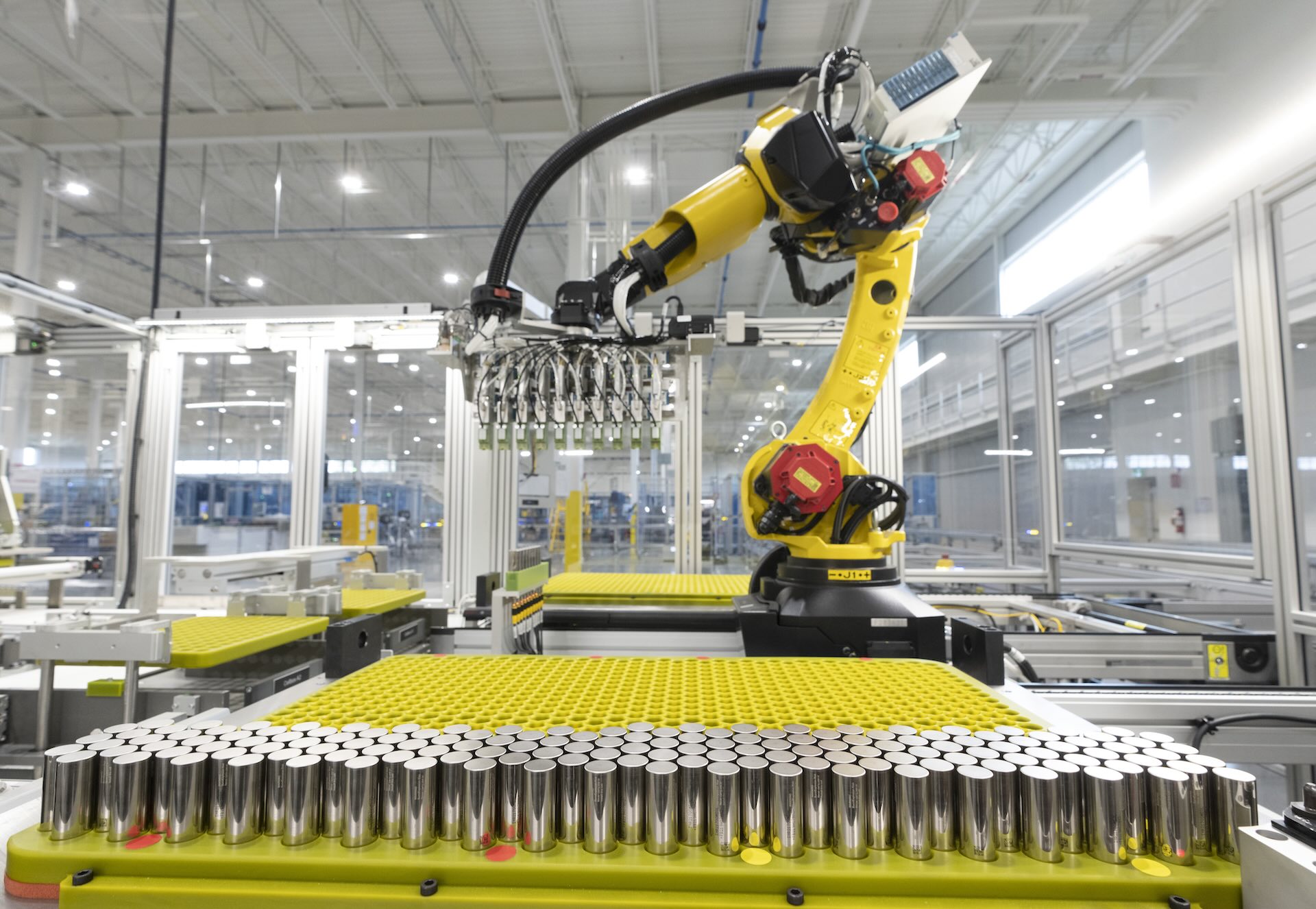 Lithium-ion commanded nearly 70 per cent of the EV battery market in 2023, according to one report. Photo: The Canadian Press/Christinne Muschi

Commentary: Quebec Ink
Is Canada backing the Betamax of EV batteries?
Governments and companies have bet big on lithium-ion, even as competing technologies emerge
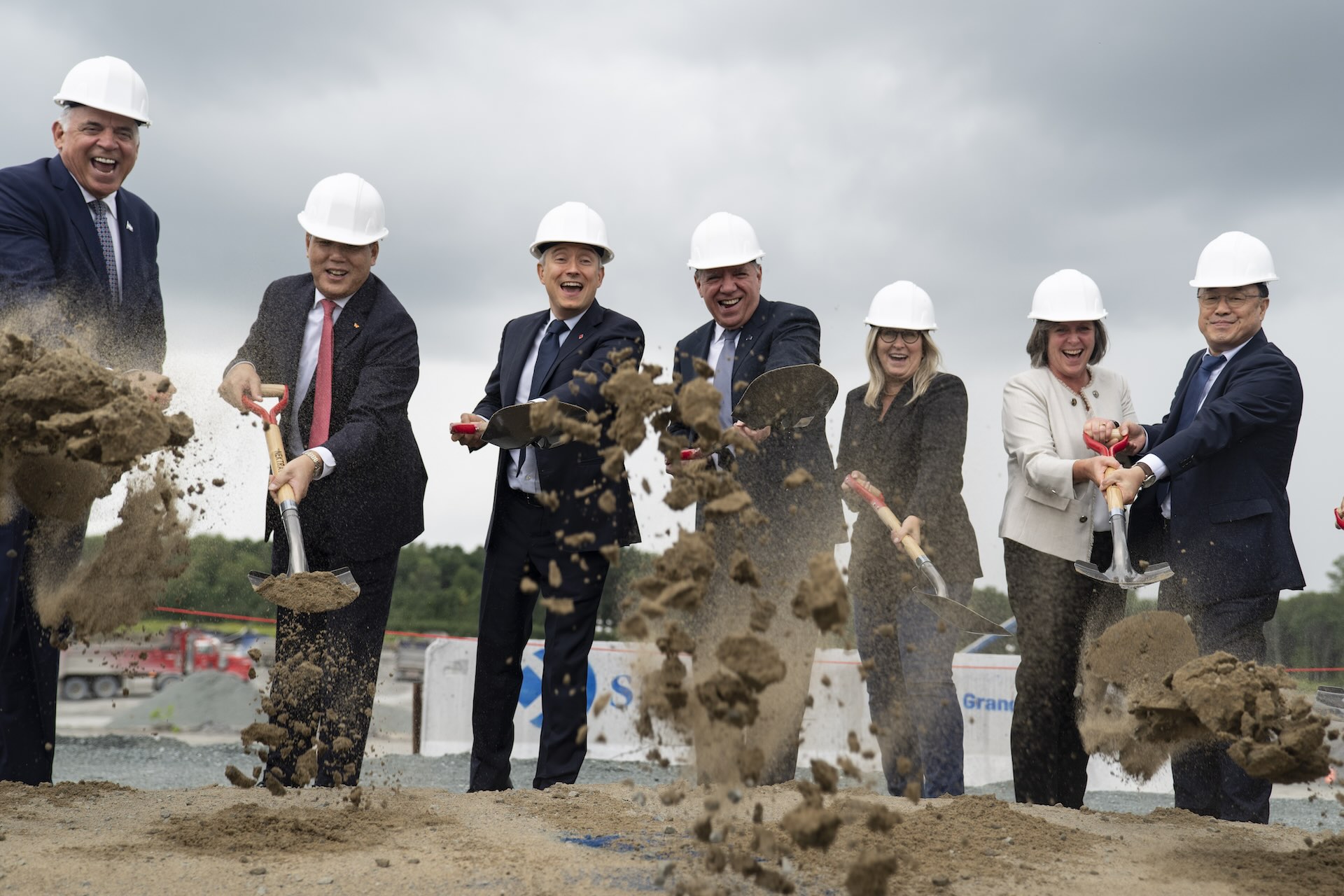
Government and corporate leaders at the groundbreaking ceremony for Ford's manufacturing plant in Becancour, Que., in August 2023. Photo: The Canadian Press/Christinne Muschi
MONTREAL — In the late 1970s, amid oil shocks and flared trousers, consumers were witness to a war over the hallowed space above or below their television sets. In one corner, the VHS tape, developed by JVC. In the other, Sony’s Betamax. Smaller with higher resolution and recording capacity, Betamax also had the advantage of being first to market. Yet JVC’s technology ultimately won out—and you, fair consumer of a certain age, were forced to change tapes in the middle of Titanic as a result.
The great tape war of yore came to mind last year as I tooled around Bécancour, the formerly sleepy burgh northeast of Montreal. Everywhere, farm fields and fallow lands were being dug up and transformed, either into myriad production facilities for EV batteries, or the mind-bending number of houses being built for the workers who will staff them. This jolt to the landscape, which we are told is beneficial to both Quebec’s economy and the transition to electric vehicles, came courtesy of hundreds of millions of dollars in government investment.
But as I gazed at the bones of Bécancour’s future, I wondered: what if we’re betting on Betamax?
Related Articles
Quebec’s burgeoning EV battery production tilts heavily in a certain direction. Northvolt, Ford and GM-Posco: all of these corporate entities are settling in the province, and all of them are either producing materials for lithium-ion batteries, or producing the batteries themselves.
The reasoning is simple. In the EV game, lithium-ion is king, commanding nearly 70 per cent of the market share in 2023, according to a Vantage Market Research report. The chemistry dominates partly because it was first to market—a lithium-ion battery sits in the hull of the Nissan Leaf, generally accepted as the first mass-produced electric car—and partly because of its relatively high energy efficiency, density and output. Much of the up to $3 billion the Quebec government plans to invest in Bécancour alone is for lithium-ion EV battery production.
But as Betamax taught us, first and better are no guarantees of success. We are still at the beginning of EV adoption, and competing technologies and chemistries circle the market, looking to grow. The range of lithium-ion alternatives on the horizon is dizzying, from changing lithium-ion technologies like lithium-iron-phosphate, to newer ones like sodium-ion or magnesium-ion or lithium-sulphur. There is also the very large matter of China, whose output and growth in the EV space dwarfs much of the rest of the world. “The current lithium-ion battery is just the tip of the iceberg,” as University of Waterloo professor Michael Pope told me last week.
Forecasting the EV battery market is, admittedly, a speculative endeavor. It’s fair to say, too, that lithium-ion chemistry will be standard in EVs, at least in the short term. But in the fraught and disruption-prone EV sector, one thing is certain: change comes quick, and there will be many on the wrong side of the technology.
Consider solid-state batteries. As the name suggests, the technology replaces the liquid electrolyte, the material through which the electrical charge passes, with a solid one. Toyota plans to roll out solid-state batteries in 2027, with mass production starting in 2030. The market is listening, with investment in the technology expected to grow by more than 1,000 per cent between 2023 and 2030, to reach US$963 million, according to a Markets and Markets report.
China recently announced a government-led consortium of battery and car manufacturers tasked with bringing solid-state batteries to market by 2030. “Anything that China wants to focus on from a manufacturing standpoint is likely to create a cost structure that makes it competitive globally,” Sino Auto Insights managing director Tu Le told me.
This is where the VHS/Betamax analogy breaks down, because unlike the VHS, solid-state batteries are a demonstrably better product than first-to-market lithium-ion. They will have longer range, faster charging times and less tendency to overheat and burst into flames. They are lighter and pack more energy into a smaller cell, and so could use fewer amounts of critical minerals.
And should they disrupt the EV market as many predict, solid-state batteries will render lithium-ion EV batteries obsolete, along with the plants that produce them. “For solid state you are dealing with new materials and a fundamentally different manufacturing process which is quite challenging. This would require significant retooling,” Jard van Ingen, CEO of the Netherlands-based tech-tracking outfit Get Focus, told me recently.
“If solid state ends up dominating,” he added, lithium-ion battery producers “are a bit screwed.”
I asked Northvolt spokesperson Laurent Therrien how the company plans to incorporate new technology, and who would be responsible for footing the bill should the 170-hectare plant need to retool. “The development of cutting-edge technologies has traditionally been the subject of public funding, particularly for research and development, and in this context, we are very much open to public-private collaborations that foster innovation,” he said. Translation: retooling for solid state would necessarily involve more government investment.
Scaling and mass-producing solid-state batteries will require massive feats of engineering and capital, and some doubt Toyota’s ability to bring them to market by 2027. But that is the very definition of disruptive technology: it does not seem possible until it is. Just ask anyone who has a Betamax player gathering dust in the attic.
Martin Patriquin is The Logic’s Quebec correspondent. He joined in 2019 after 10 years as Quebec bureau chief for Maclean’s. A National Magazine Award and SABEW winner, he has written for The New York Times, The Guardian, The Walrus, Vice, BuzzFeed and The Globe and Mail, among others. He is also a panelist on CBC’s “Power & Politics.”



Loading...
Thanks for sharing!
You have shared 5 articles this month and reached the maximum amount of shares available.
CloseThis account has reached its share limit.
If you would like to purchase a sharing license please contact The Logic support at [email protected].
CloseGift the full article!
You have gifted 0 article(s) this month and have 5 remaining.
Recipients will be able to read the full text of the article after submitting their email address. They will not have access to other articles or subscriber benefits.
Photo: The Canadian Press/Christinne Muschi
Lithium-ion commanded nearly 70 per cent of the EV battery market in 2023, according to one report.
Most Popular This Week




In-depth, agenda-setting reporting
Great journalism delivered straight to your inbox.
News
A tech firm born from post-Brexit trade chaos sets its sights on Canada
Briefing
Dozens of Canadian researchers join chorus of scientists calling for a global AI oversight
TC Energy strikes deal with Indigenous groups for ownership stake in Coastal GasLink pipeline
Canada’s Tailscale taps Google Moonshot alum to lead sovereign AI push
Best business newsletter in Canada
Get up to speed in minutes with insights and analysis on the most important stories of the day, every weekday.
Exclusive events
See the bigger picture with reporters and industry experts in subscriber-exclusive events.
Membership in The Logic Council
Membership provides access to our popular Slack channel, participation in subscriber surveys and invitations to exclusive events with our journalists and special guests.