MONTREAL — Mark Carney was at a campaign in Vaughan, Ont., when he casually upended over half a century of received wisdom when it comes to stumping for votes in neighbouring Quebec. “Do we have rights in Canada, or not? A right is a right is a right,” he said in response to a question about his views on language legislation in the province.
Skip to content


Commentary: Quebec Ink
Mark Carney’s views on Quebec’s language law could stir an angry, silent minority
Carney has made clear he backs the aim of Quebec’s strict French language law—but he also hinted his government would challenge it in court
A Poulet Frit Kentucky sign in Montreal. KFC’s use of a different name in Quebec, and some parts of New Brunswick, is in part a result of the former province's strict language laws. Photo: The Canadian Press/Francis Vachon
MONTREAL — Mark Carney was at a campaign in Vaughan, Ont., when he casually upended over half a century of received wisdom when it comes to stumping for votes in neighbouring Quebec. “Do we have rights in Canada, or not? A right is a right is a right,” he said in response to a question about his views on language legislation in the province.
He went on to express his government’s “malaise” with Quebec’s language law, which he claimed likely contravenes the Charter of Rights and Freedoms. The law, he went on, was ripe for a Supreme Court challenge, which he has already pledged to support. It was a very political way for Carney to say that Quebec’s methods of protecting the French language are demonstrably unfair and legally unsound, and would wind up in court as a result.
History hasn’t been kind to politicians who speak ill of Quebec identity laws, and you’d think a Northwest Territories-born, Edmonton-bred banker with shaky French skills would abide—particularly during an incredibly consequential election campaign. Yet Carney has shown there is a political upside in stabbing a sacred cow, especially if the cow in question poses an existential threat to Quebec’s economy.
Related Articles

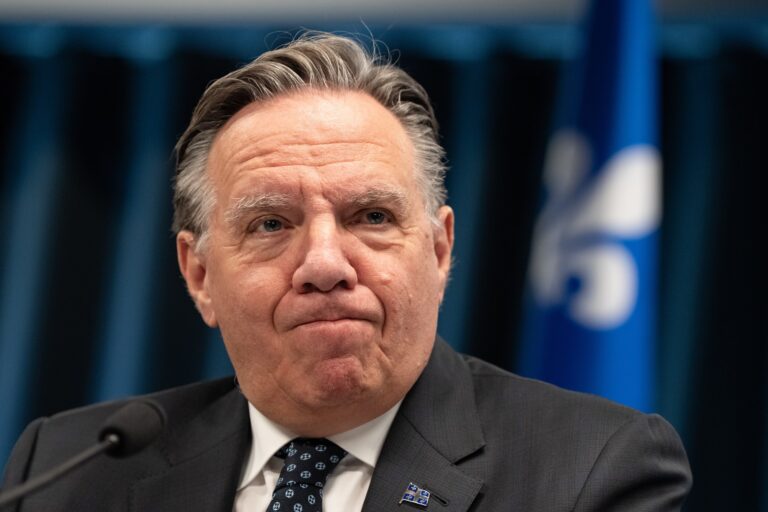
In 2021, Quebec’s Coalition Avenir Québec (CAQ) government introduced Bill 96, legislation that would allow the province’s language authority warrant-free access to businesses and their computer systems, among other things. This authority could also mete out fines of up to $20,000 to those businesses lacking a requisite amount of French, either in their hallways or in the data coursing through their networks. (The maximum fine for a first offence is increasing to $30,000 this June.) Opposition was swift, with 171 Quebec business executives saying the legislation threatened “to do enormous damage to the province’s economy.”
Regardless, Bill 96 became the law of the land in June 2022, after the Quebec government repeatedly and preemptively used the notwithstanding clause to effectively shield it from judicial review or the inevitable court challenges.
Exactly why a government would pass a law to kneecap a huge swath of its own businesses is a matter of political expediency. In short, the CAQ says the French language in Canada is in peril, despite significant indications to the contrary, and the government benefits mightily by making a show of coming to its defence. Under Justin Trudeau, the Liberal government was loath to criticize the law or the CAQ, allowing the latter to throttle the finances of both McGill and Concordia with similar evidence-free demagoguery.
It’s what makes Carney’s critique significant. Those 171 business executives who put their name to their ire are in the minority. Most businesses, tech firms in particular, have stayed mum, out of fear of speaking out against a law targeting them. Grant them anonymity, as I did last year, and the silent minority starts to talk.
The stories are absurd and telling: I spoke to the CEO of a $200-million company that has remained in Quebec because of its culture and plethora of talented workers, yet who finds himself explaining to U.S. investors that the state probably won’t barge in to collect data and test the French mettle of employees and executives—even though it is expressly allowed to do so.
Or the tech CEO who has 500 employees spread around the world, and who finds himself defending his use of English-language keywords in job postings when the authorities visit every two years.
Last year, Council of Canadian Innovators (CCI) president Benjamin Bergen told me that many Quebec businesses responded to this bureaucratic cruelty by hiring outside Quebec, setting up elsewhere in Canada, or resorting to teleworking. Others still grin and bear it. No one is particularly happy with the situation. As CCI Quebec director Jean-François Harvey told me, “Homegrown Quebecois firms want to support the local economy, and they are proud of the French language, but laws that make it more challenging to do business in global markets are an impediment to growth.”
Carney wasn’t the only one to take on Quebec identity laws on the campaign trail. During a recent French-language interview, Conservative Party leader Pierre Poilievre said he disagreed with the province’s so-called secularism law, which prevents teachers, civil servants and the like from wearing religious symbols. “He’s ready to save my life,” Poilievre said of a turban-wearing member of his security detail. “He’s ready to save my children’s lives by giving his. Am I going to say he shouldn’t have a job because he wears a turban?”
Carney’s criticism of Quebec’s language laws was muted, and couched in the importance of protecting the French language, the law’s alleged intent. But he said it nonetheless, and doing so was a choice. Quebec’s tech sector, which represents about five per cent of the province’s GDP, is a largely silent but powerful political force within the province. Carney has seemingly seen the advantage of tapping into it.
Martin Patriquin is The Logic’s Quebec correspondent. He joined in 2019 after 10 years as Quebec bureau chief for Maclean’s. A National Magazine Award and SABEW winner, he has written for The New York Times, The Guardian, The Walrus, Vice, BuzzFeed and The Globe and Mail, among others. He is also a panelist on CBC’s “Power & Politics.”



Loading...
Thanks for sharing!
You have shared 5 articles this month and reached the maximum amount of shares available.
CloseThis account has reached its share limit.
If you would like to purchase a sharing license please contact The Logic support at [email protected].
CloseGift the full article!
You have gifted 0 article(s) this month and have 5 remaining.
Recipients will be able to read the full text of the article after submitting their email address. They will not have access to other articles or subscriber benefits.
Photo: The Canadian Press/Francis Vachon
Most Popular This Week




In-depth, agenda-setting reporting
Great journalism delivered straight to your inbox.
The Big Read
Beacon is building an AI empire by fixing Main Street’s software
Briefing
Inovia raises US$200M for new VC fund as it eyes AI’s impact
43% of eligible Albertans voted ahead of Monday’s referendum
AI chip company Tenstorrent raises US$1.5B, valuing it at US$6.2B
Best business newsletter in Canada
Get up to speed in minutes with insights and analysis on the most important stories of the day, every weekday.
Exclusive events
See the bigger picture with reporters and industry experts in subscriber-exclusive events.
Membership in The Logic Council
Membership provides access to our popular Slack channel, participation in subscriber surveys and invitations to exclusive events with our journalists and special guests.







