MONTREAL — Outwardly, there is no logic behind the Quebec government’s plan to effectively double rates at English universities for out-of-province Canadian students. Doing so, as the universities have pointed out, will crater enrolment, deny them tens of millions of dollars annually and, in the case of tiny Bishop’s University in Lennoxville, threaten its very existence.
Skip to content

Commentary: Quebec Ink
The real reason the Quebec government is scapegoating out-of-province students
A resurgent and youthful Parti Québécois has caught the CAQ government flat-footed
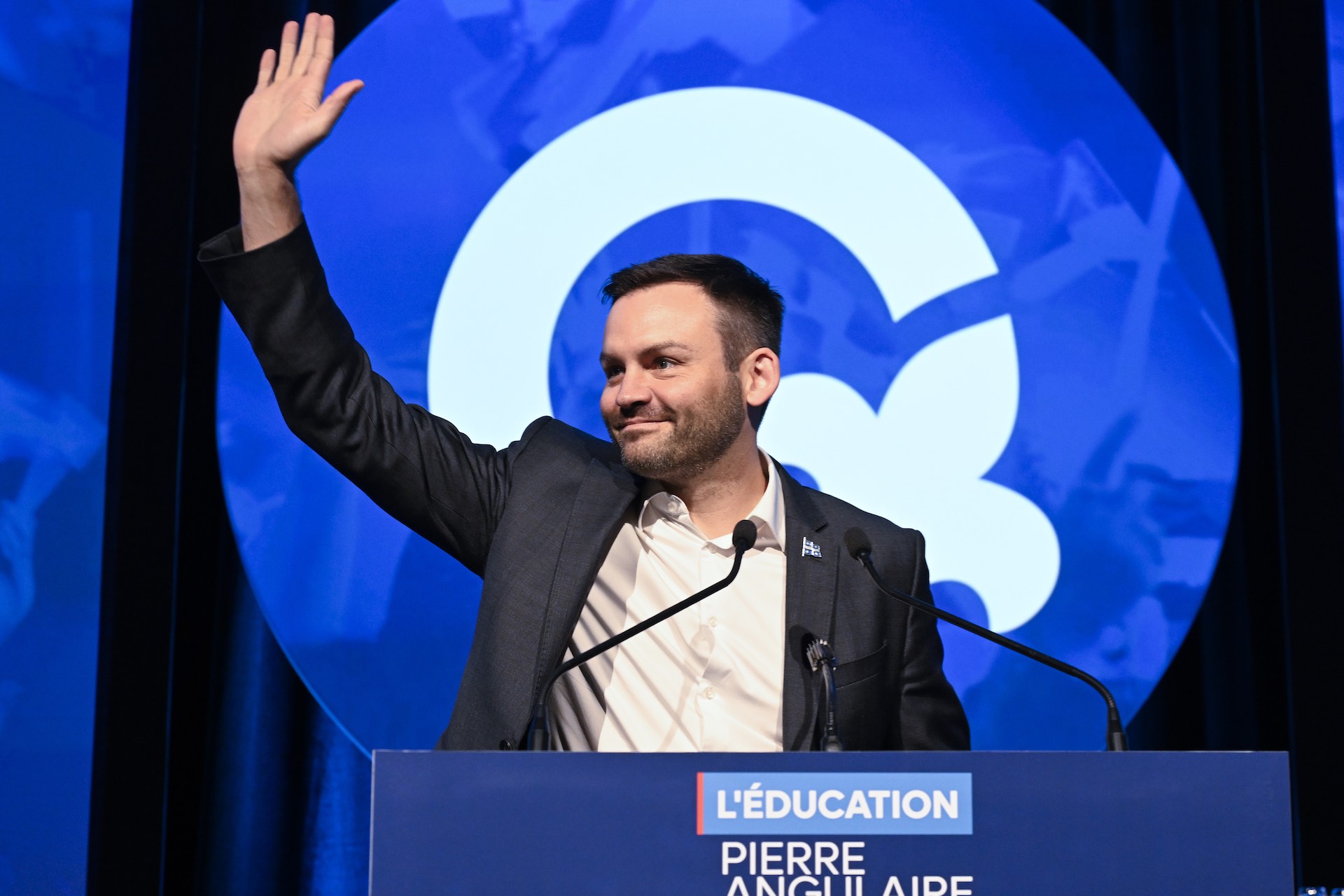
Parti Quebecois Leader Paul St-Pierre Plamondon at a PQ national council meeting on education in Saint-Hyacinthe Que., Oct. 28, 2023. Photo: The Canadian Press/Jacques Boissinot
MONTREAL — Outwardly, there is no logic behind the Quebec government’s plan to effectively double rates at English universities for out-of-province Canadian students. Doing so, as the universities have pointed out, will crater enrolment, deny them tens of millions of dollars annually and, in the case of tiny Bishop’s University in Lennoxville, threaten its very existence.
The province’s French language universities are overwhelmingly against the idea, as is one of its main teachers unions. The president of BMO’s Quebec operations says the increase will undermine the province’s economy, while Montreal’s mayor says it will hurt the city.
Eric Girard, the province’s finance minister, recently showed himself to be extremely uncomfortable with his government’s initiative.
The increase—to $17,000, from about $9,000—makes sense only if you consider Quebec’s current political terrain. In short, you could draw a not-uncrooked line from the government’s scapegoating of McGill University, Concordia University and Bishop’s to the awakening of the province’s sovereignist movement and its chief peddler, the Parti Québécois (PQ).
I know. Ghost jokes are passé, what with Halloween behind us. But I assure you the resurgence of this bogeyman is real, and will have profound effects on how the current Coalition Avenir Québec (CAQ) government behaves in the three years leading to the next provincial election.
Related Articles


The PQ, relegated to rump status barely a year ago, is having a moment. Its leader, Paul St-Pierre Plamondon, is a pentalingual lawyer who once counted current federal Foreign Affairs Minister Mélanie Joly as an ideological ally. Young-ish and smart, St-Pierre Plamondon has pitched himself (and his party’s gen X- and Y-dominated executive) as antithetical to the abiding cliché that Quebec separatism is an old person’s game. It’s working. Party fundraising is up. The PQ has gained ground, according to a recent poll—and St-Pierre Plamondon is more popular than François Legault. Meanwhile, the PQ is eating the governing party’s lunch, winning a byelection last month in the heart of caquiste territory.
So, why is St-Pierre Plamondon proving such a headache for the CAQ? And why has Legault responded by scapegoating English universities? The answers lie in CAQ’s origin story. The “coalition” part of the name refers to a shotgun marriage of federalists and sovereignists fatigued by the debate over Quebec’s place in Canada. Their solution was a sort of Quebec-first government that, while nationalist, swore off the stifling obsession of separation. Legault, the party’s leader, is an incarnation of this mantra: a former true-believing separatist (and PQ cabinet minister) who wanted to move on.
Key to the CAQ schtick is a careful exploitation of Quebecers’ collective fear that French language and culture are forever on the decline—along with a performative show of fighting this alleged decline. It is why the government made an (ultimately failed) attempt to throttle its own skilled-worker program, and the motive behind its punitive additions to the province’s language laws—tech sector be damned. It’s why you can’t be a teacher (or a cop, judge or prison guard) and wear a kippah or a hijab at the same time. It’s why the government actually considered legislating the phrase “bonjour/hi” out of existence.
The targeting of English universities is yet another of these identity-based gambits, complete with a sinister allusion, courtesy of French Language Minister Jean-François Roberge, to McGill and Concordia’s role in the alleged retreat of the French language in the streets of Montreal.
The timing is telling, as well. News of the kneecapping came less than two weeks after the CAQ’s byelection loss, and about a week before the PQ released its “‘Budget of an independent Quebec”—the mother of all identity gambits, in which St-Pierre Plamondon and friends said Quebec separation would be a largely painless, even economically advantageous, affair. (Legault wrote his own rose-tinted would-be budget in 2005, when he was still in the PQ.)
Generally, economically-minded CAQ ministers are a united bunch when it comes to the messy business of identity-related matters. When I talked to him last week, Economic Minister Pierre Fitzgibbon said he was all in favour of the increases.
But they are clearly a sore spot for Girard, who was reappointed as Quebec’s finance minister after the 2022 election. On Oct. 20, he was part of a panel discussion on federalism at the Banff Forum, an off-record, invite-only gabfest set in the Canadian Rockies. Girard, according to four people who were in the audience, was peppered with questions about the tuition increases, looking uncomfortable throughout. So many questions, in fact, that organizers had to turn people away from the microphones.
I went to McGill, my wife went to Bishop’s, he pleaded, according to three of the four people I spoke with. This is not my portfolio, this is not my department, he said.
When I reached out to Girard, his spokesperson Claudia Loupret told me via email, “The minister said during this event that he anticipated new developments and a positive outcome in this matter. We stand by this statement.”
Girard’s discomfort was understandable: he also serves as the government’s Minister Responsible for Relations with English-Speaking Quebecers. But no doubt his chief concern is the threat the policy poses to Quebec’s economy. Concordia president Graham Carr told me that the increases will have long-term effects on Quebec’s tech sector, ravaged as it is by a chronic labour shortage.
“Through co-op and other programs, Concordia has long been an innovative training ground for high-tech industries and I have to believe that any reduction in the flow of great students coming through our ranks is bad news for employers who are competing for talent in a global market,” Carr said via email.
In a note published on Concordia’s website, Carr estimated the anticipated decline in enrolment as a result of the tuition hikes could cost the university $62 million in lost revenue. Over at McGill, there were similarly depressing projections from principal Deep Saini, including annual losses of between $17.6 million and $69.8 million, a hiring freeze and up to 700 layoffs should the tuition increases happen.
I wonder what Girard’s “positive outcome” really means. I’ve heard talk that the government may exclude Bishop’s from the hikes, given its small size and its distance from Montreal. Whatever the outcome, the sudden rise of the PQ only reinforces what has become a CAQ truism: offending, even beggaring, English institutions is a feature, not a bug, for this government.
Clarification: This story was updated to accurately reflect Eric Girard’s tenure as Quebec’s finance minister
Martin Patriquin is The Logic’s Quebec correspondent. He joined in 2019 after 10 years as Quebec bureau chief for Maclean’s. A National Magazine Award and SABEW winner, he has written for The New York Times, The Guardian, The Walrus, Vice, BuzzFeed and The Globe and Mail, among others. He is also a panelist on CBC’s “Power & Politics.”



Loading...
Thanks for sharing!
You have shared 5 articles this month and reached the maximum amount of shares available.
CloseThis account has reached its share limit.
If you would like to purchase a sharing license please contact The Logic support at [email protected].
CloseGift the full article!
You have gifted 0 article(s) this month and have 5 remaining.
Recipients will be able to read the full text of the article after submitting their email address. They will not have access to other articles or subscriber benefits.
Photo: The Canadian Press/Jacques Boissinot
Most Popular This Week



In-depth, agenda-setting reporting
Great journalism delivered straight to your inbox.
News
A tech firm born from post-Brexit trade chaos sets its sights on Canada
Briefing
Dozens of Canadian researchers join chorus of scientists calling for a global AI oversight
TC Energy strikes deal with Indigenous groups for ownership stake in Coastal GasLink pipeline
Canada’s Tailscale taps Google Moonshot alum to lead sovereign AI push
Best business newsletter in Canada
Get up to speed in minutes with insights and analysis on the most important stories of the day, every weekday.
Exclusive events
See the bigger picture with reporters and industry experts in subscriber-exclusive events.
Membership in The Logic Council
Membership provides access to our popular Slack channel, participation in subscriber surveys and invitations to exclusive events with our journalists and special guests.