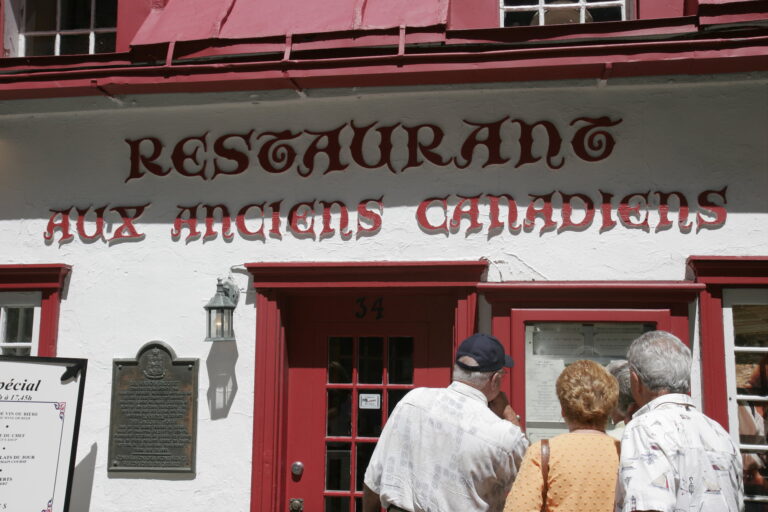
MONTREAL — La Banquise, a poutine shop on Montreal’s Rue Rachel, is notable for several reasons. The regular lineups outside the 24-hour establishment speak both to its popularity and to the gamut of its clientele, which runs from dedicated locals to blind-drunk tourists.
It is arguably the only poutinerie where a guacamole-topped version of the dish doesn’t feel like heresy. In fact, along with Schwartz’s on Saint-Laurent, L’express on Saint-Denis and Au Pied de Cochon around the corner, La Banquise is a culinary rarity: a tourist trap that lives up to the hype.
La Banquise is now also notable for what it isn’t: independent. Last week, the owners of the 55-year-old institution announced its sale to Quebec City-based poutine chain Chez Ashton. Having Quebec City usurp a Montreal institution doesn’t just aggravate an eternal civic rivalry. It also means that the teeming and shambolic La Banquise, housed as it is in a teeming and shambolic part of Montreal, will be run out of a suburban corporate office some 250 kilometres from La Banquise’s front door.
In the media onslaught following the announcement, Ashton’s owners assuaged the restive masses that La Banquise wasn’t going to become a cog in the wheels of Big Poutine. “Don’t panic: La Banquise won’t become an Ashton,” reads a typical headline.
Having never indulged in an Ashton poutine, I can’t judge. (Reddit’s verdict: middle-of-the-road decent.) But it is tough to imagine two more different venues for clogging your arteries. The palette in Ashton’s outlets is lipstick red, the way Tim Hortons stores tend to be milky-coffee brown. The decor at La Banquise might be described as colour-clash cabin hangover chic. We can only hope its new owners will do as Céline Dion did when she and her partners bought Schwartz’s in 2012: That is to say, nothing. You don’t mess with a good thing.
Ashton’s very existence underscores the size and vitality of Big Poutine in Quebec. Yes, the likes of McDonald’s and Burger King have glommed onto poutine. But between these corporative carpetbaggers and the tiny caisse croûtes that dot the province lies something distinctly Québécois: poutinerie chains that only service Quebec.
The exterior of La Banquise in Montreal in November 2023. Photo: Roger Lemoyne for The Logic
When Ashton’s current owners purchased that chain in 2022, it had the hallmarks of any other acquisition you might expect to read about in The Logic. You know the language: entrepreneurs Jean-Christophe Lirette and Émily Adam acquired it in a private equity-backed leveraged buyout, with participation from Desjardins Capital, Fonds de solidarité FTQ and CIBC, according to PitchBook data. The buyers said at the time they planned to expand the chain, which counted 23 locations and 650 employees. Terms of the deal weren’t announced.
The participation by Desjardins Capital et al. suggests there is money to be made in the mass marketing of poutine chez nous.
Ashton isn’t the only player on the field. Montreal-based Frites Alors!, owned by the accurately named Cholestérol Plus Inc., slings fries, gravy and cheese in its 13 restaurants. Bières et Frites has two locations, while Fromagerie Victoria counts 22.
The reason behind Big Poutine’s emergence: a frankly bonkers demand curve. Consider the case of Fromagerie Roy in Rawdon, about 80 kilometres north of Montreal. Demand for curd cheese—formally fromage en grains, colloquially skouik-skouik, after the noise it makes when you chew it—has tripled at the small cheese shop since it opened in 2016, owner Bruno Roy told me recently. It now produces 250 tonnes of the stuff a year, every kernel of which is sold within provincial borders. “Curd cheese is typically Québécois. You rarely find it elsewhere in the world. If you do, chances are a Quebecer brought it there, or it was imported from Quebec,” Roy told me.
The Conseil des industriels laitiers du Québec, which represents 92 cheesemakers across the province, has seen demand explode past Quebec’s borders. So much so, in fact, that the Conseil is working on an appellation d’origine to ensure that, like Bordeaux wine and Parmigiano Reggiano, real and true skouik-skouik comes only from Quebec.
A server delivers poutine at La Banquise. Photo: Roger Lemoyne for The Logic
“There are companies that have started exporting curd cheese to allow poutine to be made in Brussels and France and Asia,” Conseil president Charles Langlois told me. Poutine, he said, is “a product that’s in full growth, on the same path as pizza was in the 1950s.”
From pâté chinois to pizzaghetti to pets de sœurs to oreilles de crisse, you can eat your way through Quebec without going near Poutineville. So why is it that poutine has become the province’s reigning, bankable culinary success? Why not Big Tourtière?
I put the question to Concordia University professor Geneviève Sicotte, who teaches and researches the cultural impact of food. She made a damn good point: You can make and consume pâté chinois, tourtière and the like at home. But unless you own a deep fryer (guilty as charged) or are willing to risk a grease fire, you are more or less compelled to go out to eat poutine.
No surprise, then, that there’s a good chance you’ll stand in line before doing so.
Martin Patriquin is The Logic’s Quebec correspondent. He joined in 2019 after 10 years as Quebec bureau chief for Maclean’s. A National Magazine Award and SABEW winner, he has written for The New York Times, The Guardian, The Walrus, Vice, BuzzFeed and The Globe and Mail, among others. He is also a panelist on CBC’s “Power & Politics.”