MONTREAL — As a spectacle, Startupfest was perfectly, predictably on-brand.
Plunked in Montreal’s Old Port, the venue was smack in the middle of Montreal’s postcard-worthy charms, with Habitat 67, architect Moshe Safdie’s livable ode to brutalist Lego, just across the way. Downriver, the Jacques Cartier Bridge’s grand, army-green spires stood guard over the St. Lawrence.
If Toronto’s Collision is perpetually concussive in its ethos, Startupfest is decidedly laissez-faire: always-enthusiastic, generally-handsome denizens of this country’s startup community zen zoning, braindate lounging and, yes, submitting to the judgment of grandmothers. When Shopify president Harley Finkelstein declared on Wednesday his intention to move back to Montreal from his spread in Ottawa’s Rockcliffe Park, it seemed to underscore the tone and feeling of the whole shebang. Montreal is back, and it is thriving.
And you know what? It is indeed both.
Consider artificial intelligence, which over the last year has become a world-bending technology disruptor par excellence. Montreal has incubated AI from its birth over three decades ago as a wonky futurist plaything; the city is now a recognized global leader in the field as a result. It has the highest university research funding in the country, according to Montréal International, a non-profit that works to attract talent and foreign investment to the city. Not coincidentally, Montreal’s Concordia University is opening a campus dedicated to energy transition in far flung Shawinigan, as good a nod as any to Quebec’s burgeoning role in EV battery production.
Speaking of energy transition, there are now brand new light rail trains on Montreal’s horizon, riding along the 67-kilometre network built in a tidy five years, for a (relatively) tidy $7 billion. (For a bit of context/schadenfreude, Toronto’s Eglinton Crosstown LRT remains a 12-year, 19 -kilometre debacle of blown deadlines and cost overruns.) As for deals, how’s this: Montreal-based companies closed 25 private-equity deals in the first quarter of 2023—by far the most of any Canadian city.
At the same time, the city remains affordable compared to other North American tech hubs, in that you can still get an apartment without selling an organ or three. “Montreal, in all honesty, is one of the best kept secrets in tech,” Jacob Lanyadoo, of the recruiting firm Tech Bonjour told me as we jawed amidst the yoga mats and bean bag chairs in the aforementioned Zen Zone. “If you want to build very cool products, and you want to be a little more bleeding edge and a little more creative, and you want that kind of energy, it’s a great place to be.”
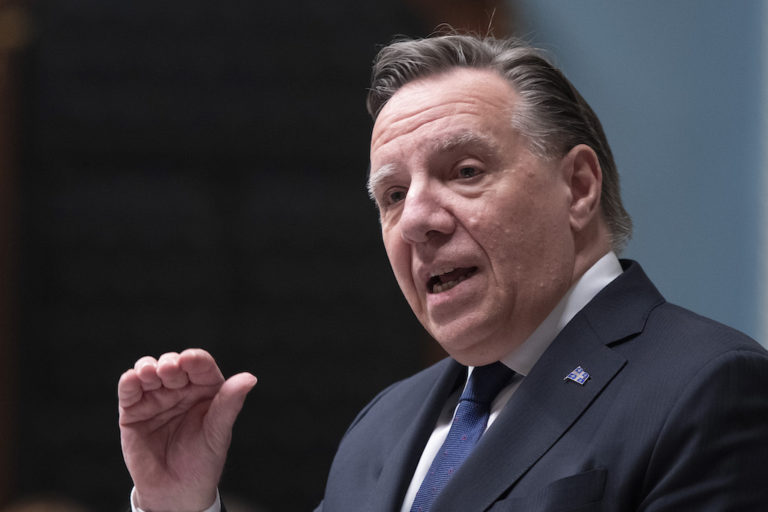
So what could possibly sour Montreal’s sweet spot? Quebec City. Or, more specifically, lawmakers in Quebec City. I’ve banged this particular gong before, but the province’s arbitrary, repressive, ridiculous and ill-thought language laws constitute nothing short of an existential threat to Montreal’s business sector, and its tech sector in particular.
Startupfest attendees in Montreal in July 2023. Photo: Roger Lemoyne for The Logic
Time was, these blunt-force laws were reserved for companies with more than 50 employees, with requirements that included a “francization” certificate dictating the use of French in internal and external communications, networks and software. While the merits of this requirement are up for debate—and god knows we’ve debated them a lot since their inception in 1977—it remains that bigger companies generally have the resources to deal with the added financial and bureaucratic burdens they entail.
Yet the current Coalition Avenir Québec government has since inflicted these burdens on businesses with 25 or more employees. As I noted at the time, the law allows the state to enter businesses without warning or warrant, inspect the data coursing through its computer systems and electronic devices, and issue fines of up to $20,000 if it finds the data doesn’t contain the requisite amount of French.
I asked Lanyadoo what effects he’s noticed since the law’s inception just over a year ago. He said it hasn’t slowed demand much, but has fundamentally altered what companies do once they’re established here. In short, many are intentionally throttling their growth plans to keep employee counts below 25. He told me about a small Houston-based supply-chain logistics company that is hiring in Canada because it is cheaper to do so on this side of the border. “They’re keeping engineering [in Montreal], and all business operations in Toronto so they don’t have to flirt with 25 employees,” Lanyadoo said.
There is an obvious knock-on effect of keeping companies intentionally smaller. The average Montreal-based startup is 22 employees, according to a 2020 Bonjour Startup Montréal report. Faced with the bureaucratic burden that comes with adding three more employees, keeping it below the threshold simply makes business sense. Translation: by limiting them to branch-plant-tier size, the law as it stands cuts off Quebec startups at the knees.
There are other odious, identity-based rumblings from the current Quebec government. The scapegoating of immigrants by suggesting they are allergic to work, prone to violence and responsible for the alleged demise of the French language. What’s heartening is how hard much of Quebec’s tech community has pushed back against the government and the law. Over 170 tech firms have signed an open letter calling on the government to pause the implementation of the new language laws, saying it threatens to do “enormous damage to the province’s economy.”
Of course, the government did no such thing. Yet given the level to which it funds tech in this province, putting one’s name to this letter constitutes an act of bravery. Which was perhaps an unspoken theme at this year’s Startupfest: Montreal’s future is too bright to smother.
Martin Patriquin is The Logic’s Quebec correspondent. He joined in 2019 after 10 years as Quebec bureau chief for Maclean’s. A National Magazine Award and SABEW winner, he has written for The New York Times, The Guardian, The Walrus, Vice, BuzzFeed and The Globe and Mail, among others. He is also a panelist on CBC’s “Power & Politics.” @MartinPatriquin