Commentary
Letter from the editor: The politicians taking on Big Tech
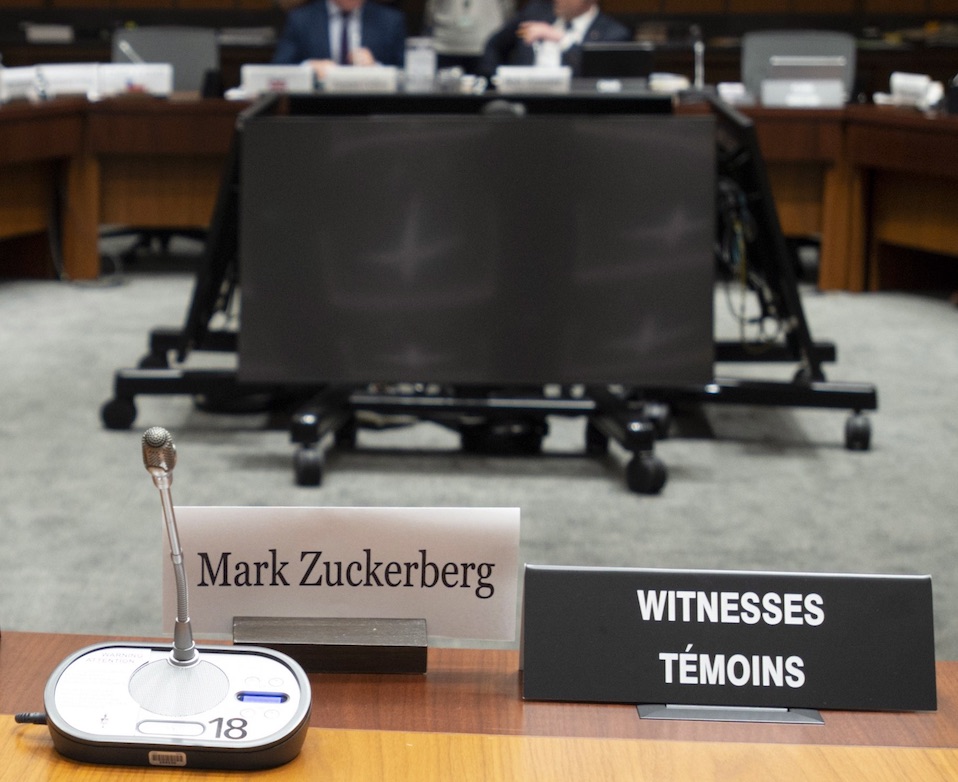
An empty chair sits behind the name plate for Facebook's Mark Zuckerberg as the International Grand Committee on Big Data, Privacy and Democracy waits to begin in Ottawa, Tuesday May 28, 2019. Zuckerberg did not appear before the committee. Photo: THE CANADIAN PRESS/Adrian Wyld
I spent most of the week in Ottawa for the International Grand Committee on Big Data, Privacy and Democracy. The hearings in the new West Block were certainly a spectacle—an opportunity for politicians from 12 countries to question some of the world’s largest tech companies about antitrust, online misinformation and privacy.
Or, at least, the—mostly Canadian—representatives for those companies who bothered to show up. The Logic’s Ottawa correspondent, Murad Hemmadi, wrote an excellent breakdown of the proceedings worth reading to see what the tech companies had to say.
But I was more struck by the questions the politicians asked—and the ones they didn’t.
First, we’ve certainly come a long way from Facebook founder Mark Zuckerberg’s testimony in Washington last April. There was no equivalent of his exchange with then-Senator Orrin Hatch, which resulted in Zuckerberg’s meme-ified explanation of his platform’s business model: “Senator, we run ads.”
The collection of global politicians in Ottawa representing 400 million citizens were well-informed, pointed in their questioning, and seemed to have a strong understanding of how the internet—and, specifically, social platforms—impact the democratic process. We should take comfort in knowing that the complexities of these issues are now better understood by lawmakers, something that wasn’t a given as recently as 18 months ago.
Second, Canadian MPs on the committee across the political spectrum widely agreed that disinformation needs to be tackled and tech platforms need to be regulated. Even the Big Tech representatives themselves acknowledged in their testimonies the need for new rules.
Which is why Prime Minister Justin Trudeau’s remarks shortly after the hearings were so surprising to many. Speaking at an open government event, Trudeau seemed to contradict almost everything that came out of committee. He told a room full of digital government leaders on Wednesday night that he viewed new rules as a last resort, framing the situation as a binary choice between regulation and free speech.
“Fundamentally, we can’t look at platforms as automatic antagonists. We recognize the solution doesn’t lie in government’s heavy hand over our internet, over our public spaces,” said Trudeau.
It’s now not a matter of if, but when such measures will be put in place. So Trudeau’s comments seemed out of touch with not only the work of the grand committee, but that of his own government. Think of Innovation Minister Navdeep Bains’ digital charter or Democractic Minister Karina Gould’s funding of disinformation campaigns. Or ethics committee vice-chair—and Liberal MP—Nathaniel Erskine-Smith, who asked many of the most pointed questions about competition law, algorithmic accountability and content liability at the hearings.
It’s an example of the disconnect between what we hear in public and what’s said in private between the tech companies and governments. “What they tell us here is a charade, because what’s happening behind the scenes [with] … their lobbyists and their continual meetings is the ongoing attempt to deny the right of legislators to bring in regulation,” said Charlie Angus, ethics committee vice-chair and NDP MP, pointing to communication between the platforms and senior officials in Canada, the U.K. and elsewhere.
And then there’s what wasn’t really discussed during the committee’s meetings with the tech platforms: the role that political parties themselves play in using social networks and data to their own benefit.
The Toronto Star’s Susan Delacourt called out this hypocrisy in her recent column, as did Samara Centre for Democracy’s Michael Morden in his Globe and Mail op-ed.
Politicians are themselves some of the biggest beneficiaries of the data collection that tech platforms allow. The Liberals have the Liberalist platform—which they’ve used to vet judicial appointments—the Conservative Party has the Constituent Information Management System and the NDP has Populus. All three of those parties aggregate the data that politicians are able to gather when canvassing voters.
While it’s been fairly pointed out to me that not all party candidates input their canvassing information into the central database, that the servers even exist gives a unique and unfair advantage to candidates who run for office through a political party rather than as independents.
Politicians are also the biggest amplifiers of misinformation—whether directly through political advertising, indirectly through third-party ideological fellow travellers like North99 or Canada Proud or through the hosting of Facebook pages and the artificial amplification of tweets to “game the algorithms” of social networks.
All of these tools undermine the democratic process, and all are perfectly legal today. We have campaign finance laws—why don’t we have campaign data laws?
Bill C-76, the government’s Elections Modernization Act, could have curtailed many of these challenges to the democratic process. But it didn’t.
Don’t expect any new legislation to be put forward until after the election.
But this fall, when a candidate comes knocking on your door seeking your vote, turn the tables on their questioning of tech companies. Ask them what they’re going to do to protect your data after they’re done collecting it.



Loading...
Thanks for sharing!
You have shared 5 articles this month and reached the maximum amount of shares available.
CloseThis account has reached its share limit.
If you would like to purchase a sharing license please contact The Logic support at [email protected].
CloseGift the full article!
You have gifted 0 article(s) this month and have 5 remaining.
Recipients will be able to read the full text of the article after submitting their email address. They will not have access to other articles or subscriber benefits.










