Commentary
Letter from the editor: The cost of living with climate change
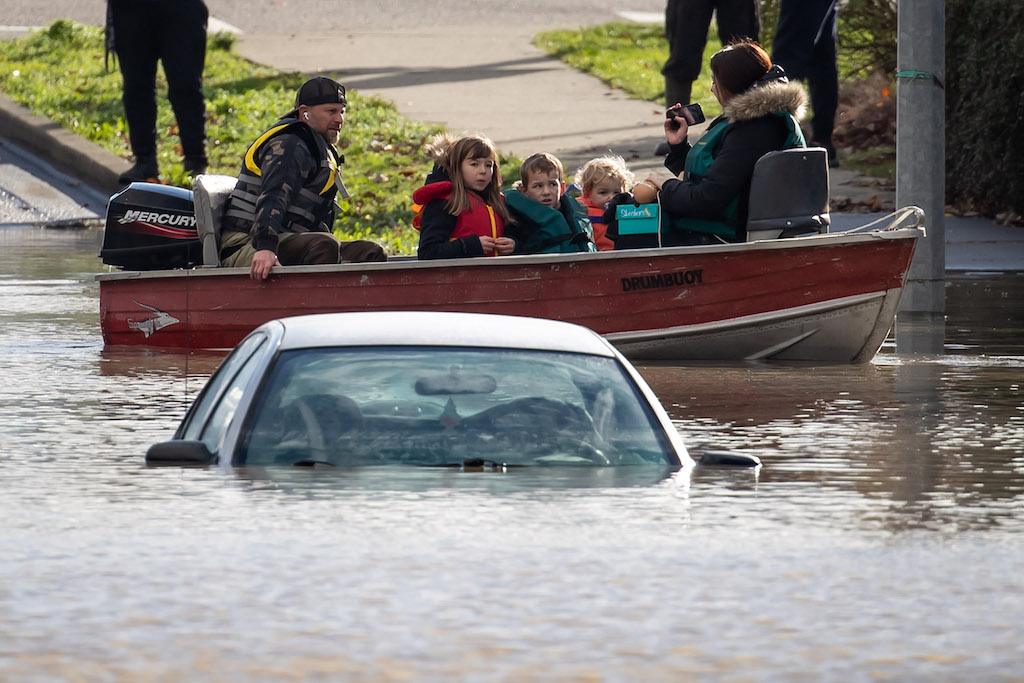
Photo: The Canadian Press/Darryl Dyck
It’s been less than a week since COP26, the UN climate-change summit in Glasgow where the world’s governments set lofty targets for reducing carbon emissions at some point in the future. The days since have been filled with images of devastation in B.C.—scenes of burning vehicles and local farmers on jet skis towing cattle through the flooded Fraser Valley—that illustrate just how unprepared we are for the reality of climate change.
While the focus at COP26 was mainly on mitigating greenhouse-gas emissions, there was relatively little discussion about how we’ll adapt to the extreme weather that’s already here. This lack of preparation is proving costly—there is a profound human cost, of course, but also one in crude dollars and cents.
According to a report from the Intact Centre on Climate Adaptation, while property and casualty (P&C) insurance payouts in Canada were on average $405 million a year between 1983 and 2008, those figures more than doubled in the next decade; payouts surpassed $1 billion in 11 of the 12 years leading up to 2020. “Water-related losses were a significant driver of bigger payouts,” the report states, “accounting for more than 50 per cent of the increase.” As we’ve seen this week, flooding is the biggest risk for catastrophic weather-related events in Canada.

There’s also an insurance gap: for every dollar of losses that insurers take in Canada, three to four are absorbed by governments, homeowners and business owners, according to the report. Take Calgary, for example, whose flood in 2013 was the country’s most expensive natural disaster to date. Assessed at approximately $5 billion, it directly cost taxpayers $787 million in city infrastructure, emergency response and recovery alone.
We can choose to politicize climate change as much as we want to, but like it or not, a tidal wave of very expensive bills is heading our way.
As Craig Stewart, vice-president of federal affairs at the Insurance Bureau of Canada, told me on Wednesday, “We need to develop a culture of preparedness.”
Canada is already lagging in disaster mitigation.
The Globe and Mail reported in July that “a national climate-adaptation strategy … is not expected before the end of next year, meaning funding commitments may not flow from it until 2023 at the earliest.”
It was only three years ago that the federal government committed $2 billion over 10 years for the Disaster Mitigation and Adaptation Fund, to “increase the resilience of communities that are impacted by natural disasters triggered by climate change.” (Let’s ignore for a moment that $200 million a year is a relative pittance when you consider that, as my colleague Jesse Snyder reported, this flooding in the Fraser Valley alone could cost anywhere between $19.3 billion and $32.7 billion.)
And it was just last year that Public Safety Canada set up a task force for emergency preparedness in the event of flooding. Its recommendations are expected next spring.
“It’s a matter of will,” Blair Feltmate, head of the University of Waterloo-based Intact Centre on Climate Adaptation, told me in a phone call Wednesday. “Federal, provincial and municipal governments have to understand that climate change is here to stay; we’re not going backwards. Expressions of extreme weather are going to get more dire going forward.”
You don’t even need to believe in climate change to feel its impacts. To illustrate, let’s use Canada’s favourite pastime: the real estate market.
Feltmate gave me an early look at a study the Intact Centre plans to release early next year, looking at key real estate metrics in five cities that experienced one or two catastrophic floods from 2009 to 2020. They found that on average, over the six-month period before and after a significant flood, homes sold for 8.2 per cent less, and took almost 20 per cent longer to sell. That was despite housing inventory being down 44.3 per cent.
In short, catastrophic flooding leads to less inventory, lower selling prices and longer list times. And that doesn’t include the additional cost of insuring your property—if you’re able to get insurance at all.
Insurance companies, with a business model predicated entirely on guaranteeing the long-term solvency of pooled capital, are the canaries in the coal mine. Their actuaries apply sophisticated long-term risk modelling using proprietary flood-mapping and climate-measurement tools to set rates for your P&C insurance. And what they’re finding isn’t good news.
“Climate extremes have been consistently occurring at well above the rate seen from 1961 to 1990,” said Doug Collins, chair of the Climate Index Working Group, in a release for the group’s most recent report.

As a result, insurance companies are taking action. After years of huge losses, the industry all but abandoned fire-prone areas in California in 2020. And one of the world’s largest insurers, Lloyd’s of London, dramatically reduced its exposure to the Canadian market after absorbing £2.9 billion in global losses from climate change in 2018 and 2019.
“They took a look at countries where they were experiencing significant losses and they contracted, in part due to climate-change property losses,” said Stewart.
This raises a second-order financial impact of climate disasters. Lloyd’s backing out of Canada led directly to a hardening of the commercial insurance market right before the pandemic. “Many commercial businesses could not get insurance, or their insurance tripled in rate,” Stewart told me.
Along with insurers forecasting rate increases for individuals and companies, institutional investors are having to factor climate-change risk into their real estate portfolios. If they forecast incorrectly and their portfolios take a hit due to a catastrophic weather event, that could impact your retirement plans. And I haven’t even touched on what supply-chain delays will cost consumers and businesses, for example, as a result of the Port of Vancouver being cut off from the mainland.
Forecasting isn’t an exact science. The models used in underwriting include a fair degree of uncertainty, meaning premiums—already increasing—still may be low.
“The base data that we’re using for our models is, frankly, not good,” said Stewart.
That uncertainty comes from the compounding effect of catastrophic events. Remember last summer’s heat wave and wildfires in B.C that burned over 868,000 hectares of land? That scorched tree canopy and soot-laden soil was unable to absorb much of the water from this week’s atmospheric river, contributing directly to the mudslides and flooding in the same areas this week.
“You’re dealing with complex effects and our models, frankly, are still backwards-looking,” Stewart told me.
Stewart said the federal government is working with insurers to improve their models and to ultimately make them more transparent to help homeowners with buying decisions.
He added that the government task force is also considering creative financial instruments to securitize the expensive infrastructure investments needed to prepare for future catastrophes.
“We can’t appropriate climate disasters only to drive emissions reduction and future climate action. We need an all-hands-on-deck approach backed by both the public and private sector to deal with these issues now.”
If all of this sounds incredibly depressing, that’s because it is. What’s worse, scientists have been sounding the alarm for years. As climate scientist Trevor Murdock pointed out this week, a report done over a decade ago on climate change’s potential impact on the Coquihalla Highway, which was battered by mud and rock-slide damage this week, found 14 high risks—every single one relating to extreme precipitation from atmospheric rivers.
The aforementioned Feltmate was quoted four years ago in a prophetic CBC News article that asked several insurance executives what kept them up at night. “What they’re worried about is, ‘What do we do when the $15-billion to $25-billion flood hits Canada?’ You know, it takes out the Port of Vancouver or the Fraser Valley or the City of Kingston?”
What’s happening this week in B.C. is horrifying, and my heart goes out to everyone affected. I wish I could believe it won’t happen again—but if anything, we need to brace for this being the new normal.
The next hundred-year storm is no longer a matter of “if” but “when.” And it’s going to cost us. You think carbon taxes are expensive? Wait until your taxes go up to pay for a new dike that prevents you from drowning in your own home.
A UN-commissioned report released at COP26 found that global warming of 1.5 C by 2030 will result in a 43 per cent rise in the number of people exposed to severe climate hazards. Canadians are tragically starting to find out what that means.
Put even more starkly: instead of just setting targets to try to prevent global temperature increases, we need a culture of preparedness to help us withstand them.



Loading...
Thanks for sharing!
You have shared 5 articles this month and reached the maximum amount of shares available.
CloseThis account has reached its share limit.
If you would like to purchase a sharing license please contact The Logic support at [email protected].
CloseGift the full article!
You have gifted 0 article(s) this month and have 5 remaining.
Recipients will be able to read the full text of the article after submitting their email address. They will not have access to other articles or subscriber benefits.