Mothers are still far more likely than fathers to put their careers on hold to care for children, so there is still some work to do in levelling a playing field that favours men.
Skip to content

 Are young Canadian men "Kenough" for the modern labour market? (Canadian-born Hollywood stars aside.) Photo: IMDB, Warner Bros. Pictures

Commentary
Carmichael: Where the boys aren’t
In Canada’s weak labour market, young women are doing better than young men
Young women are being hired at a much faster rate than young men. Some 69 per cent of women aged 20 to 24 were employed in July, compared with 66.1 per cent for men of the same age. Photo: Pexels/Christina Morillo
Mothers are still far more likely than fathers to put their careers on hold to care for children, so there is still some work to do in levelling a playing field that favours men.
Nevertheless, it might be time to call a truce in the gender wars to consider what might be happening to young men and boys. The labour market appears to be leaving them behind, creating the possibility that whatever gains come from the increased participation of women could be offset by underperforming men.
I concluded my previous column with this thought: The young will find their way. I wanted to push back against the notion that history has treated millennials and Gen Z unfairly. They might have to wait longer to buy a house than their parents and grandparents did, but they will start their careers with significantly higher wages and with better educations. They’ll begin their adult lives as savers and investors rather than mortgage-holders, which means they’ll discover there are paths to financial security other than homeownership.
Prime Minister Justin Trudeau leads a proudly activist government. He and his ministers are wired to attack problems.
Related Articles


If they sense unquiet among the youth, much of it could be coming from the young men who are struggling to keep up with economic trends that don’t favour them.
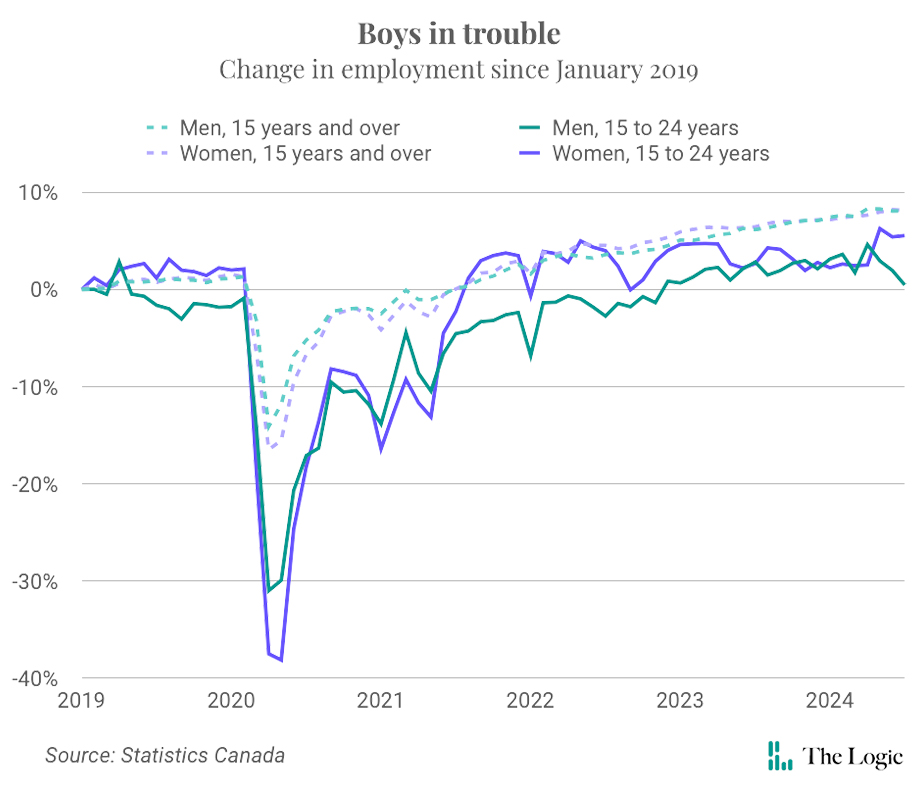
There’s still a sizable employment gap between men and women, but younger women are charging hard. Some 69 per cent of women aged 20 to 24 were employed in July, compared with 66.1 per cent for men of the same age; adding teenagers to the youth numbers didn’t change the three per cent gap.
Youth unemployment has spiked in recent months, a warning that economic momentum is waning, as the least experienced workers will be the first to feel the effects of a weaker labour market. But so far, young women appear to be doing better than young men.
The employment rate of women aged 20 to 24 averaged 72 per cent in 2019, compared with about 70 per cent for men of the same age, so the employment drop for young women this summer has been less severe. That might be because they are better educated. The correlation between education and employment is strong, and the gap between how much time women and men are spending in school is wide: some 40 per cent of women aged 20 to 24 have bachelor degrees or higher, according to 2021 census data, while only 26 per cent of men of the same age had earned similar credentials.
It’s no surprise then that girls have the momentum. Total employment has increased about 8.1 per cent for both working-age men and women since the start of 2019. Yet employment of women aged 20 to 24 was 9.6 per cent higher, while employment of men the same age had increased 7.3 per cent. More stark: add teenagers, and employment for men aged 15 to 24 plunged to roughly the same level as at the start of 2019 in July, while employment of women in that age group was still 5.5 per cent higher.
To be sure, there is considerable risk that momentum will fade once those women begin having children. When conducting its latest monthly labour force survey, Statistics Canada found that seven per cent of women aged 25 to 54 with a child aged 12 or younger had turned down a job offer over the previous 12 months, and 8.2 per cent had shifted to a less demanding position—roughly double the number of fathers who said they made such life decisions.
Gender balance and policies such as affordable childcare became mainstream economic issues when it became clear that richer countries with aging populations would need to get serious about maximizing the potential of their existing labour pools.
Finance Minister Chrystia Freeland’s $30-billion daycare subsidy is a significant achievement because it should let more of those highly educated young women remain active participants in the labour market. The boost to household income, government revenue and productivity should more than cover the cost of capping out-of-pocket child care expenses at $10 per day.
There’s work left to do in securing that legacy. An outfit critical of the federal plan called the Association of Alberta Childcare Entrepreneurs has begun sending emails to people like me, suggesting there is frustration with the way the plan is being implemented. Politics could yet undo a good policy. Conservative Leader Pierre Poilievre, who is currently so popular he could be on his way to winning a majority, has promised he will “fix the budget,” but he hasn’t really said how.
Still, two things can be true at the same time. Norway, a country that has a better record on gender equality than Canada, created a men’s equality commission in 2022 that published a report and recommendations earlier this year. The Norwegian proposals appealed to Richard Reeves, a scholar at the Brookings Institution and the author of the 2022 book Of Boys and Men: Why the Modern Male Is Struggling, Why it Matters and What to Do about It. They included making paid leave equal for men and women; encouraging more men to study for careers in health, education and social care; and offering parents the option of starting their children’s education at an older age.
Here in Canada, data show clearly that the economic system we’ve built over decades continues to favour men over women—and data are beginning to suggest that by putting extra emphasis on correcting that imbalance, we might be creating another one.
Kevin Carmichael is The Logic’s economics columnist and editor-at-large. He has spent more than two decades covering economics, business and finance for outlets including Bloomberg News, The Globe and Mail and the Financial Post, where he also served as editor-in-chief.



Loading...
Thanks for sharing!
You have shared 5 articles this month and reached the maximum amount of shares available.
CloseThis account has reached its share limit.
If you would like to purchase a sharing license please contact The Logic support at [email protected].
CloseGift the full article!
You have gifted 0 article(s) this month and have 5 remaining.
Recipients will be able to read the full text of the article after submitting their email address. They will not have access to other articles or subscriber benefits.
Photo: Pexels/Christina Morillo
Are young Canadian men "Kenough" for the modern labour market? (Canadian-born Hollywood stars aside.)
Most Popular This Week




In-depth, agenda-setting reporting
Great journalism delivered straight to your inbox.
The Big Read
Alberta’s referendum is just the start of the turmoil
Briefing
EverWind plans $10B data centre and wind development in Nova Scotia
Canada ready to force Stelco to sell its Canadian operations, Joly says
Feds plan a 60 MW defence-oriented data centre for Ottawa
Best business newsletter in Canada
Get up to speed in minutes with insights and analysis on the most important stories of the day, every weekday.
Exclusive events
See the bigger picture with reporters and industry experts in subscriber-exclusive events.
Membership in The Logic Council
Membership provides access to our popular Slack channel, participation in subscriber surveys and invitations to exclusive events with our journalists and special guests.






