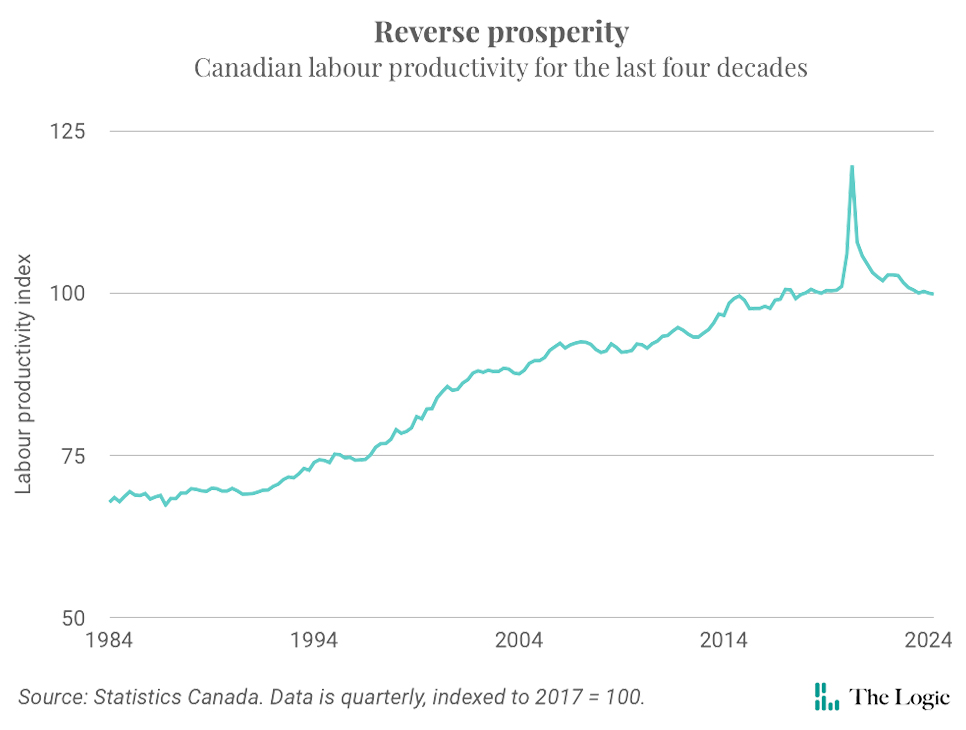
The productivity problem didn’t go away over the summer. In case you missed it, inflation-adjusted gross domestic product increased 0.5 per cent in the second quarter, but on the back of a larger increase in hours worked, Statistics Canada reported this week. Do the math, and you get the eighth quarterly decline in labour productivity in the previous nine quarters, and the twelfth drop in the 14 quarters since the start of 2021.
Skip to content

 Robert Asselin, senior vice-president of policy at the Business Council of Canada. Photo: Public Policy Forum/Handout

Commentary
Carmichael: The productivity slump is now a crisis. Let’s not waste it
It’s time for extraordinary measures—like letting the government lead
Loblaw executive chair and president Galen Weston in Toronto in October 2023. Photo: The Canadian Press/Chris Young
The productivity problem didn’t go away over the summer. In case you missed it, inflation-adjusted gross domestic product increased 0.5 per cent in the second quarter, but on the back of a larger increase in hours worked, Statistics Canada reported this week. Do the math, and you get the eighth quarterly decline in labour productivity in the previous nine quarters, and the twelfth drop in the 14 quarters since the start of 2021.
It’s a historic slump as serious as the budget crisis of the 1990s and the inflation surge of the past few years. If companies were more efficient, the economy could have absorbed more of the inflation shock that followed the pandemic and Russia’s invasion of Ukraine. Instead, the Bank of Canada has to throttle demand by ratcheting up interest rates. Think about all the pain that has caused and you’ll understand why the likes of Bank of Canada senior deputy governor Carolyn Rogers and Loblaw executive chair and president Galen Weston characterize the situation as a crisis.
“What’s the prosperity narrative for the country?” Weston, who leads one of the country’s largest employers, said this week on a podcast hosted by Business Council of Canada president Goldy Hyder. “We need to talk more about what it’s going to take for us to be prosperous in five years, in 10 years, in 25 years.”
The chattering classes are obsessed with the issue. I wrote my first of many, many productivity columns in December. Rogers used a speech at the end of March to declare that it was time to “break the glass.” There have been numerous panel discussions and conferences, and more are in the works: the Toronto Region Board of Trade is hosting an event featuring former finance minister Bill Morneau on Sept. 9, and the University of Calgary has scheduled a “Productivity Summit” for Oct. 16 and 17.
Related Articles


What has all this talk accomplished? Hard to say. On everyone’s shortlist of explanations is weak business investment. Statistics Canada reported this week that Canadian businesses spent a record $30.4 billion on in-house research and development in 2022, and preliminary data suggest that amount increased by about 3.4 per cent in 2023. But that headline isn’t as positive as it seems. Research spending is simply rising with the tide of natural economic growth—R&D expenditures remain around one per cent of gross domestic product, which is half the average of Canada’s peers in the OECD group of rich countries.
Productivity will continue to languish without business, yet we can’t rely on industry to lead a turnaround because the incentives don’t line up. The U.S. is experiencing a productivity boom because it is home to so many relatively young and cutting-edge technology companies that must invest heavily to stay ahead of the curve in areas such as artificial intelligence and biotechnology. Canada’s biggest companies tend to be older players in oligopolistic industries that deploy technology rather than create it. The incentives guiding the CEO of a company such as Loblaw are simply different from those facing the leader of a company such as Alphabet.
So the government must lead. That needn’t be as scary as it sounds. The all-stars of innovation—countries such as the U.S., South Korea, Taiwan, Germany, the Netherlands and Israel—are all creations of public policy. As Robert Asselin, the top adviser at the Business Council of Canada, observes in a new paper, Canada’s challenge will be choosing “economic pragmatism over ideology,” rejecting both “rent-seeking industrial policy and free-market naiveté.”
In economics, “rent” is free money—like the tens of billions of dollars in subsidies that Ottawa and the governments of Ontario and Quebec have been throwing at international makers of automobiles and batteries in recent years. Asselin argues that money would have been better used to fund advanced research and companies with the ambition to take new ideas to market. Instead, Canada let itself get pulled into a bidding war for global assembly-line jobs.
That’s probably not the optimal use of scarce resources. Asselin, who advised Morneau before both he and his former boss left Justin Trudeau’s government, argues that if smaller countries such as Canada decide to embrace industrial policy, they have to be smart about it. We have to identify what we’re good at, and then resist the urge to play regional politics by making sure each province gets a little money. Industrial policy must be guided by where industry is located, not votes.
Asking too much? History suggests “yes,” but crises allow for narrative shifts. The last thing this anti-American country wanted was a free-trade agreement with the U.S., until conditions let Brian Mulroney do a deal with Ronald Reagan. Similarly, the budget cuts that Jean Chrétien and Paul Martin oversaw in the 1990s were unfathomable until they happened. Politics change.
If the political class wants to get serious about productivity, Asselin offers a set of concrete policy proposals. He suggests focusing public resources on energy, infrastructure, advanced building and manufacturing materials, agriculture and biotechnology. He’d focus on creating wealth through productivity and innovation, rather than creating jobs. He’d create guardrails that protect industrial policy from political capture.
There’s more, including specific proposals to review the tax system and creating 10-year roadmaps of how government and businesses will cooperate in the industries in which Canada has decided it has a chance to win. I encourage you to read it—and then to call your MP. The productivity problem isn’t going to fix itself.
Kevin Carmichael is The Logic’s economics columnist and editor-at-large. He has spent more than two decades covering economics, business and finance for outlets including Bloomberg News, The Globe and Mail and the Financial Post, where he also served as editor-in-chief.



Loading...
Thanks for sharing!
You have shared 5 articles this month and reached the maximum amount of shares available.
CloseThis account has reached its share limit.
If you would like to purchase a sharing license please contact The Logic support at [email protected].
CloseGift the full article!
You have gifted 0 article(s) this month and have 5 remaining.
Recipients will be able to read the full text of the article after submitting their email address. They will not have access to other articles or subscriber benefits.
Photo: The Canadian Press/Chris Young
Robert Asselin, senior vice-president of policy at the Business Council of Canada.
Most Popular This Week



In-depth, agenda-setting reporting
Great journalism delivered straight to your inbox.
News
Tech firms want AI models to create better versions of themselves
Briefing
Lightspeed cuts 250 jobs through layoffs and attrition
Oil tycoon Adam Waterous aims to build new Canadian energy player with US$1B fund
Data centre infrastructure firms 3C and Datalec merge, plan Calgary expansion
Best business newsletter in Canada
Get up to speed in minutes with insights and analysis on the most important stories of the day, every weekday.
Exclusive events
See the bigger picture with reporters and industry experts in subscriber-exclusive events.
Membership in The Logic Council
Membership provides access to our popular Slack channel, participation in subscriber surveys and invitations to exclusive events with our journalists and special guests.