Statistics Canada reported this week that 83,770 enterprises were “born” in 2023. That sounds like a lot, but then you get to the previous year’s death count: 88,040. So, more evidence that Canada’s animal spirits have gone into hibernation.
Skip to content

Commentary
Carmichael: Carney’s budget missed a big opportunity
A tax policy designed to help entrepreneurs actually might be dulling Canada’s entrepreneurial drive
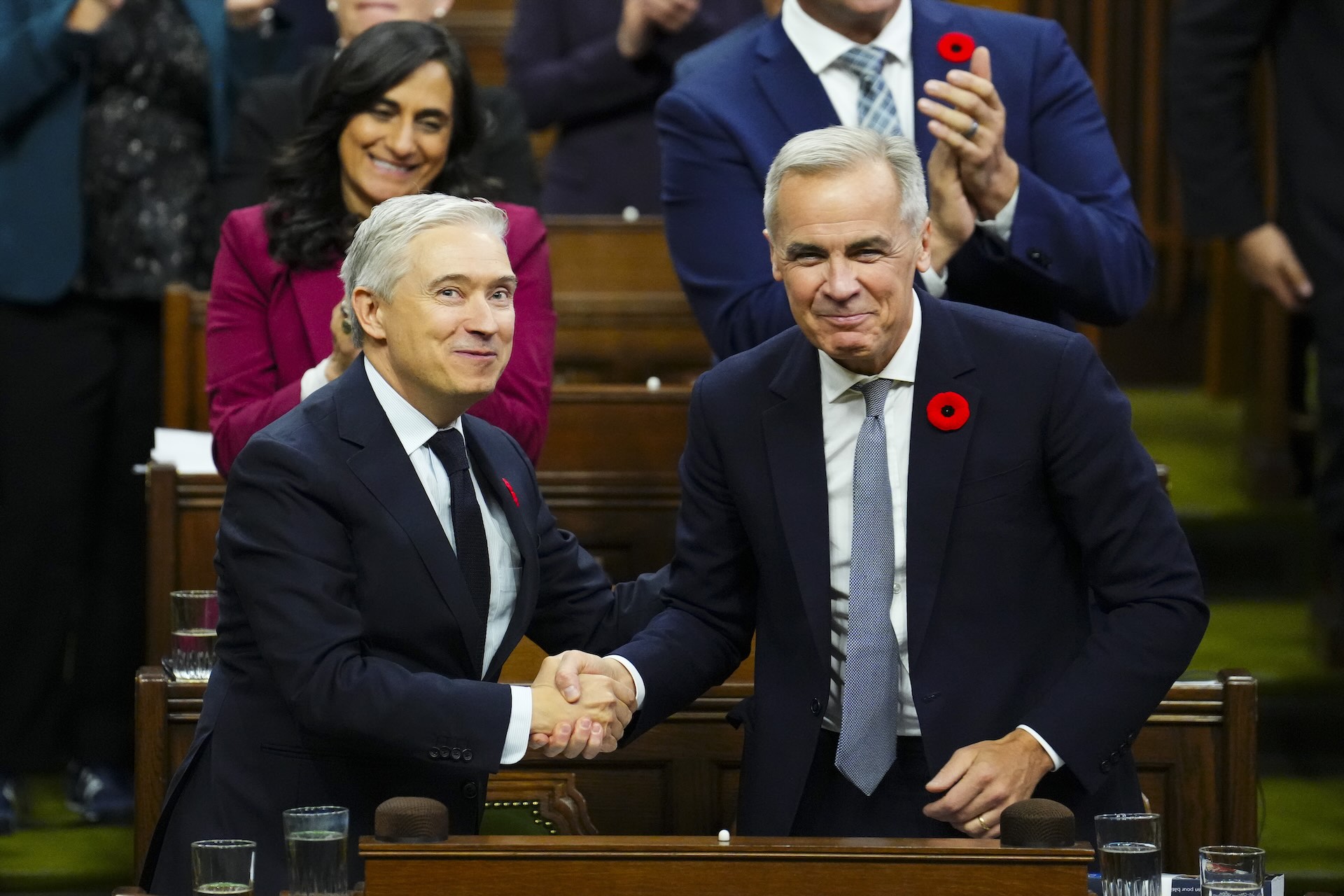
Finance Minister François-Philippe Champagne shakes hands with Prime Minister Mark Carney after delivering his budget speech in the House of Commons on Nov. 4, 2025. Photo: The Canadian Press/Sean Kilpatrick
Statistics Canada reported this week that 83,770 enterprises were “born” in 2023. That sounds like a lot, but then you get to the previous year’s death count: 88,040. So, more evidence that Canada’s animal spirits have gone into hibernation.
What will it take to coax them back? According to economist David Watt, more than what Prime Minister Mark Carney and Finance Minister François-Philippe Champagne proposed in their first budget. “Here we are… doing the same things again,” Watt wrote in his Substack newsletter. “If this is a ‘hinge moment,’ repeating past mistakes won’t lead to different outcomes.”
Watt used to keep tabs on Canada for HSBC. These days, he’s running his own advisory firm. His lament puts him in the camp of non-partisans who see the budget as a missed opportunity. In particular, Watt thinks Carney and Champagne missed a chance to overhaul tax policy, which probably has become an impediment to growth and innovation.
Related Articles


The budget boasts that various tweaks it proposes—including allowing the immediate write-off of manufacturing equipment—would drop Canada’s marginal effective tax rate (METR) on corporate income to 13.2 per cent from 15.6 per cent, lower than the U.S. and all the other G7 countries.
But the METR—a theoretical calculation, not a rate that any company would actually pay—was already the lowest in the G7 at 15.6 per cent, and business investment still languished. “Seemingly, it is not tax RATES that matter to investment,” Watt wrote, before offering a thought on what a government that was all-in on rebooting the economy might have done.
“Maybe Canada would benefit more from a corporate tax system that encourages firms to start small but to have big dreams, rather than a system that has an arbitrary threshold that strangles growth,” Watt added. “If firms end up punished for becoming too big and too successful, they won’t be.”
TD chief economist Beata Caranci made the same point ahead of the budget. A policy designed to help entrepreneurs actually might be dulling the country’s entrepreneurial drive. Caranci cited TD research from 2021 that found that smaller firms are less likely than larger ones to adopt new technology, another argument for undoing incentives to stay small.
But governments have been doing the opposite for two decades. Former prime minister Stephen Harper dropped the preferential small-business rate to 11 per cent from 12 per cent, and raised the limit to $500,000 from $400,000. Former prime minister Justin Trudeau cut the rate to 10.5 per cent in 2016, to 10 per cent in 2018 and to nine per cent in 2019. This was the period when business investment stagnated and productivity growth stalled. It was also a period in which waves of individuals turned themselves into corporations.
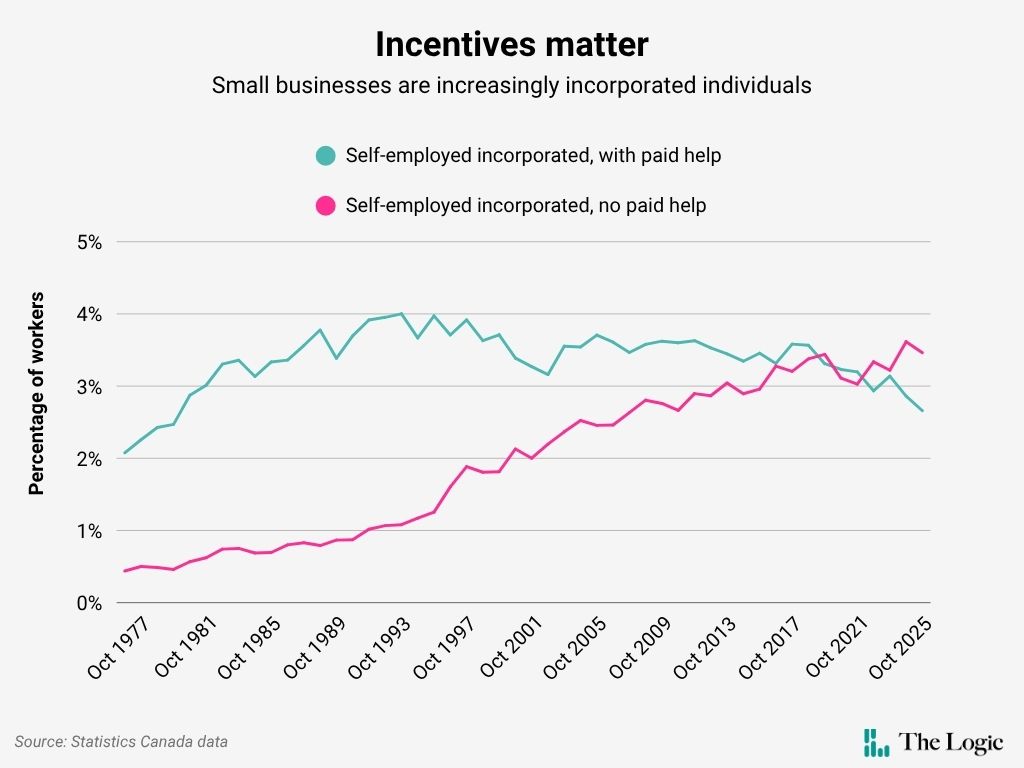
Statistics Canada needs time to produce its official birth and death counts of enterprises. In the meantime, self-employment figures are a decent real-time proxy.
The agency tracks the number of self-employed individuals who are incorporated, and distinguishes those individuals by registering how many report having paid help. As the small-business tax rate came down, the number of incorporated individuals working alone surpassed those supporting a payroll. The shift suggests the policy created an incentive for freelancers to incorporate and avoid higher individual tax rates, rather than inspiring a new wave of entrepreneurs.
In a paper published by Statistics Canada, economist Josip Lesica used corporate tax returns to show that firms tend to bundle at the $500,000 “kink.” Lesica observed that investment also spikes at that threshold, but not necessarily in a bid to grow. Instead, the objective appears to be to keep taxable revenue below $500,000. The leading type of investment was new vehicles, which also come with the largest depreciation write-offs. Lesica called his findings “revealing,” but cautioned against making “causal” conclusions. He was confident, stating that “small businesses in Canada respond strongly to tax incentives.”
Carney and his government understand this. Unlike Trudeau, Carney is fine with “builders” enjoying the rewards of their efforts: the budget would kill Trudeau’s luxury tax on private planes and yachts, an eat-the-rich levy that Finance now says isn’t worth the added costs of trying to collect it. The former investment banker knows that a little greed is good.
But Carney isn’t OK with wealthy people whose idea of building is paying accountants to design elaborate tax structures. The budget anticipates a windfall of almost $500 million next year by putting an end to something Finance calls “tax deferral through tiered corporate structures,” an apparent dodge that required more than a page to explain. By way of comparison, the proposed enhancements to the Scientific Research and Experimental Development (SR&ED) tax credit will cost the government about $290 million over five years.
I read Finance’s description of this $500-million ruse several times and still don’t completely understand it. But I do understand incentives. The scheme is more evidence that the tax system is littered with too many opportunities for an aging, risk-averse and increasingly unequal society to shelter its wealth.
Don’t hate the players, hate the game. Rarely is such aggressive tax planning illegal. It’s just humans succumbing to the overwhelming impulse to protect what they have. That’s why a 3,690-page tax code that is full of kinks like the small-business deduction has become a barrier to growth. Canada will continue to struggle until someone finds the courage to pound them out.
Kevin Carmichael is The Logic’s economics columnist and editor-at-large. He has spent more than two decades covering economics, business and finance for outlets including Bloomberg News, The Globe and Mail and the Financial Post, where he also served as editor-in-chief.



Loading...
Thanks for sharing!
You have shared 5 articles this month and reached the maximum amount of shares available.
CloseThis account has reached its share limit.
If you would like to purchase a sharing license please contact The Logic support at [email protected].
CloseGift the full article!
You have gifted 0 article(s) this month and have 5 remaining.
Recipients will be able to read the full text of the article after submitting their email address. They will not have access to other articles or subscriber benefits.
Photo: The Canadian Press/Sean Kilpatrick
Most Popular This Week




In-depth, agenda-setting reporting
Great journalism delivered straight to your inbox.
News
Ottawa is softening its ban on stablecoin yield
Briefing
Rio Tinto gets nearly $165M in additional federal funds for Quebec aluminum
U.S. to lift tariffs on some Canadian products crucial to Maine: Collins
Carney warns of tech dependence after Starlink disruptions in Ukraine
Best business newsletter in Canada
Get up to speed in minutes with insights and analysis on the most important stories of the day, every weekday.
Exclusive events
See the bigger picture with reporters and industry experts in subscriber-exclusive events.
Membership in The Logic Council
Membership provides access to our popular Slack channel, participation in subscriber surveys and invitations to exclusive events with our journalists and special guests.






