The punters at Polymarket appear to think they have a handle on how the federal election is going to go.
Skip to content

Commentary
Carmichael: The looming election plunges Canada’s businesses deeper into uncertainty
Trump’s ‘yo-yo economics’ have crushed business confidence. The winner of this contest will need to work fast to restore it
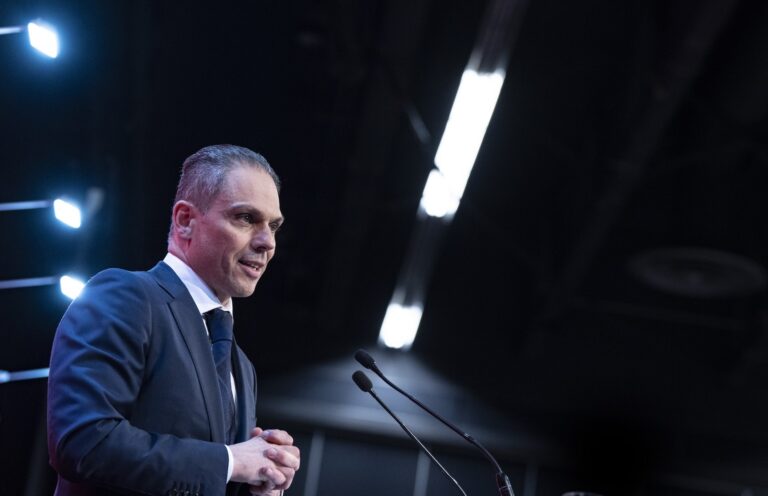
As Canada heads into an election, confidence among smaller businesses has reached an all-time low. Photo: The Canadian Press/Sean Kilpatrick
The punters at Polymarket appear to think they have a handle on how the federal election is going to go.
Earlier this week, amid pictures of Prime Minister Mark Carney in Paris and London, the prediction market that heralded Donald Trump’s return to the White House broke hard for the Liberals; the odds of Carney making some political history of his own swung to almost 60 per cent from about 30 per cent at the start of the month.
If only the future felt as certain. Daniel Kahneman and Amos Tversky showed that we humans are terrible at computing probabilities. We know how things are going to go when there is a zero per cent chance of something happening, and we do well at predicting the future when the outcome is guaranteed. Otherwise, loss aversion tends to cause us to misprice the future.
We’re especially poor at making decisions when probabilities fall in the middle of the distribution—like, say, 60 per cent. Our brains generate decision weights that turn more-than-likely outcomes into unlikely ones, which might explain why so many people continue to say the Conservatives remain the favourites.
Related Articles

Loss aversion might be the most important economic variable in Canada right now. We don’t like risk at the best of times and we’ve been plunged into a state of extreme uncertainty. The Canadian Federation of Independent Business’s monthly confidence index fell in March to the lowest reading on record. The prospect of economic war with U.S. President Donald Trump has rattled smaller businesses more than calamities such as the 9/11 terrorist attacks, the Great Recession and the COVID-19 pandemic.
“Gobsmacked, alarming, frightening,” were the words economist David Watt used to describe the results, noting that in November, the index showed that smaller businesses were optimistic about the year ahead of them. “In just a few months, the business outlook for the next year has been absolutely crushed,” Watt wrote in his newsletter.
Tariffs get all the attention, probably because they’re tangible. They hurt initially. The economy might even be hobbled for a time as lost sales cause an increase in layoffs and bankruptcies. But companies and workers adjust.
U.S. trade policy now poses a more existential threat because no one knows what it is. At an event I attended this week, one of the participants called it “yo-yo economics.” It’s hard to make plans when one day you’re up and the next you’re down. It’s especially hard when the downs are associated with talk of being cut off from your livelihood, seeking new markets in exotic places and the threat of annexation via economic force. The amygdala lights up, and before you know it, you are firing people and shelving investment plans before the tariffs even start.
“The uncertainty is already causing harm,” Bank of Canada governor Tiff Macklem told an audience in Calgary on Thursday.
It’s not entirely rational. Mackenzie King worried about annexation in the aftermath of the Second World War, yet nothing came of it. The lumber industry bent under decades of U.S. tariffs, yet never broke. But we’re not conditioned to put weight on the upside. A maker of playground equipment in Ontario told The Logic’s Catherine McIntyre that he had already fired 90 per cent of his staff in part because offering lower prices to offset any tariffs would wipe out his profit margins.
Statistics Canada data show corporate net income was about seven per cent of revenue at the end of last year, better than the average since 2010 of about six per cent. With the country shifting to a war footing, you might assume that businesses would accept narrower margins—or even zero margins for a period of time.
But Kahneman showed in Thinking, Fast and Slow that our internal reference points outweigh real-world thresholds. So a seven per cent profit margin becomes the equivalent of ground zero, and companies will make potentially ruinous decisions to preserve what they have, rather than use that margin to absorb some short-term pain.
The political class isn’t helping. Carney said Thursday in Edmonton that “in this time of crisis, the government needs a strong and clear mandate.” That’s what Ontario Premier Doug Ford said earlier this year, when he saw a chance to consolidate his power via an early election, and that’s what Conservative leader Pierre Poilievre was saying when he was ascendant before Justin Trudeau’s resignation.
At least politicians at one point had the wisdom to separate important institutions from the political cycle. The Bank of Canada remains a source of calm. Macklem said policymakers have adjusted their approach to setting interest rates to focus on minimizing risk rather than betting on a single path that could end up being wrong.
With inflation heating up again, that means the Bank of Canada could be less willing to offset the economic pain of tariffs with interest rate cuts. That’s why it will be incumbent on governments to offset all that uncertainty. The urgency of the moment suggests they will do so, but only in a couple of months. Our federal leaders have some urgent business of their own to attend to first.
Kevin Carmichael is The Logic’s economics columnist and editor-at-large. He has spent more than two decades covering economics, business and finance for outlets including Bloomberg News, The Globe and Mail and the Financial Post, where he also served as editor-in-chief.



Loading...
Thanks for sharing!
You have shared 5 articles this month and reached the maximum amount of shares available.
CloseThis account has reached its share limit.
If you would like to purchase a sharing license please contact The Logic support at [email protected].
CloseGift the full article!
You have gifted 0 article(s) this month and have 5 remaining.
Recipients will be able to read the full text of the article after submitting their email address. They will not have access to other articles or subscriber benefits.
Photo: The Canadian Press/Sean Kilpatrick
Most Popular This Week




In-depth, agenda-setting reporting
Great journalism delivered straight to your inbox.
News
National Bank CEO warns AI alone won’t give banks a lasting edge
Briefing
Canada and Ontario commit over $5B to support tariff-hit steel sector
Hackers will see cars as major targets in next 3 years, 83% of car-tech workers say
EA shutting down Edmonton studio BioWare
Best business newsletter in Canada
Get up to speed in minutes with insights and analysis on the most important stories of the day, every weekday.
Exclusive events
See the bigger picture with reporters and industry experts in subscriber-exclusive events.
Membership in The Logic Council
Membership provides access to our popular Slack channel, participation in subscriber surveys and invitations to exclusive events with our journalists and special guests.





