In the days leading up to this week’s AI Safety Summit in the U.K., there was a clear tension between those who believe artificial intelligence will be an unprecedented boon to society and those who fear it will end the world.
Skip to content

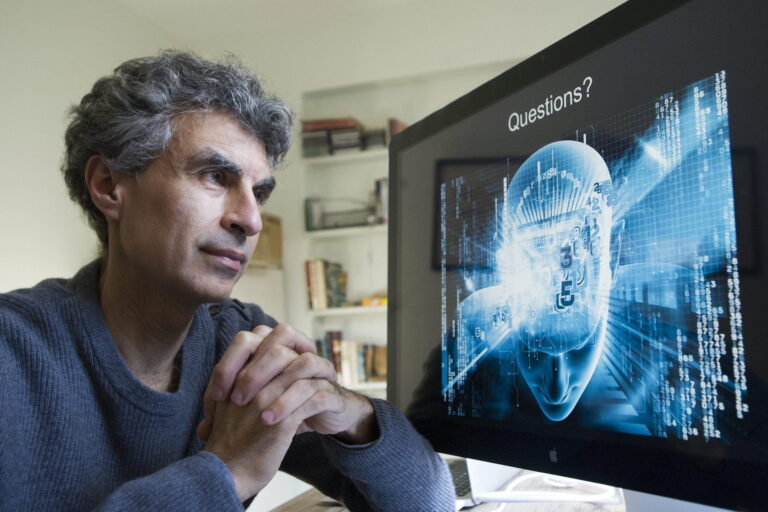
 Canadian AI pioneer Yoshua Bengio—one of the most vocal of those warning about the technology’s risks—will help guide the thinking of the world’s governments on how to regulate it. Photo: AP Photo/Alastair Grant

Commentary
Carmichael: Amid AI worries, a fine line between caution and opportunity lost
Canada isn’t good at taking advantage of technological change, but this is a test we can’t fail
World leaders and AI leaders gather for the U.K. AI Safety Summit in November 2023. Photo: Leon Neal/Pool Photo via AP
In the days leading up to this week’s AI Safety Summit in the U.K., there was a clear tension between those who believe artificial intelligence will be an unprecedented boon to society and those who fear it will end the world.
As The Logic’s Murad Hemmadi reported from Bletchley Park, the Canadian AI pioneer Yoshua Bengio—one of the most vocal of the doomsayers—will help guide the thinking of the world’s governments on how to regulate the technology.
I don’t have Bengio’s command of the subject, but I’m drawn more to the arguments of his peers who believe in AI’s vast economic upside.
Maybe I should be among those who see AI as a threat. As a journalist, some of my competitive advantage over technology eroded when OpenAI took down the fence that had confined ChatGPT to munching on data produced before September 2021. Want real-time news? Ask Bing.
Related Articles


Adding value to the first draft of history is also getting harder. I’ve typed enough words about the Bank of Canada and the Federal Reserve to play a credible “central-bank watcher” on social media. But JPMorgan Chase is already using a ChatGPT-based AI to analyze Fed statements and speeches for clues on where interest rates are headed. And researchers at the Bank of Canada last year showed that it’s possible to use face- and voice-recognition technology to anticipate how Fed chair Jerome Powell’s emotions during congressional testimony will affect stock prices.
Whatever existential angst I’m feeling is an example of the fear and loathing that comes with every big technological or structural change, as Matt Ridley showed in How Innovation Works.
The Luddites wreck the looms, then lose momentum when the broader public realizes the looms mean more cotton of an acceptable or better quality, for less money. A more productive and profitable textile industry generates previously unimaginable scale and profits, leaving the economy wealthier. That wealth generates more jobs than existed before and the Luddites are eventually forgotten—until scribes need a metaphor for technophobia at the beginning of the next period of disruption.
The economist Tyler Cowen argues that AI will make society vastly more intelligent. Most everyone will have access to a personal research assistant, speechwriter and life planner. That’s bad news for anyone who had hoped for a career doing the bidding of researchers, speech givers or the habitually disorganized. But it’s undeniably good for everyone else.
A few years ago, I noticed a spot on my back. It grew, and my partner nudged me to ask my family doctor about it. My doctor was pretty sure it was nothing, but he put me in line to see a dermatologist. In Quebec, where I live, wait times for a specialist are between three days and 12 months, according to the provincial government. My appointment, when it arrived several months later, lasted less than five minutes. I had barely removed my shirt when the dermatologist said the spot was nothing but a sign of age. I apologized for taking up valuable space in his calendar. He told me I shouldn’t worry; he and his colleagues see a dozen cases like mine a day.
Think about that for a minute. Highly trained professionals who wake up every day facing backlogs they will never clear are spending significant time on age spots. If machine learning can see into the souls of central bankers, then it surely could be used by a nurse practitioner or some other technician to help members of an aging society avoid further clogging the health-care system’s waiting lists.
AI won’t turn us all into doctors. But it could let someone with a base level of knowledge do things that currently require over a decade of post-secondary training. Across society, talent would be able to maximize its potential. Everyone would be rewarded with more time, money or both. Society would be healthier and wealthier, and the economy would be stronger.
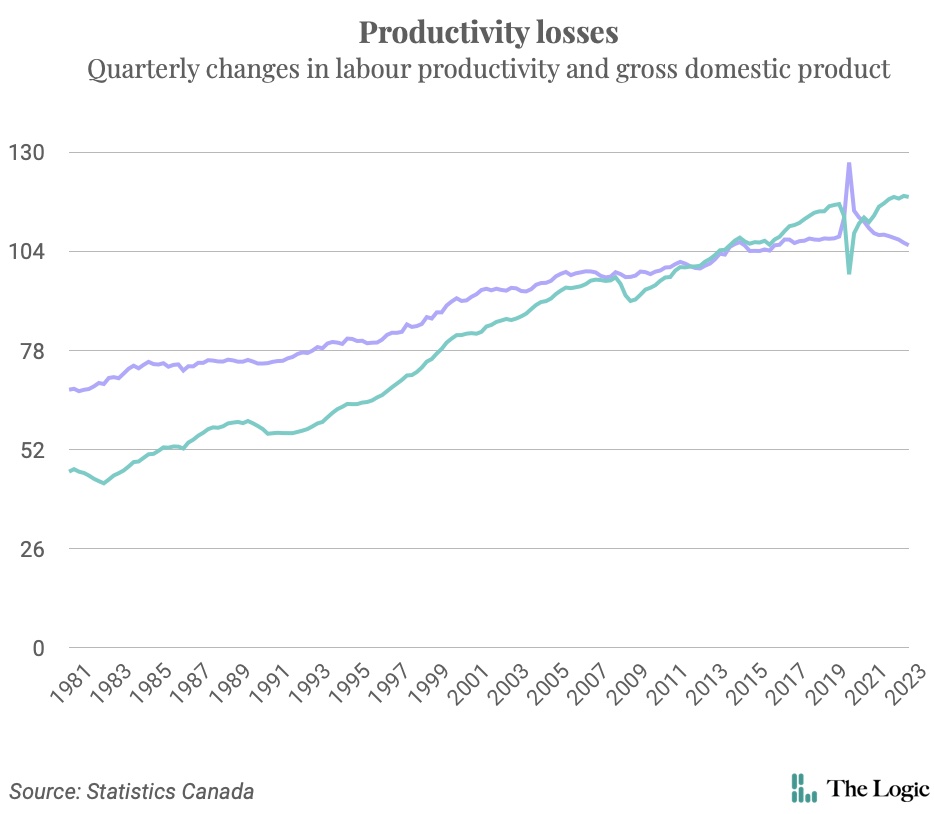
Unfortunately, Canada isn’t good at taking advantage of technological change. It’s one of the reasons—and maybe the biggest one—why the amount of economic output per hour worked has been declining for more than a year, according to Statistics Canada’s quarterly measure of labour productivity, a statistic that can only be interpreted as a marker of fundamental weakness.
“This country has actually done a very good job of growing by adding workers,” Bank of Canada governor Tiff Macklem told the House finance committee on Oct. 30. “Companies are good at hiring workers and integrating them into the workforce, and that has really been the key to our growth. What has been disappointing is we’ve been much less successful in growing output per worker, or productivity. Why that really matters is that higher productivity pays for higher wages; it’s the source of sustained increases in our standard of living.”
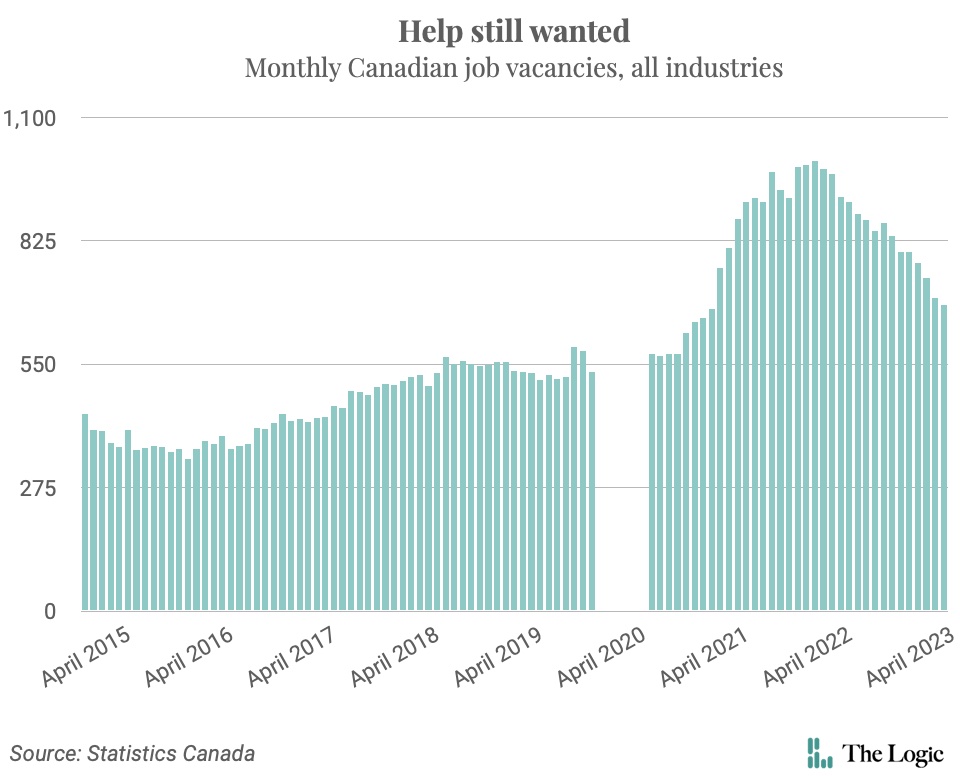
We’re testing the limits of the growth-by-hiring model. The economy has slowed to a crawl, yet the job vacancy rate is still considerably higher than it was before the pandemic. That suggests demographics are making it harder for companies to satisfy demand by hiring more people. Immigration Minister Marc Miller’s decision this week to cap immigration at current levels suggests that employers won’t be able to fill gaps with temporary foreign workers or by raiding other countries for talent.
Productivity is about more than technology, of course. We reduce the supply of skilled workers by letting professional associations control accreditation, which has the effect of constraining supply by blocking talent from maximizing its potential. Regulation by multiple levels of government frustrates innovation, and our relatively small market dulls the incentive to invest at home when opportunities across the border in the U.S. are so much greater.
A technology as powerful as AI could help companies power through such friction, turning disincentives into mere excuses. AI will make hundreds of thousands of us redundant in our current positions. But there’s every reason to believe that it will create just as many opportunities—if employers embrace it.
In Canada, the biggest risk AI poses is that companies will balk at doing so.
Kevin Carmichael is The Logic’s economics columnist and editor-at-large. He has spent more than two decades covering economics, business and finance for outlets including Bloomberg News, The Globe and Mail and the Financial Post, where he also served as editor-in-chief.



Loading...
Thanks for sharing!
You have shared 5 articles this month and reached the maximum amount of shares available.
CloseThis account has reached its share limit.
If you would like to purchase a sharing license please contact The Logic support at [email protected].
CloseGift the full article!
You have gifted 0 article(s) this month and have 5 remaining.
Recipients will be able to read the full text of the article after submitting their email address. They will not have access to other articles or subscriber benefits.
Photo: Leon Neal/Pool Photo via AP
Canadian AI pioneer Yoshua Bengio—one of the most vocal of those warning about the technology’s risks—will help guide the thinking of the world’s governments on how to regulate it.
Most Popular This Week




In-depth, agenda-setting reporting
Great journalism delivered straight to your inbox.
News
Panel decries Canada’s chaotic way of funding world-class science
Briefing
Feds pledge $15M for U.S. satellite navigation company Xona to expand in Montreal
Inovia raises US$200M for new VC fund as it eyes AI’s impact
43% of eligible Albertans voted ahead of Monday’s referendum
Best business newsletter in Canada
Get up to speed in minutes with insights and analysis on the most important stories of the day, every weekday.
Exclusive events
See the bigger picture with reporters and industry experts in subscriber-exclusive events.
Membership in The Logic Council
Membership provides access to our popular Slack channel, participation in subscriber surveys and invitations to exclusive events with our journalists and special guests.





