
Listen Now
0:00
I alluded last week to Google chief economist Fabien Curto Millet’s disagreement with Stanford University’s Erik Brynjolfsson over whether artificial intelligence has already begun taking jobs from aspirant white-collar workers—mostly from Curto Millet’s perspective, which is that broader macroeconomic factors better explain why entry-level workers are having such a hard time in the U.S. despite strong economic growth.
Well, Brynjolfsson wrote to make me aware of a few things. He wanted me to know that he takes Curto Millet’s critique of his original findings seriously. He and his co-writers published updated research in February that found AI is a compelling explanation for the drop in entry-level employment starting from 2024—not late 2022 or 2023 as they previously thought.
Related Articles


In other words, they say, the technological disruption from AI is only just getting started. But Brynjolfsson’s team at the Stanford Digital Economy Lab remain confident in their core argument that there’s a correlation between the sharp drop in youth employment in AI-exposed occupations and AI adoption. Their update argues that demand for such work isn’t overly affected by interest rates. They agree that employment is determined by many variables, but they think it would be a grave mistake to blame everything on the Federal Reserve. “Since we don’t have an experiment where we can compare a world with AI to one without, this will remain an active area for scientific research,” Brynjolfsson and his co-authors wrote.
I don’t return to this subject because I want to moderate a debate between two influential economists. There’s a polycrisis to cover and AI is only one part of it.
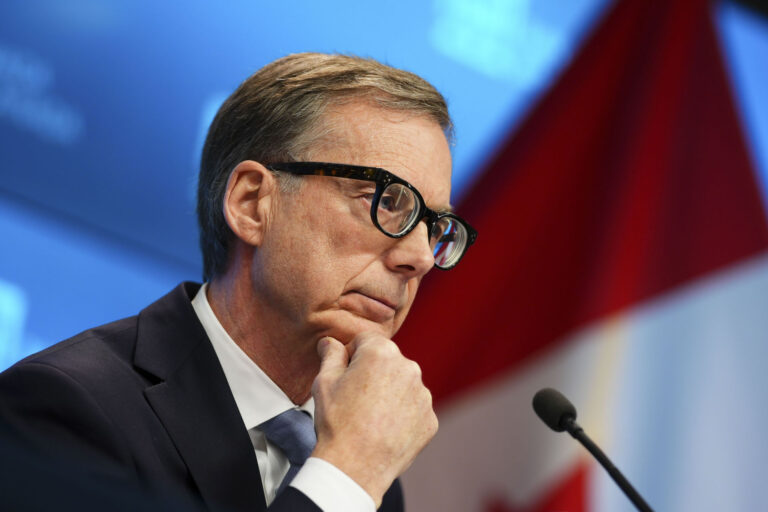
What I want to do is highlight how agonizing these questions must be for Bank of Canada governor Tiff Macklem and anyone else charged with making long-term decisions.
There’s no settled opinion on anything. We live in a world where false precision undermines forecasts, polarizing opinions drive audiences and AI chatbots have been trained to be overly confident in what they know. Maybe that’s why we just spent two weeks arguing over the definition of a recession. It’s a conversation that can be distilled easily into a short-form video. It’s a language we understand.
Structural change—when economies transform into something new—demands a longer attention span. You could scream “jobs apocalypse” into a camera for 90 seconds, but it might not age well. In January, Statistics Canada’s Tahsin Mehdi and Marc Frenette went deep on the question of whether the AI explosion was destroying Canadian jobs. They found that the gap between older and younger workers in coding-related positions widened between 2022 and 2025, while it remained constant in other jobs. That could be indicative of something.
However, Mehdi and Frenette said it was impossible to state with certainty that robots are responsible for such changes, or whether they are the result of companies such as Shopify correcting for overhiring they did during the COVID-19 pandemic. The overall mix of occupations was “not markedly different from previous periods of technological disruption,” suggesting AI might “align with historical patterns of technological change rather than representing an unprecedented transformation,” Mehdi and Frenette wrote.
Those of you who subscribe to The Logic Professional already know what I think about the recession debate. It was an attempt to put a one-dimensional frame on a four-dimensional problem. If we stop what we’re doing every time the economy slides into a soft patch, we’ll be in trouble. We’re now in a long game and we’ll lose if we fixate on short-term pain. “The Canadian economy could fail to restructure,” Macklem said in a speech in February. “That’s what we really can’t afford. That’s why we need to lean into this structural change.”
It’s a shame central bankers only drive the conversation during pandemics and global financial meltdowns. That speech was Macklem’s attempt to avoid reflexive reactions to high-frequency data. He said the moment we’re in now is similar to those that followed the original Canada-U.S. trade agreement in 1989 and the spread of the internet in the 1990s. Companies died and jobs were lost. But new companies were born and more jobs were created. Productivity increased and stuff got cheaper. That’s generally how structural change unfolds, provided policymakers, businesses and workers roll with it.
Hindsight makes structural change look easy. It’s anything but. Consider Macklem’s interest rate decision this week. Employment is essentially unchanged this year. In isolation, six months of zero jobs growth argues for a rate cut.
In February, Macklem identified three structural changes that will drive the economy for the next couple of years: AI, the U.S.’s decision to abandon free trade and the collapse in population growth. If any or all of those factors explain the weak hiring, then there is nothing the Bank of Canada can do—an interest rate cut isn’t going to persuade a firm to hire more coders if it has decided to automate that work. Macklem would only stoke inflation at a moment when price pressures are a growing concern because of the Iran war.
But what if that weakness is the result of cyclical factors? Structural change is linear—it can’t be stopped. But as these mega trends advance, old-fashioned business cycles will play out underneath them, as companies adjust to short-term demand. Most Canadian exports to the U.S. have been spared from tariffs. Those that haven’t, such as automobiles and steel, are getting hammered. If their plight is spilling into the broader economy, then lower interest rates might help. Policymakers have learned that sectoral adjustments needn’t become a headwind for the entire economy.
Macklem’s decision Wednesday was to leave interest rates unchanged. He helpfully sketched some scenarios that we can use to understand how he might respond down the road. He said an escalation of the economic war with the U.S. probably would require an interest rate cut, while the inflationary effects of the actual war in the Middle East might force “consecutive” increases. He emphasized that the priority would be keeping inflation at two per cent.
The central bank said much the same in April. The low-key announcement was itself a reminder that structural change shifts the locus of power. We’ve grown accustomed to relying on central banks to get us out of trouble. That psychological dependence was also on Macklem’s mind in February. “Monetary policy will not be at the centre of the action,” Macklem said.
In case you haven’t been paying attention, he meant it. Zero interest rate policy is for normal crises. We’re in the early stages of something bigger.
Kevin Carmichael is The Logic’s economics columnist and editor-at-large. He has spent more than two decades covering economics, business and finance for outlets including Bloomberg News, The Globe and Mail and the Financial Post, where he also served as editor-in-chief.














