Skip to content

Canada's Business and Tech Newsroom

  • Professional Subscription
  • Partnerships & Advertising
  • Licensing & Syndication
Log In Subscribe
Welcome,
  • My Account
  • Log Out
  • Business
  • Tech
  • National
  • The Big Read
  • Briefings
  • Commentary
Search
Log In Subscribe
Welcome,
  • My Account
  • Log Out
Commentary

Carmichael: The G7 has its swagger back, but for how long?

In February 2010, Stephen Harper’s government hosted a meeting of G7 finance ministers and central bank governors in Iqaluit. 

The financial crisis of 2008 and 2009 had morphed into a sovereign debt crisis in Europe. Folks were busy. Yet Canada had the audacity to use its turn as G7 chair to force people such as the U.S. treasury secretary and the managing director of the International Monetary Fund to gather in the Canadian Arctic—in February. 

Commentary

Carmichael: The G7 has its swagger back, but for how long?

Or, why people who live in glass houses shouldn’t throw BRICs

By Kevin Carmichael
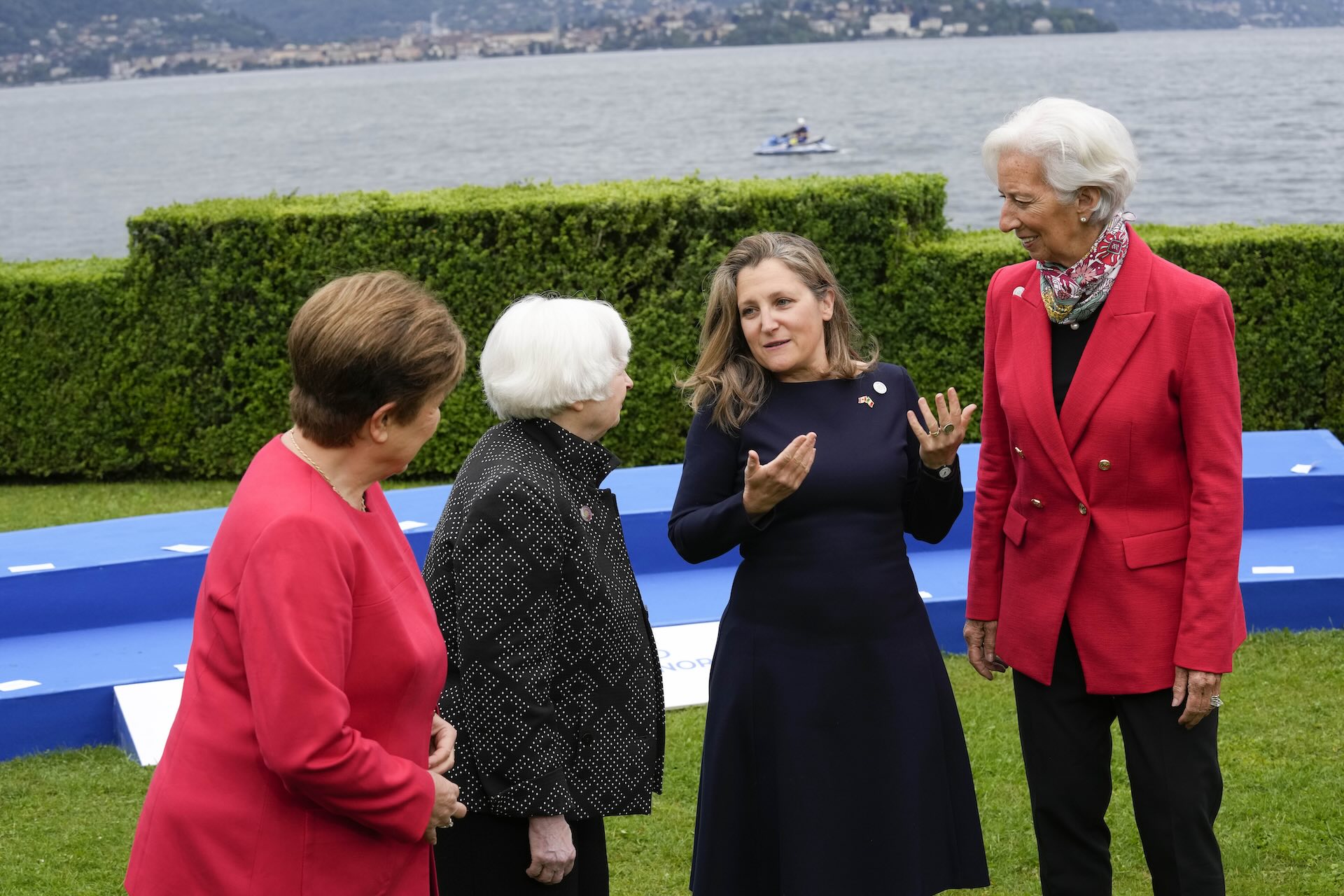
From left, IMF Managing Director Kristalina Georgieva, U.S. Treasury Secretary Janet Yellen, Canada's Finance Minister Chrystia Freeland and European Central Bank President Christine Lagarde meet during the G7 finance ministers’ meeting in Italy on May 24. Photo: AP Photo/Antonio Calanni
Jun 1, 2024
A A
A Small A Medium A Large
Share

Gift

Share

In February 2010, Stephen Harper’s government hosted a meeting of G7 finance ministers and central bank governors in Iqaluit. 

The financial crisis of 2008 and 2009 had morphed into a sovereign debt crisis in Europe. Folks were busy. Yet Canada had the audacity to use its turn as G7 chair to force people such as the U.S. treasury secretary and the managing director of the International Monetary Fund to gather in the Canadian Arctic—in February. 

At least one European official thought the idea was “crazy,” The Guardian reported at the time. Somehow, the meeting ended without a vote to remove Canada from the group. 

I remember wondering why the G7 was bothering to meet at all. Global powers had by then decided that the larger G20 was the better forum to seek cooperation on big cross-border problems. Wall Street, the City of London and their regulators had been humbled by their roles in causing the Great Recession. China had done as much as anyone in resolving that crisis by executing a fiscal stimulus program so large that it revived global economic growth and commodity prices.   

Related Articles

Carmichael: Geopolitics is now a major macroeconomic risk

By Kevin Carmichael
Trade Minister Mary Ng wears a black sweater with white pearls. Her arms are outstretched as two mics point toward her. The photo is taken from a low angle, looking up at Ng.

Carmichael: Membership in ‘Stronghold North America’ comes with a trade-off

By Kevin Carmichael

Fast forward to the present: the G7 is getting its swagger back. Like Kate Bush, Bruce Springsteen and Judas Priest, this act that debuted in the 1970s has managed to remain relevant despite some lulls. 

Last weekend in Italy, Finance Minister Chrystia Freeland and Bank of Canada governor Tiff Macklem backed a communiqué that the Financial Times interpreted as a pledge to use profits from the Russian assets those countries have seized to finance Ukraine’s attempt to repel Vladimir Putin’s invasion. All that’s left is for the leaders to stamp their approval when they meet in Italy later this summer. 

The G20—which includes G7 antagonists China and Russia and frenemies Turkey and Saudi Arabia—has accomplished little of consequence for years. Meanwhile, Sweden and Finland have joined NATO, and the U.S. and its friends in Europe and Asia are coalescing around the idea of “friendshoring,” a mild version of de-globalization that uses sanctions, tariffs and massive spending on industrial policy to route supply chains away from China and to isolate countries such as Russia and Iran. 

Prime Minister Justin Trudeau’s government has fully embraced this new/old order, deploying hundreds of millions of dollars to entice automobile and battery makers to set up in Ontario and Quebec, and using Ottawa’s foreign-investment screening process to repel Chinese investors from claiming Canadian resources.  

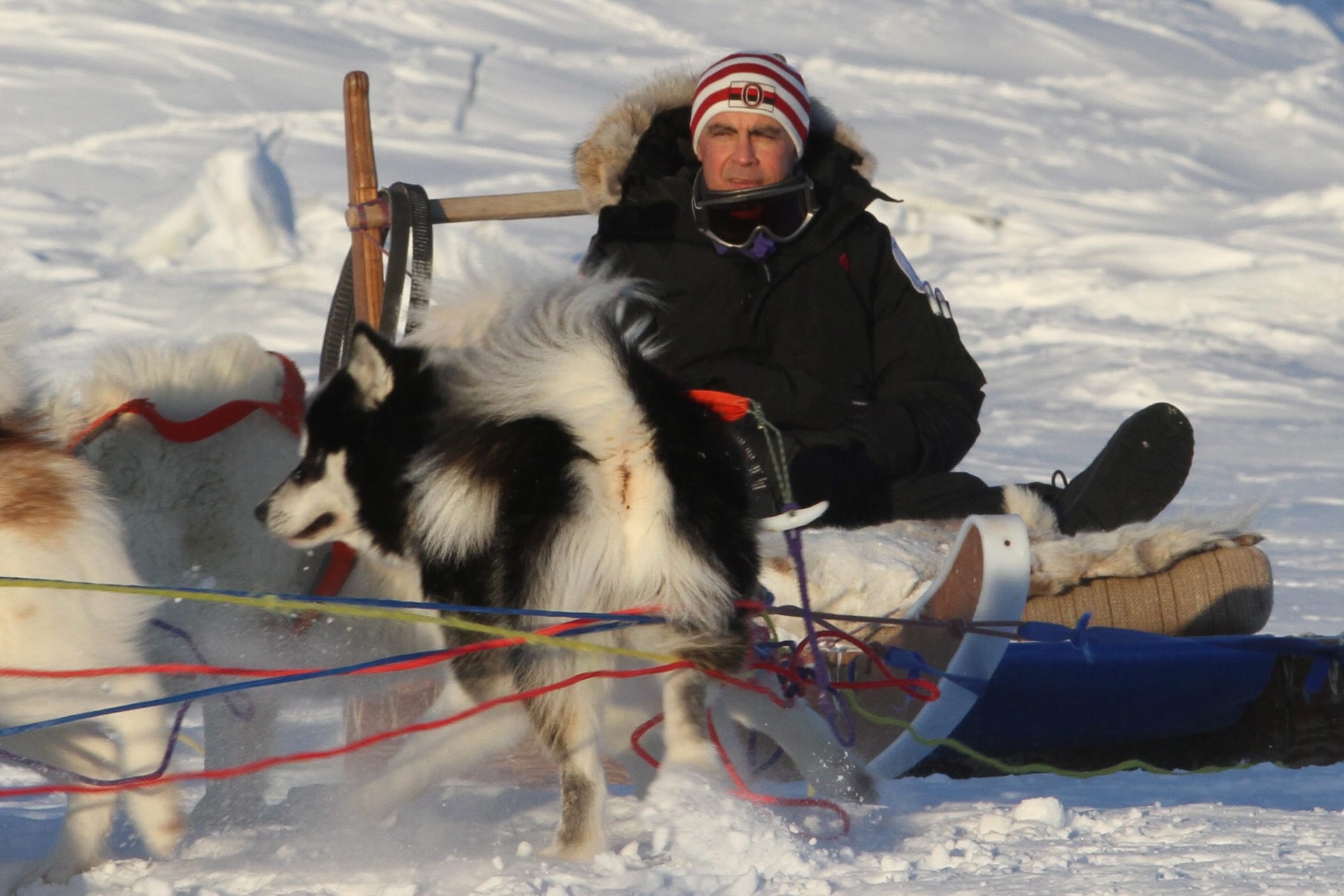
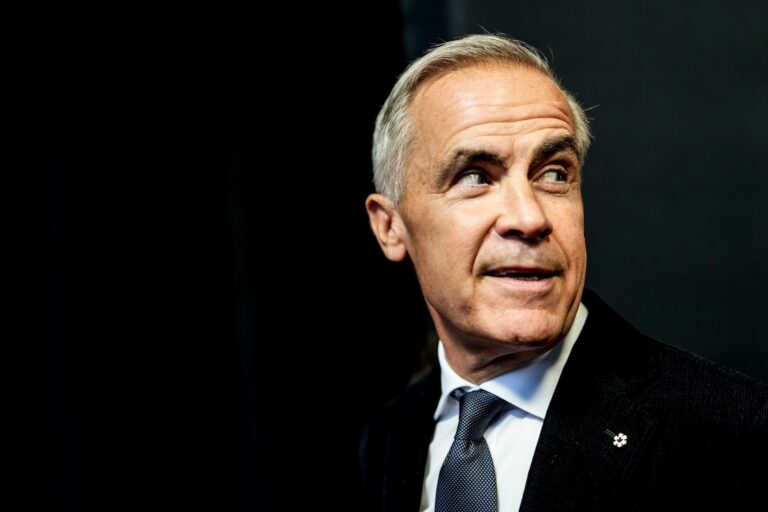
Mark Carney, then Governor of the Bank of Canada, in Iqaluit in 2010 for a meeting of G7 finance ministers and central bank governors. Photo: The Canadian Press/Fred Chartrand

Some Canadian executives and investors will be relieved by this turn of geopolitical events. For a decade or so, it looked like anyone who wanted to surf the biggest waves would have to find a beach in Asia. Suddenly, the U.S. is back on top. Marc Gilbert, a managing director at Boston Consulting Group in Toronto, said “a lot” of clients are thinking like this: “My Lord, we are so fortunate to be next to the U.S. and their economy is very strong … Let’s live off that fortune and be more present in it. Let’s expand in it.” 

Expand in it, we should. The U.S. government is spending heavily on clean technology and artificial intelligence, the country’s economy is experiencing a productivity boom, and its population is growing—and it’s all happening right next door. 

Just because it feels like the 1970s doesn’t mean the Western powers have turned back the clock, however. Hans Rosling, author of the Factfulness, warned against dividing the world into halves and assuming there was a gap between the West and the rest. That’s never been more true.  

China generates output of US$25,000 per person, when adjusted for purchasing power parity, according to the International Monetary Fund; Canada produces about US$60,500. Be wary of letting that gap create a sense of economic superiority, because averages obscure reality. China might still have a large number of relatively poor people, but it also has a lot of rich ones. 

The point is to avoid the mental trap of thinking about the world in binary terms—in this case, the rich and powerful democracies and the autocracies that govern the “developing” world. Many of the countries that tend to get lumped into the latter group are no longer developing, they’ve arrived. As my colleague Anita Balakrishnan showed last week, countries such as Canada and the U.S. have little to teach China when it comes to creating clean technology.  

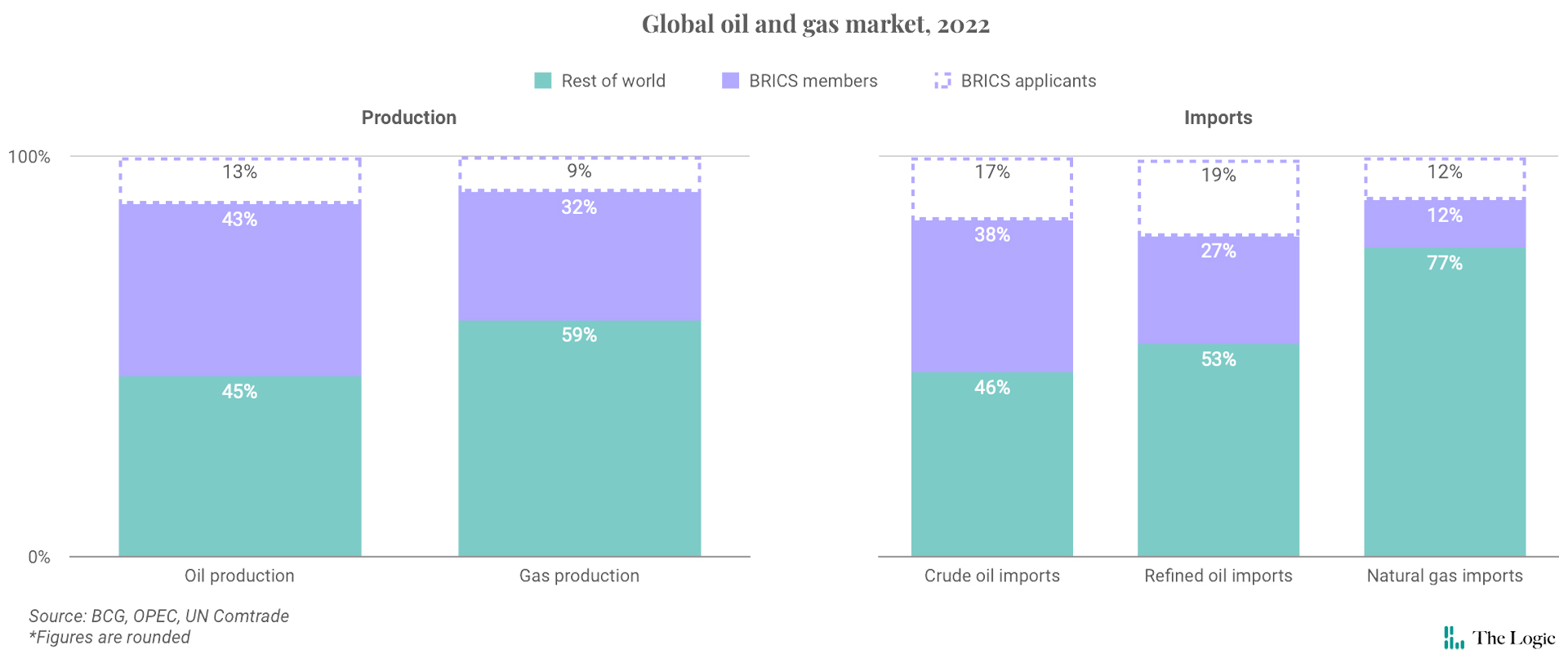
In April, Gilbert and some of his Boston Consulting colleagues published a report on how the BRICS countries—Brazil, Russia, India, China and South Africa—are stitching together a network that already rivals that of the G7. This year the group expanded to include Egypt, Ethiopia, Iran, Saudi Arabia and the United Arab Emirates. Another dozen countries have asked to join. If they are accepted, the group would represent a third of global GDP, more than half of all oil production and a lot of economic opportunity.  

That opportunity won’t be restricted to the members of the newly expanded BRICS group. Gilbert is advising his clients to look for opportunities to trade and invest within the group, or in a BRICS-adjacent country. In other words, set up shop in one of those places, rather than give up because geopolitics makes it too difficult to conduct business by remote control.

Gift the full article

For Canada, that will require more geopolitical savvy than doing business in the U.S., but the rewards could be worth it. The G7’s leaders might be trying to replay the 1970s, but don’t expect the rest of the world to follow.  

Kevin Carmichael is The Logic’s economics columnist and editor-at-large. He has spent more than two decades covering economics, business and finance for outlets including Bloomberg News, The Globe and Mail and the Financial Post, where he also served as editor-in-chief. 
#commentary #economy

Loading...

Thanks for sharing!

You have shared 5 articles this month and reached the maximum amount of shares available.

Close
This account has reached its share limit.

If you would like to purchase a sharing license please contact The Logic support at [email protected].

Close
Want to share this article?

Upgrade to all-access now

Close
Gift the full article!

You have gifted 0 article(s) this month and have 5 remaining.

Copy link and gift
Copy Link
Email to a friend
Send Email
Gift on Social Media

Recipients will be able to read the full text of the article after submitting their email address. They will not have access to other articles or subscriber benefits.

Photo: AP Photo/Antonio Calanni

Mark Carney, then Governor of the Bank of Canada, in Iqaluit in 2010 for a meeting of G7 finance ministers and central bank governors.

Most Popular This Week

A diptych showing Mark Carney on the left, and CIBC CEO Harry Culham on the right.
News

Diversifying trade requires banks to take bigger risks, official advised Carney before CIBC meeting

By Joanna Smith
The image shows the inside of Toronto Stadium on a sunny day. The rows of seats are empty; an empty green field is visible.
News

Toronto and Vancouver aren’t getting a World Cup bookings boom

By Chaimae Chouiekh
A yellow ambulance is pictured outside of a hospital in Montreal. A red sign in the foreground reads, “Urgence / Emergency.”
Commentary: Quebec Ink

Quebec just found out what not having digital sovereignty really means

By Martin Patriquin
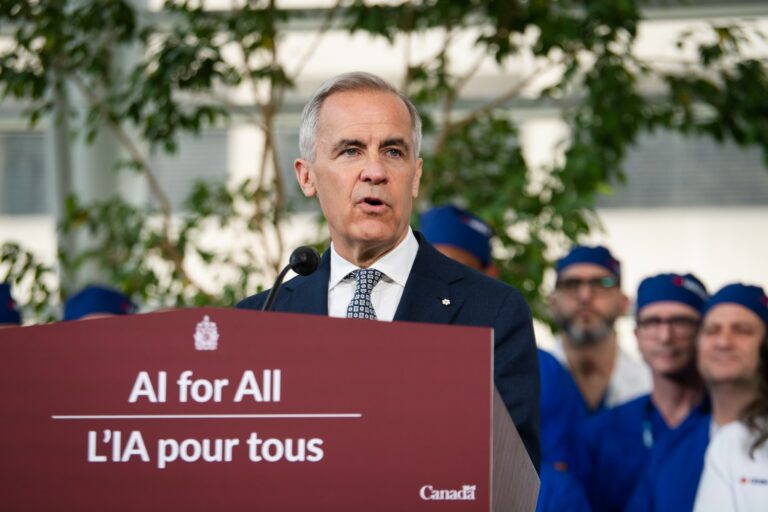
An image of Mark Carney standing in front of a red podium with the words "AI for All / L'IA pour tous." He is wearing a suit and tie. In the background, people wearing scrubs and white coats are visible.
Special Report

Canada’s new AI strategy sets lofty goals for adoption and growth

By Murad Hemmadi and Laura Osman

In-depth, agenda-setting reporting

Great journalism delivered straight to your inbox.

An image of Tiff Macklem standing in a dimly-lit hallway, wearing a blue suit and glasses. He is clasping his hands in front of him and looking ahead.
Commentary

Carmichael: Tiff Macklem can’t save you

By Kevin Carmichael

Briefing

Canada to publish list of imports at risk of being made with forced labour

By Joanna Smith   |   Jun 12, 2026

TMX Group acquires RAFI Indices for $683M

By Anita Balakrishnan   |   Jun 12, 2026

Ikea invests in Toronto food startup NS/TX Industries’ US$10.5M fundraise

By Catherine McIntyre   |   Jun 12, 2026

Best business newsletter in Canada

Get up to speed in minutes with insights and analysis on the most important stories of the day, every weekday.

Exclusive events

See the bigger picture with reporters and industry experts in subscriber-exclusive events.

Membership in The Logic Council

Membership provides access to our popular Slack channel, participation in subscriber surveys and invitations to exclusive events with our journalists and special guests.

Recent Popular Stories

Commentary: Quebec Ink

Quebec just found out what not having digital sovereignty really means

By Martin Patriquin   |   Jun 8, 2026
A yellow ambulance is pictured outside of a hospital in Montreal. A red sign in the foreground reads, “Urgence / Emergency.”
News

OMERS investment chief departs for Singapore’s Temasek

By Chaimae Chouiekh   |   Jun 10, 2026
The Big Read

We found every data centre in Canada

By Murad Hemmadi, David Reevely, Aleksandra Sagan, Chaimae Chouiekh, Martin Patriquin and Catherine McIntyre   |   Apr 8, 2026
Four vertical slices of aerial view photos. From left, a building in downtown Toronto housing several data centres, a picture of the Albertan wilderness where the proposed Wonder Valley data centre would go, a lit-up QScale data centre in Quebec, and a data centre at a Hydro-Quebec dam.
News

Diversifying trade requires banks to take bigger risks, official advised Carney before CIBC meeting

By Joanna Smith   |   Jun 9, 2026
A diptych showing Mark Carney on the left, and CIBC CEO Harry Culham on the right.
News

Canada’s surprise plan to buy Saab command jets leaves competitors seeking answers

By David Reevely   |   May 29, 2026
A closeup of a scale model of a jet covered in pixellated camouflage, with sensor equipment attached to the top of its fuselage. There are civilians and uniformed military personnel milling in the background.
The Big Read

ApplyBoard faces a reckoning as Canada’s immigration boom turns into a bust

By Claire Brownell and David Reevely   |   May 27, 2026

Canada's most influential executives and policymakers are reading The Logic

  • CPP Investments
  • Sun Life Financial
  • C100
  • Amazon
  • Telus
  • Mastercard
  • bdc
  • Shopify
  • Rogers
  • RBC
  • General Motors
  • MaRS
  • Government of Canada
  • Uber
  • Loblaw Companies Limited
logic-logo

Canada's Business and Tech Newsroom

100% human-crafted journalism

Newsroom

  • News Tips
  • AI Policy
  • Editorial Disclosures
  • Story Pitches

Company

  • About Us
  • Terms of Service
  • Privacy Statement
  • Corporate Information

Contact

  • Contact Us
  • Advertise
  • FAQs
  • Work at The Logic

© 2026 The Logic Inc. All Rights Reserved.

Trusted by leaders

Error

Account creation failed.

Please email us at [email protected].

Create Account

[wppb-register form_name=”cozmo-registration-form-for-modal”]

I do have an account
Login
or

[wppb-login]

I don’t have an account