Skip to content

Canada's Business and Tech Newsroom

  • Professional Subscription
  • Partnerships & Advertising
  • Licensing & Syndication
Log In Subscribe
Welcome,
  • My Account
  • Log Out
  • Business
  • Tech
  • National
  • The Big Read
  • Briefings
  • Commentary
Search
Log In Subscribe
Welcome,
  • My Account
  • Log Out
Commentary

Carmichael: Canada has problems, but the deficit isn’t one

It’s been a tough start to the budget season for fiscal hawks. 

First, British Columbia Finance Minister Katrine Conroy presented a pre-election financial plan that forecasts a deficit wider than the shortfall the province ran during the COVID-19 recession, and the province’s largest debt burden as percentage of gross domestic product in almost forty years. 

Commentary

Carmichael: Canada has problems, but the deficit isn’t one

Our politicians need to make choices, but there’s no ’90s-style debt crisis on the horizon

By Kevin Carmichael
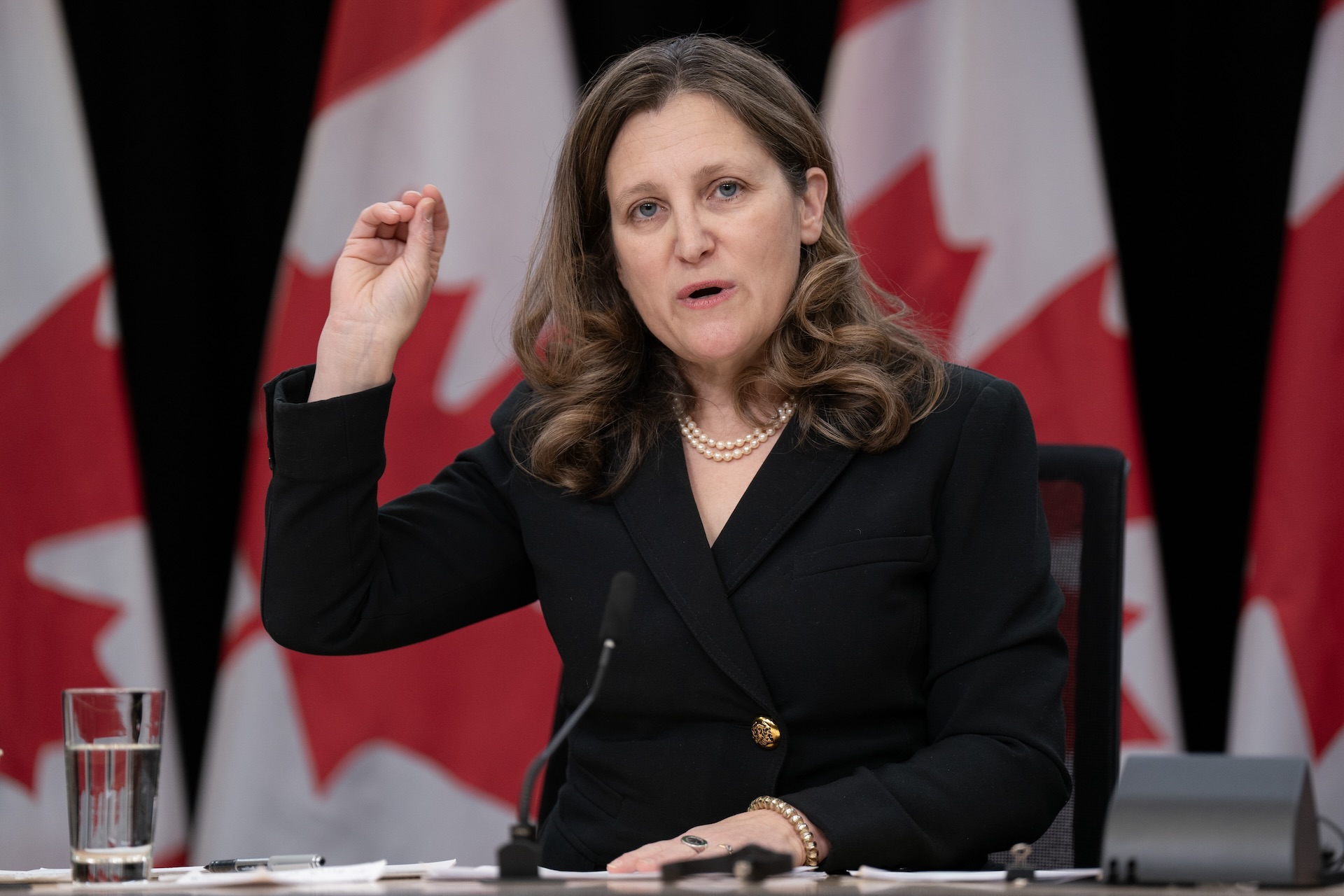
Finance Minister Chrystia Freeland in Ottawa on Feb. 27. Photo: The Canadian Press/Adrian Wyld
Feb 28, 2024
A A
A Small A Medium A Large
Share

Gift

Share

It’s been a tough start to the budget season for fiscal hawks. 

First, British Columbia Finance Minister Katrine Conroy presented a pre-election financial plan that forecasts a deficit wider than the shortfall the province ran during the COVID-19 recession, and the province’s largest debt burden as percentage of gross domestic product in almost forty years. 

Then, New Democratic Party Leader Jagmeet Singh announced that he and Prime Minister Justin Trudeau had agreed on legislation that would provide universal coverage of contraception and diabetes medication at a cost of about $1 billion a year. 

“Single-payer pharmacare is a risk our country can’t afford right now,” Kathy Megyery, a senior vice-president at the Canadian Chamber of Commerce, said in a statement. 

The desire of the party that keeps Trudeau in power for more social spending proved more persuasive than the various fiscally conservative economists, small-government think tanks and business lobbyists who insist Canada is on the road to perdition. “We believe in investing in the health of Canadians,” Finance Minister Chrystia Freeland said at a press conference Tuesday. “We laid out a clear set of fiscal guideposts in the fall economic statement. We will meet those guideposts.”  

Related Articles

Carmichael: The end of the gen-X economic consensus

By Kevin Carmichael

Carmichael: Poilievre makes the business of governing sound easy

By Kevin Carmichael

Freeland’s fall fiscal update pledged to keep the deficit from growing in the immediate term, keep the debt-to-GDP ratio on a downward track and get the deficit-to-GDP ratio below one per cent by 2027. That’s no one’s definition of austerity, but it’s better than most of Canada’s peers, which should be enough to keep the bond vigilantes at bay. 

Given all the disruption that’s happening, Freeland’s approach is a reasonable mix of prudence and long-term bets. Canada can afford a pharmacare program if that’s how it chooses to use scarce resources. And though resources are more scarce than they were in the late 1990s and during the commodities boom of the early 2000s, the federal government and the provinces can borrow at relatively reasonable rates. 

The average yield on five- to 10-year federal debt was 3.35 per cent in January, according to Bank of Canada data. That’s a significant increase from 1.76 per cent, the average of the past 10 years. But it’s nothing like the double-digit rates Canada paid in the early 1990s, when the country was on the verge of becoming a fiscal basketcase. Today, the government of Canada is among a dwindling number of sovereigns with a AAA credit rating, yet some who favour austerity frame their arguments as though Canada were on the verge of a debt crisis. 

“Deficits impose a disproportionate tax burden on future generations,” the Fraser Institute’s Jake Fuss and Grady Munro wrote in The Globe and Mail earlier this month. 

Not if that spending generates economic growth, or helps build a social safety net that offsets inequality. Ambitious finance ministers have been ignoring the advice of economists and thought leaders since Alexander Hamilton read Adam Smith’s The Wealth of Nations, used those ideas to help him demolish the notion that the U.S. economy should be based on agriculture, and then dismissed Smith’s theory of free trade in favour of import tariffs and subsidies that he felt were necessary if fledgling American factories were to have a chance against established competitors in Europe. 

Hamilton liked free trade in theory, but “experience,” he wrote in the “Report on the Subject of Manufactures,” showed that “men are often so much governed by what they are accustomed to see and practice, that the simplest and most obvious improvements, in the [most] ordinary occupations, are adopted with hesitation, reluctance and by slow gradations.” In other words, getting out of the way of the invisible hand might well improve the welfare of individuals, but you can’t trust it to achieve larger national objectives. Those “may therefore require the incitement and patronage of government,” according to Hamilton. 

Context matters. Canada isn’t a developing country in the early stages of building an industrial base, able to count on high rates of future growth to pay off whatever debt it takes on today. But we’ve entered a moment where disruption is everywhere. An aging population, the mental health crisis and the threat of further pandemics demand an overhaul of our approach to health, welfare and retirement. Climate change and artificial intelligence will transform the global economy. Geopolitical rivalry will demand a greater financial commitment to defence. All this while inequality feeds political polarization that is making democracies harder to govern.

Is this really a moment when governments should prioritize balancing their budgets because, in theory, that’s optimal policy? Experience suggests the stakes are too high. 

Fuss and Munro would balance the federal budget by cutting “corporate welfare.” Good advice in the 1990s, when a new free-trade agreement with the United States and Mexico and the prospect of freer trade with China offered Canadian companies lots of opportunity. But that’s not the world we’re in today. It’s more like the period between 1921, when the Alberta government backed research at the University of Alberta into extracting bitumen from the province’s oilsands, and the late 1970s and 1980s, when government funding allowed a handful of private companies to turn those oilsands into a going concern. 

The tens of billions of dollars in subsidies that Ottawa and the governments of Ontario and Quebec have deployed over the past couple of years could be wasteful, but the spending represents the same kind of bet we made on the oilsands. You can have a debate over the environmental costs of developing Alberta’s oil industry, but it’s impossible to argue those early investments were a waste of money. 

Gift the full article

Big spenders such as Freeland and the governments of British Columbia, Ontario and Quebec should certainly be held to account, but balancing the budget just for the sake of balancing the budget is no longer the right standard.  

Kevin Carmichael is The Logic’s economics columnist and editor-at-large. He has spent more than two decades covering economics, business and finance for outlets including Bloomberg News, The Globe and Mail and the Financial Post, where he also served as editor-in-chief. 
#B.C. #Chrystia Freeland #commentary #economy #pharmacare

Loading...

Thanks for sharing!

You have shared 5 articles this month and reached the maximum amount of shares available.

Close
This account has reached its share limit.

If you would like to purchase a sharing license please contact The Logic support at [email protected].

Close
Want to share this article?

Upgrade to all-access now

Close
Gift the full article!

You have gifted 0 article(s) this month and have 5 remaining.

Copy link and gift
Copy Link
Email to a friend
Send Email
Gift on Social Media

Recipients will be able to read the full text of the article after submitting their email address. They will not have access to other articles or subscriber benefits.

Photo: The Canadian Press/Adrian Wyld

Most Popular This Week

A head-on shot of James Neufeld seated with others at a round table in a meeting room. Eleanor Olszewski is seated to his left. There's a laptop open in front of Neufeld.
News

For this Alberta tech firm, ‘Buy Canadian’ isn’t working as advertised

By David Reevely
News

Everything you need to know about the debate over stablecoin yields

By Claire Brownell
In this photo illustration, the Manulife company logo is seen displayed on a smartphone screen.
News

Manulife and Intact buck a global trend by reporting AI returns

By Anita Balakrishnan
A photo of Daniel Sax shot through a circular piece of ironwork on a stairway balustrade. He's looking off-camera, and is wearing a dark blue jacket bearing his company's logo.
The Big Read

Mining the moon. Selling nuclear reactors. For this Canadian, it’s all part of the plan

By David Reevely

In-depth, agenda-setting reporting

Great journalism delivered straight to your inbox.

A wide shot of the Vancouver skyline shot from the east, featuring the Science World geodesic dome painted as a FIFA 2026 World Cup soccer ball. B.C. Place stadium appears on the right side of the frame.
News

Canada gets low returns from events like the World Cup. Ottawa wants to know why

By Laura Osman

Briefing

Nokia to spin out space communications business through Canadian SPAC deal

By David Reevely   |   Jun 19, 2026 | 4:11 PM ET

Ontario police aren’t reporting spyware use, senior privacy official warns

By David Reevely   |   Jun 19, 2026 | 3:37 PM ET

Magna founder Stronach found guilty of indecent and sexual assault

By Anita Balakrishnan   |   Jun 19, 2026 | 3:33 PM ET

Best business newsletter in Canada

Get up to speed in minutes with insights and analysis on the most important stories of the day, every weekday.

Exclusive events

See the bigger picture with reporters and industry experts in subscriber-exclusive events.

Membership in The Logic Council

Membership provides access to our popular Slack channel, participation in subscriber surveys and invitations to exclusive events with our journalists and special guests.

Recent Popular Stories

News

Manulife and Intact buck a global trend by reporting AI returns

By Anita Balakrishnan   |   Jun 16, 2026
In this photo illustration, the Manulife company logo is seen displayed on a smartphone screen.
Commentary: Quebec Ink

Quebec just found out what not having digital sovereignty really means

By Martin Patriquin   |   Jun 8, 2026
A yellow ambulance is pictured outside of a hospital in Montreal. A red sign in the foreground reads, “Urgence / Emergency.”
News

Canada’s surprise plan to buy Saab command jets leaves competitors seeking answers

By David Reevely   |   May 29, 2026
A closeup of a scale model of a jet covered in pixellated camouflage, with sensor equipment attached to the top of its fuselage. There are civilians and uniformed military personnel milling in the background.
The Big Read

Mining the moon. Selling nuclear reactors. For this Canadian, it’s all part of the plan

By David Reevely   |   Jun 12, 2026
A photo of Daniel Sax shot through a circular piece of ironwork on a stairway balustrade. He's looking off-camera, and is wearing a dark blue jacket bearing his company's logo.
News

Canadians could demand firms delete their personal data under new privacy bill

By Laura Osman   |   Jun 15, 2026
Evan Solomon in a suit and tie, gesturing with his left hand as he speaks, Several people sit and stand behind him looking in other directions. There's an orange curtain behind him lit from above.
The Big Read

We found every data centre in Canada

By Murad Hemmadi, David Reevely, Aleksandra Sagan, Chaimae Chouiekh, Martin Patriquin and Catherine McIntyre   |   Apr 8, 2026
Four vertical slices of aerial view photos. From left, a building in downtown Toronto housing several data centres, a picture of the Albertan wilderness where the proposed Wonder Valley data centre would go, a lit-up QScale data centre in Quebec, and a data centre at a Hydro-Quebec dam.

Canada's most influential executives and policymakers are reading The Logic

  • CPP Investments
  • Sun Life Financial
  • C100
  • Amazon
  • Telus
  • Mastercard
  • bdc
  • Shopify
  • Rogers
  • RBC
  • General Motors
  • MaRS
  • Government of Canada
  • Uber
  • Loblaw Companies Limited
logic-logo

Canada's Business and Tech Newsroom

100% human-crafted journalism

Newsroom

  • News Tips
  • AI Policy
  • Editorial Disclosures
  • Story Pitches

Company

  • About Us
  • Terms of Service
  • Privacy Statement
  • Corporate Information

Contact

  • Contact Us
  • Advertise
  • FAQs
  • Work at The Logic

© 2026 The Logic Inc. All Rights Reserved.

Trusted by leaders

Error

Account creation failed.

Please email us at [email protected].

Create Account

[wppb-register form_name=”cozmo-registration-form-for-modal”]

I do have an account
Login
or

[wppb-login]

I don’t have an account